3-Bromoaniline → 4-(3-Bromophenylamino)benzo[4,5]furo[3,2-b]pyridine-3-carbonitrile
Reaction equation
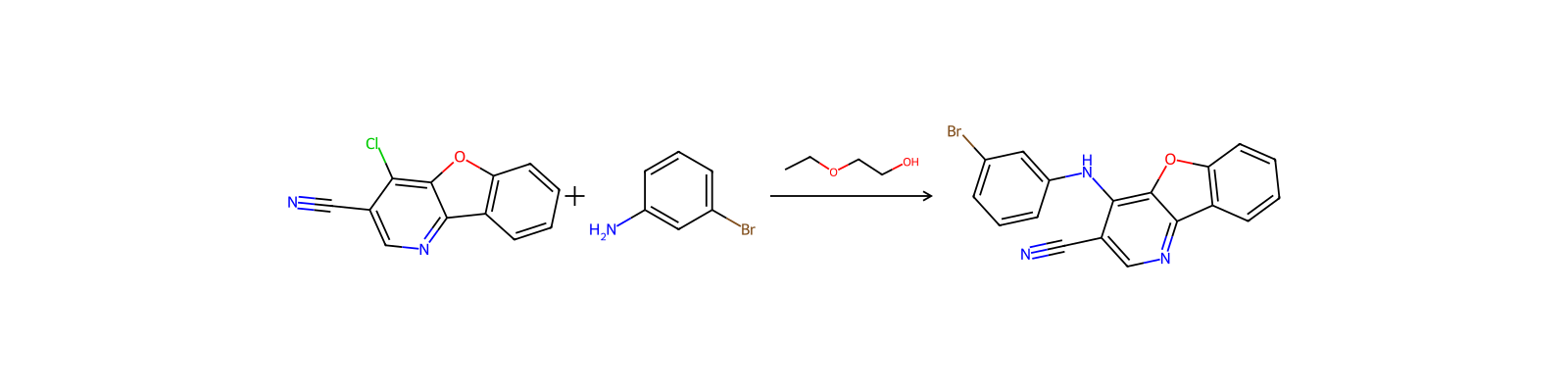
Cl[C:2]1[C:7]([C:8]#[N:9])=[CH:6][N:5]=[C:4]2[C:10]3[CH:16]=[CH:15][CH:14]=[CH:13][C:11]=3[O:12][C:3]=12.[Br:17][C:18]1[CH:19]=[C:20]([CH:22]=[CH:23][CH:24]=1)[NH2:21]>C(OCCO)C>[Br:17][C:18]1[CH:19]=[C:20]([NH:21][C:2]2[C:7]([C:8]#[N:9])=[CH:6][N:5]=[C:4]3[C:10]4[CH:16]=[CH:15][CH:14]=[CH:13][C:11]=4[O:12][C:3]=23)[CH:22]=[CH:23][CH:24]=1Participants
4


Procedure
A solution of 300 mg (1.30 mmol) of 4-chlorobenzo[4,5]furo[3,2-b]pyridine-3-carbonitrile and 0.160 mL (1.43 mmol) of 3-bromoaniline in 8 mL of 2-ethoxyethanol is heated at reflux temperature for 24 hours. The reaction mixture is partitioned between ethyl acetate and saturated sodium bicarbonate. The organic layer is washed with saturated sodium bicarbonate, followed by brine, then dried over sodium sulfate, filtered through a pad of diatomaceous earth and concentrated in vacuo. The resultant solid is collected by filtration to give 300 mg (42%) of a beige solid, mp 242-245° C.
Workup
- temperatureat reflux temperature for 24 hours
- customThe reaction mixture is partitioned between ethyl acetate and saturated sodium bicarbonate
- washThe organic layer is washed with saturated sodium bicarbonate
- dry with materialdried over sodium sulfate
- filtrationfiltered through a pad of diatomaceous earth
- concentrationconcentrated in vacuo
- filtrationThe resultant solid is collected by filtration
Sources & evidence
- ORD record
- ord-b2e5a98a6c8941f1ac2fb5c20131ae6a
- Source dataset
- uspto-grants-2003_10
- Patent number
- US06638929B2
Reaction notes
Loading…