Sodium Hydroxide → 6-Bromo-2-naphthalenecarboxylic acid
Reaction equation

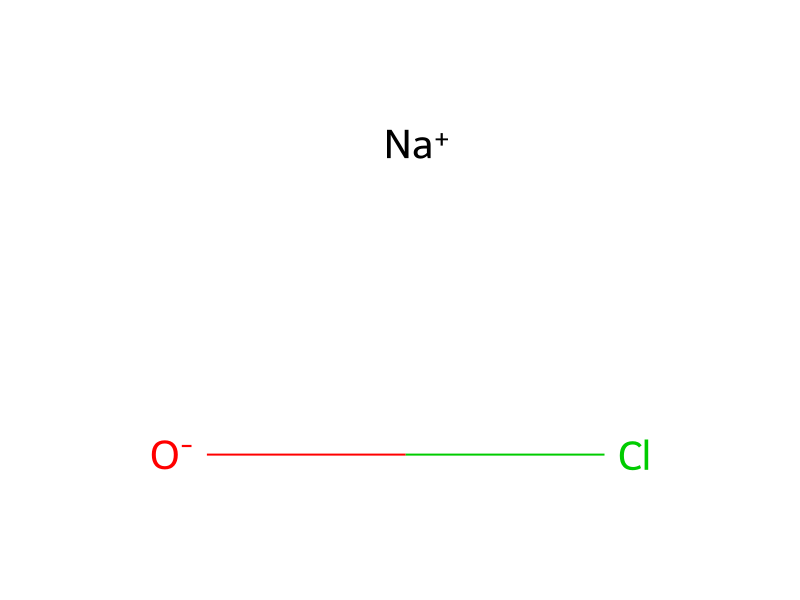
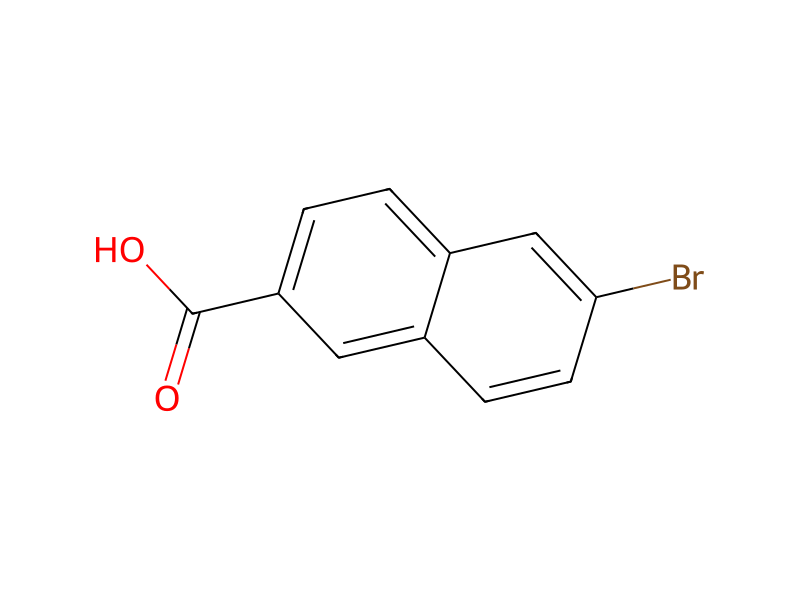
Cl[O-].[Na+].[OH-].[Na+].[C:6]([C:9]1[CH:18]=[CH:17][C:16]2[C:11](=[CH:12][CH:13]=[C:14]([Br:19])[CH:15]=2)[CH:10]=1)(=[O:8])C.CC1(C)CC=C(C2C=CC(C)=CC=2)C2C=C(C#CC3C=CC(C(OCC)=[O:45])=CC=3)C=CC1=2>O.O1CCOCC1>[Br:19][C:14]1[CH:15]=[C:16]2[C:11](=[CH:12][CH:13]=1)[CH:10]=[C:9]([C:6]([OH:8])=[O:45])[CH:18]=[CH:17]2Participants
Reactant 4



Product 1
Reagents, catalysts & solvents 2


Conditions
- Temperature
- 70 °C
Procedure
To a solution of sodium hypochlorite (62 ml, 5.25% in water (w/w), 3.6 g, 48.18 mmol) and sodium hydroxide (6.4 g, 160.6 mmol) in 50 ml of water was added a solution of 2-acetyl-6-bromonaphthalene (Compound L) 4 g, (1 6.06 mmol) in 50 ml of 1,4-dioxane. The yellow solution was heated to 70° C. in an oil bath for 2 hours, cooled to ambient temperature, and extracted with ethyl ether (2×50 ml). The aqueous layers were diluted with NaHSO3 solution (until KI indicator solution remained colorless) and then acidified (pH <2) with 1N sulfuric acid to give a white precipitate. The mixture was extracted with ethyl ether, and the combined organic phase washed with saturated aqueous NaCl, dried (MgSO4) and concentrated to give 3.54 g (88%) of the title compound as a solid. 1H NMR (DMSO-d6): δ8.63 (1H, br s), 8.32 (1H, d, J=2.0 Hz), 8.10 (1H, d, J=8.8 Hz), 8.00-8.05 (2H, m), 7.74 (1H, dd, J=2.0, 8.8 Hz).
Workup
- temperaturecooled to ambient temperature
- extractionextracted with ethyl ether (2×50 ml)
- additionThe aqueous layers were diluted with NaHSO3 solution (until KI indicator solution remained colorless)
- customto give a white precipitate
- extractionThe mixture was extracted with ethyl ether
- washthe combined organic phase washed with saturated aqueous NaCl
- dry with materialdried (MgSO4)
- concentrationconcentrated
Sources & evidence
- ORD record
- ord-03d720fd6314409e8d2ddc0715570e7e
- Source dataset
- uspto-grants-2002_10
- Patent number
- US06469028B1
Reaction notes
Loading…