5'-[[(3S)-3-氨基-3-羧丙基丙基]甲基硫磺基]-5'-脱氧腺苷
Ademetionine
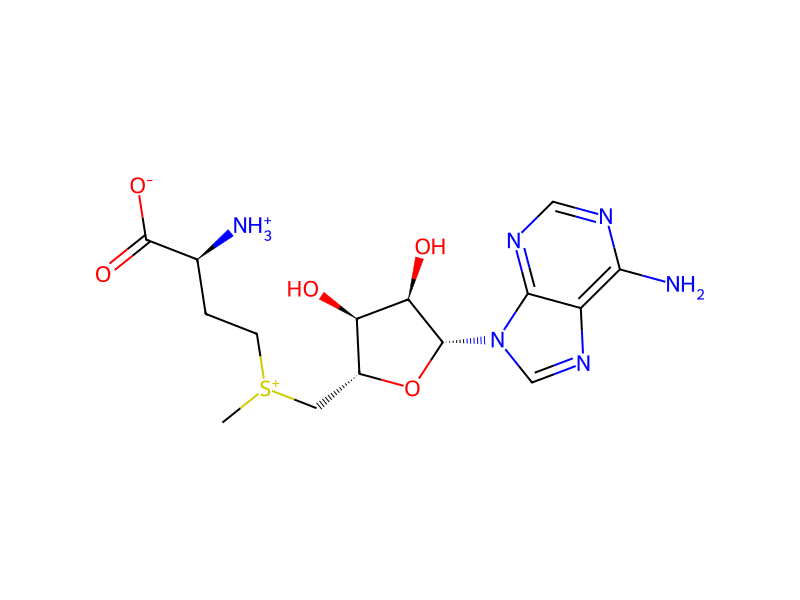
基本信息
- CAS
29908-03-0- 标准SMILES
C[S+](CC[C@H]([NH3+])C(=O)[O-])C[C@H]1O[C@@H](n2cnc3c(N)ncnc32)[C@H](O)[C@@H]1O- InChIKey
MEFKEPWMEQBLKI-AIRLBKTGSA-O- 分子式
- C15H23N6O5S+
- 平均分子量
- 399.4 g/mol
- 单同位素质量
- 399.14506403
概述
S-adenosyl-L-methionine zwitterion is a zwitterionic tautomer of S-adenosyl-L-methionine arising from shift of the proton from the carboxy group to the amino group. It has a role as a cofactor. It is an organic cation and a sulfonium compound. It is a tautomer of a S-adenosyl-L-methionine.
名称与标识
- 首选名称
- Ademetionine
- IUPAC
- (2S)-4-[[(2S,3S,4R,5R)-5-(6-aminopurin-9-yl)-3,4-dihydroxyoxolan-2-yl]methyl-methylsulfonio]-2-azaniumylbutanoate
- 中文名
- 5'-[[(3S)-3-氨基-3-羧丙基丙基]甲基硫磺基]-5'-脱氧腺苷
- 英文名
- S-adenosylmethionine
- 分子式
- C15H23N6O5S
- 分子量
- 400.45
名称与别名
S-adenosyl-L-methionineAdemetionineadenosylmethionine139517-02-5(R)-S-adenosyl-L-methionine(S)-S-adenosyl-L-methionine(R,S)-AdoMet(S,S)-AdoMet2-S-adenosyl-L-methionine16-DENYPRASTERONEACETATESAM(R,S)-AdoMet zwitterion
展开更多名称
腺苷杂质39S-腺苷蛋氨酸(询价)丁二磺酸腺苷蛋氨酸杂质18 单体S-adenosylmethionine稀释液5'-[[(3S)-3-氨基-3-羧丙基丙基]甲基硫磺基]-5'-脱氧腺苷13CH3-SAMMethionine,activeS-ADENOSYLMETHIONINEAdenosine Impurity 39S-(5'-Adenosyl)methionineMEFKEPWMEQBLKI-AIRLBKTGSA-OS-adenosylmethionine USP/EP/BPAdemetionine 1,4-Butanedisulfonate Impurity 18 MonomerGalactose Impurity 1 (Galactose EP Impurity A)(Lactose)S-Adenosyl-L-methionine sulfate p-toluene sulfonate salt
(S,S)-AdoMet zwitterionCHEBI:59789CHEBI:142093CHEBI:142094S-adenosyl-L-methionine zwitterion(R)-S-adenosyl-L-methionine zwitterion(S)-S-adenosyl-L-methionine zwitterion(R,S)-S-adenosyl-L-methionine zwitterion
性质
结构计算性质
- XLogP
- -2.8
- 极性表面积
- 188 Ų
- 氢键供体
- 4
- 氢键受体
- 9
- 可旋转键
- 6
- 重原子
- 27
- 形式电荷
- 1
- 复杂度
- 527
实验与物化性质
LogP-5.3
Boiling Point78 °C
Physical DescriptionSolid
物理化学性质
- InChIKey
- QOWKLNSTGYYNGX-MDHPBGAINA-N
- SMILES
- C(O)(=O)[C@H](CCS(C[C@H]1O[C@@H](N2C3=C(C(=NC=N3)N)N=C2)[C@H](O)[C@@H]1O)C)N |&1:3,8,10,21,23,r|
化学与工业
药理信息
ATC CodeA - Alimentary tract and metabolism
Pharmacodynamics
S-adenosylmethionine is an intermediate metabolite of methionine. Its involvement in methylation assists in cellular growth and repair, maintains the phospho-bilipid layer in cell membranes. It also helps in the maintenance of the action of several hormones and neurotransmitters that affect mood. Highest concentration are found in the brain and the liver.
Mechanism of Action
S-Adenosylmethionine (SAMe) is a natural substance present in the cells of the body. It is a direct metabolite of the essential amino acid L-methionine. SAMe plays a crucial biochemical role in the body by donating a one-carbon methyl group in a process called transmethylation. SAMe, formed from the reaction of L-methionine and adenosine triphosphate catalyzed by the enzyme S-adenosylmethionine synthetase, is the methyl-group donor in the biosynthesis of both DNA and RNA nucleic acids, phospholipids, proteins, epinephrine, melatonin, creatine and other molecules.
Metabolism/Metabolites
Significant first-pass metabolism in the liver. Approximately 50% of S-Adenosylmethionine (SAMe) is metabolized in the liver. SAMe is metabolized to S-adenosylhomocysteine, which is then metabolized to homocysteine. Homocysteine can either be metabolized to cystathionine and then cysteine or to methionine. The cofactor in the metabolism of homocysteine to cysteine is vitamin B6. Cofactors for the metabolism of homocysteine to methionine are folic acid, vitamin B12 and betaine.
Absorption, Distribution and ExcretionS-Adenosylmethionine is absorbed from the small intestine following oral intake. As absorption is affected by food, it is best to take on an empty stomach. Bioavailability is low following oral intake.
Tissue LocationsEpidermis
Cellular LocationsEndoplasmic reticulum
Metabolite Pathways
相关反应
0 条
当前筛选下没有反应记录。
化合物笔记
加载中…