
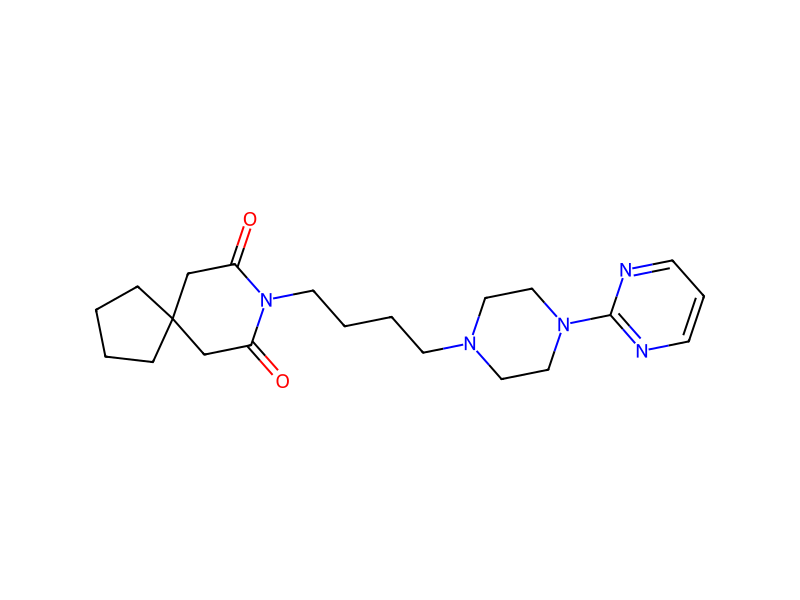
基本信息
- 标准SMILES
O=C1CC2(CCCC2)CC(=O)N1CCCCN1CCN(c2ncccn2)CC1- InChIKey
QWCRAEMEVRGPNT-UHFFFAOYSA-N- 分子式
- C21H31N5O2
- 平均分子量
- 385.5 g/mol
- 单同位素质量
- 385.24777523
概述
Buspirone is an azaspiro compound that is 8-azaspiro[4.5]decane-7,9-dione substituted at the nitrogen atom by a 4-(piperazin-1-yl)butyl group which in turn is substituted by a pyrimidin-2-yl group at the N4 position. It has a role as an anxiolytic drug, a sedative, a serotonergic agonist and an EC 3.4.21.26 (prolyl oligopeptidase) inhibitor. It is an azaspiro compound, an organic heteropolycyclic compound, a member of pyrimidines, a N-alkylpiperazine, a N-arylpiperazine and a member of piperidones. It is a conjugate base of a buspirone(1+).
名称与标识
- 首选名称
- Buspirone
- IUPAC
- 8-[4-(4-pyrimidin-2-ylpiperazin-1-yl)butyl]-8-azaspiro[4.5]decane-7,9-dione
- 中文名
- 丁螺环酮
- 英文名
- Buspirone
- 分子式
- C21H31N5O2
- 分子量
- 385.5
名称与别名
buspirone36505-84-7BuspironaAnsialBuspironumGen-BuspironeBespar8-(4-(4-(2-Pyrimidinyl)-1-piperizinyl)butyl)-8-azaspiro(4,5)decane-7,9-dione8-[4-(4-pyrimidin-2-ylpiperazin-1-yl)butyl]-8-azaspiro[4.5]decane-7,9-dioneDTXSID2022707TK65WKS8HL8-(4-(4-(Pyrimidin-2-yl)piperazin-1-yl)butyl)-8-azaspiro[4.5]decane-7,9-dione
展开更多名称
丁螺旋酮丁螺环酮希司必隆螺氮癸嘧哌嗪丁螺环酮杂质丁螺环酮杂质I丁螺环酮杂质H丁螺环酮杂质F丁螺环酮杂质D丁螺环酮杂质JBUSPIRONE HCLbuspar8-[4-[4-(2-PYRIMIDINYL)-1-PIPERAZINYL]BUTYL]-8-AZASPIRO[4,5]DECANE-7,9-DIONEBuspisalBuspimenNard:TmvinBUPROPIONHCLBUSPIRONE,USPAnsiced:Axoren
8-{4-[4-(pyrimidin-2-yl)piperazin-1-yl]butyl}-8-azaspiro[4.5]decane-7,9-dioneBCI-0248-Azaspiro[4.5]decane-7,9-dione, 8-[4-[4-(2-pyrimidinyl)-1-piperazinyl]butyl]-CHEBI:3223DTXCID4027078-Azaspiro(4,5)decane-7,9-dione, 8-(4-(4-(2-pyrimidinyl)piperizinyl)butyl)-8-Azaspiro(4.5)decane-7,9-dione, 8-(4-(4-(2-pyrimidinyl)-1-piperazinyl)butyl)-ratio Buspirone
数据库标识
- CAS
36505-84-7- PubChem CID
- 2477
- DTXSID
DTXSID2022707- ChEMBL
CHEMBL49- ChEBI
CHEBI:3223- UNII
- TK65WKS8HL
- EC Number
- 253-072-2
- Nikkaji
- J19.752A
性质
结构计算性质
- XLogP
- 2.6
- 极性表面积
- 69.6 Ų
- 氢键供体
- 0
- 氢键受体
- 6
- 可旋转键
- 6
- 重原子
- 28
- 形式电荷
- 0
- 复杂度
- 529
实验与物化性质
Drugs
Pharmaceuticals -> Listed in ZINC15
Pharmaceuticals
LogP
2.3
2.3
Solubility5.88e-01 g/L
Human Drugs
Breast Feeding; Lactation; Milk, Human; Anti-Anxiety Agents; Serotonin Agonists
Pharmaceuticals
Melting Point
201.5-202.5
201.5 - 202.5 °C
Physical DescriptionSolid
Ionization Efficiency
Positive
4.334729774
2.7
Thermo LTQ
Electrospray ionization
formic acid (5.3nM)
Dissociation Constants7.6
Collision Cross Section
196.8 Ų [M]+ [CCS Type: DT; Buffer gas: N2; Ionization: APCI+; Dataset: TOXCAST; Source Identifier: DTXSID2022707]
195.97 Ų [M+H]+ [CCS Type: TW; Method: calibrated with polyalanine and drug standards]
199.3 Ų [M+H]+ [CCS Type: TW; Method: Major Mix IMS/Tof Calibration Kit (Waters)]
物理化学性质
- 熔点
- 105 · 105-107 °C(Solv: ethyl acetate (141-78-6))
- 沸点
- 511.93 °C · 511.93°C (rough estimate)
- 密度
- 1.1527 · 1.1527 (rough estimate)
- 折射率
- 1.76 · 1.7600 (estimate)
- 储存条件
- 2 · Sealed in dry,2-8°C
- 形态
- Solid
- 酸度系数(pKa)
- 7.6 · pKa 7.60±0.01(H2O t=25.0 I=0.1(NaCl)) (Uncertain)
- 颜色
- White to off-white
- BCS Class
- 1 · 1
- CAS 数据库
- 36505 · 36505-84-7(CAS DataBase Reference)
- NIST化学物质信息
- 8 · 8-Azaspiro[4.5]decane-7,9-dione, 8-[4-[4-(2-pyrimidinyl)-1-piperazinyl]butyl]-(36505-84-7)
- EPA化学物质信息
- 8 · 8-Azaspiro[4.5]decane-7,9-dione, 8-[4-[4-(2-pyrimidinyl)-1-piperazinyl]butyl]- (36505-84-7)
化学性质
白色结晶,熔点104~106℃。盐酸丁螺环酮(Buspirone Hydrochloride):C2lH31N5O2HCI。[33386-08-2]。从无水乙醇结晶,熔点201.5~202.5℃。急性毒性LD50大鼠(mg/kg):136腹腔注射。
安全与法规
GHS分类
GHS Classification
Danger
H301 (100%): Toxic if swallowed [Danger Acute toxicity, oral]
P264, P270, P301+P316, P321, P330, P405, and P501 (click each P-code to see the statement)
Aggregated GHS information provided per 4 reports by companies from 1 notifications to the ECHA C&L Inventory.
危害信息
Regulatory InformationStatus: Active Update: 01-09-2020 https://echa.europa.eu/registration-dossier/-/registered-dossier/31319
Hazard Classes and CategoriesAcute Tox. 3 (100%)
毒理信息
Treatment
General symptomatic and supportive measures should be used along with immediate gastric lavage. Respiration, pulse, and blood pressure should be monitored as in all cases of drug overdosage. No specific antidote is known to buspirone, and dialyzability of buspirone has not been determined. (L1712)
Hepatotoxicity
Buspirone has been associated with infrequent serum aminotransferase elevations, but has not been linked to instances of clinically apparent liver injury in the published literature. Indeed, buspirone is often used as a control, noncytotoxic agent in assessment of other psychotropic drugs in vitro and in vivo. Buspirone is, nevertheless, metabolized in the liver by the P450 system (CYP 3A4) and has the potential of causing drug-drug interactions.
Adverse EffectsDizziness is a common side effect that occurs in over 10% of patients.
Exposure RoutesOral.
Rapidly absorbed in man. Bioavailability is low and variable (approximately 5%) due to extensive first pass metabolism.
Toxicity Summary
Relative to other anxiolytics, buspirone has low toxicity and potential for abuse. There have been no deaths reported from a buspirone overdose alone. In pharmacological trials, healthy male patients were given up to 375 mg daily and developed nausea, vomiting, dizziness, drowsiness, miosis, and gastric distress. While buspirone overdose typically resolves with complete recovery, high suspicion of other medication overdoses should be maintained and investigated. In a literature review, multiple reports of movement disorders, including dyskinesia, akathisia, myoclonus, parkinsonism, and dystonia, have been reported.
Buspirone binds to 5-HT type 1A serotonin receptors on presynaptic neurons in the dorsal raphe and on postsynaptic neurons in the hippocampus, thus inhibiting the firing rate of 5-HT-containing neurons in the dorsal raphe. Buspirone also binds at dopamine type 2 (DA2) receptors, blocking presynaptic dopamine receptors. Buspirone increases firing in the locus ceruleus, an area of brain where norepinephrine cell bodies are found in high concentration. The net result of buspirone actions is that serotonergic activity is suppressed while noradrenergic and dopaminergic cell firing is enhanced.
Signs and SymptomsSymptoms of overdose include dizziness, drowsiness, nausea or vomiting, severe stomach upset, and unusually small pupils.
Carcinogen ClassificationNo indication of carcinogenicity to humans (not listed by IARC).
Drug Induced Liver Injury
Benchmark Dataset for the Liver Toxicity Knowledge Base (LTKB)
buspirone
BuSpar®
Anxiolytics
3
less-DILI-concern drugs
Effects During Pregnancy and Lactation◉ Summary of Use during Lactation
Toxicity DataLD50: 136 mg/kg (Oral, rat)
安全数据
- wgk
- 3
- RTECS号
- CL9915000
- 安全说明
- 45
- 危险品标志
- T
- 危险类别码
- 25
- 危险品运输编号
- UN 2811 6.1/PG 3
化学与工业
药理信息
ATC Code
N - Nervous system
QN - Nervous system
Protein BindingBased on the findings of an _in vitro_ protein binding study, approximately 86% of buspirone is bound to plasma proteins. It is mainly bound to serum albumin and alpha-1-acid glycoprotein.
Pharmacodynamics
The clinical effect of buspirone in alleviating the symptoms of generalized anxiety disorders typically takes 2 to 4 weeks to achieve. The delayed onset of action of buspirone suggests that the therapeutic effectiveness in generalized anxiety may involved more than its molecular mechanism of action at the 5-HT<sub>1A</sub> receptors, or buspirone may induce adaptations of 5-HT<sub>1A</sub> receptors. Buspirone was not shown to alter the psychomotor or cognitive function in healthy volunteers, and the risk of developing sedation is relatively low compared to other anxiolytics, such as benzodiazepines. Unlike benzodiazepines and barbiturates used in anxiety disorders, buspirone is not associated with a risk for developing physical dependence or withdrawal, or any significant interaction with central nervous system depressants such as ethanol. This is due to the lack of effects on GABA receptors. Buspirone also does not exhibit any anticonvulsant or muscle-relaxing properties, but may interfere with arousal reactions due to its inhibitory action on the aactivity of noradrenergic locus coerulus neurons. Despite its clinical effectiveness in generalized anxiety, buspirone demonstrated limited clinical effectiveness on panic disorders, severe anxiety, phobias, and obsessive compulsive disorders. The clinical effectiveness of the long-term use of buspirone, for more than 3 to 4 weeks, has not demonstrated in controlled trials but there were no observable significant adverse events in patients receiving buspirone for a year in a study of long-term use.
Mechanism of Action
The therapeutic action of buspirone in generalized anxiety disorders is thought to be mainly derived from its interaction with two major 5-HT<sub>1A</sub> receptor subtypes that are involved in the brain's anxiety and fear circuitry to enhance the serotonergic activity in these brain areas. Buspirone acts as a full agonist at presynaptic 5-HT<sub>1A</sub> receptors, or 5-HT<sub>1A</sub> autoreceptors, expressed at dorsal raphe while acting as a partial agonist at the postsynaptic 5-HT<sub>1A</sub> receptors expressed on hippocampus and cortex. 5-HT<sub>1A</sub> receptors function as inhibitory autoreceptors by being expressed on the soma or dendrites of serotonergic neurons or mediate postsynaptic actions of 5-HT by being highly expressed on the corticolimbic circuits. They are inhibitory G-protein coupled receptors that couple to Gi/Go proteins. When activated, presynaptic 5-HT<sub>1A</sub> autoreceptors causes neuron hyperpolarization and reduces the firing rate of the serotonergic neuron, thereby decreasing extracellular 5-HT levels in the neuron's projection areas. Activated postsynaptic 5-HT<sub>1A</sub> receptors promote hyperpolarization to released 5-HT on pyramidal neurons. The anxiolytic action of buspirone is mainly thought to arise from the interaction at presynaptic 5-HT<sub>1A</sub> autoreceptors. Acting as a potent agonist in these receptors, buspirone initially causes activation of these autoreceptors and inhibition of 5-HT release. It is proposed that buspirone induces desensitization of somatodendritic autoreceptors over time, which may explain the delayed onset of action of the drug. Desensitization of the autoreceptors ultimately results in heightened excitation of serotonergic neurons and enhanced 5-HT release. Buspirone also displays a weak affinity for serotonin 5HT2 receptors and acts as a weak antagonist on dopamine D2 autoreceptors, although there is not much evidence that the action at these receptors contribute to the anxiolytic effect of buspirone. It acts as an antagonist at presynaptic dopamine D3 and D4 receptors and may bind to alpha-1 adrenergic receptors as a partial agonist.
Biological Half-LifeIn a single-dose pharmacokinetic study of 14C-labeled buspirone, the average elimination half-life of unchanged buspirone following administration of single doses ranging from 10 to 40 mg was about 2 to 3 hours.
Metabolism/Metabolites
Buspirone is extensively metabolized upon administration, where it primarily undergoes hepatic oxidation mediated by the CYP3A4 enzyme. Hydroxylated derivatives are produced, including a pharmacologically active metabolite 1-pyrimidinylpiperazine (1-PP). In animal studies, 1-PP possessed about one quarter of the pharmacological activity of buspirone.
Metabolized hepatically, primarily by oxidation by cytochrome P450 3A4 producing several hydroxylated derivatives and a pharmacologically active metabolite, 1-pyrimidinylpiperazine (1-PP) Route of Elimination: In a single-dose study using 14C-labeled buspirone, 29% to 63% of the dose was excreted in the urine within 24 hours, primarily as metabolites; fecal excretion accounted for 18% to 38% of the dose. Half Life: 2-3 hours (although the action of a single dose is much longer than the short halflife indicates).
MeSH Pharmacological Classification
Agents that alleviate ANXIETY, tension, and ANXIETY DISORDERS, promote sedation, and have a calming effect without affecting clarity of consciousness or neurologic conditions. ADRENERGIC BETA-ANTAGONISTS are commonly used in the symptomatic treatment of anxiety but are not included here.
Endogenous compounds and drugs that bind to and activate SEROTONIN RECEPTORS. Many serotonin receptor agonists are used as ANTIDEPRESSANTS; ANXIOLYTICS; and in the treatment of MIGRAINE DISORDERS.
Absorption, Distribution and Excretion
Buspirone is rapidly absorbed following oral administration. Bioavailability is low and variable (approximately 5%) due to extensive first pass metabolism. While absorption of buspirone is decreased with concomitant food intake, the first-pass metabolism of the drug is also decreased, resulting in an increased bioavailability as well as increased Cmax and AUC. Following oral administration of single oral doses of 20 mg, the Cmax ranged from 1 to 6 ng/mL and the Tmax ranged from 40 to 90 minutes.
A single-dose pharmacokinetic studies using 14C-labeled buspirone demonstrated that about 29-63% of the dose administered was excreted in the urine within 24 hours, primarily in the form of metabolites. About 18% to 38% of the dose was eliminated via fecal excretion.
In a pharmacokinetic study assessing buspirone over the dose range of 10 to 40 mg, the volume of distribution was 5.3 L/kg.
In a pharmacokinetic study assessing buspirone over the dose range of 10 to 40 mg, the systemic clearance was 1.7 L/h/kg.
Cellular LocationsMembrane
用途与制造
Uses
Use (kg; approx.) in Germany (2009): >25
For the management of anxiety disorders or the short-term relief of the symptoms of anxiety, and also as an augmention of SSRI-treatment against depression.
Use ClassificationPharmaceuticals
应用领域
用途新一代非苯并二氮杂卓类选择性抗焦虑药,通过影响5-HT(5-羟色胺)系统发挥抗焦虑作用,是5-HTIA受体的部分激动剂。它的抗焦效应强度与地西泮相当,但没有地西泮类药物的抗惊厥、肌松、精神运动功能减弱等副作用。因而被称为选择性抗焦虑药。久用也不产生自身依赖和欣快效应,成瘾性的倾向较小,不易引起滥用。用于治疗急、慢性焦虑状态,如焦虑性激动、内心不安定和紧张状态等,尚能缓解伴有或不伴抑郁症的焦虑症状。
制备方法
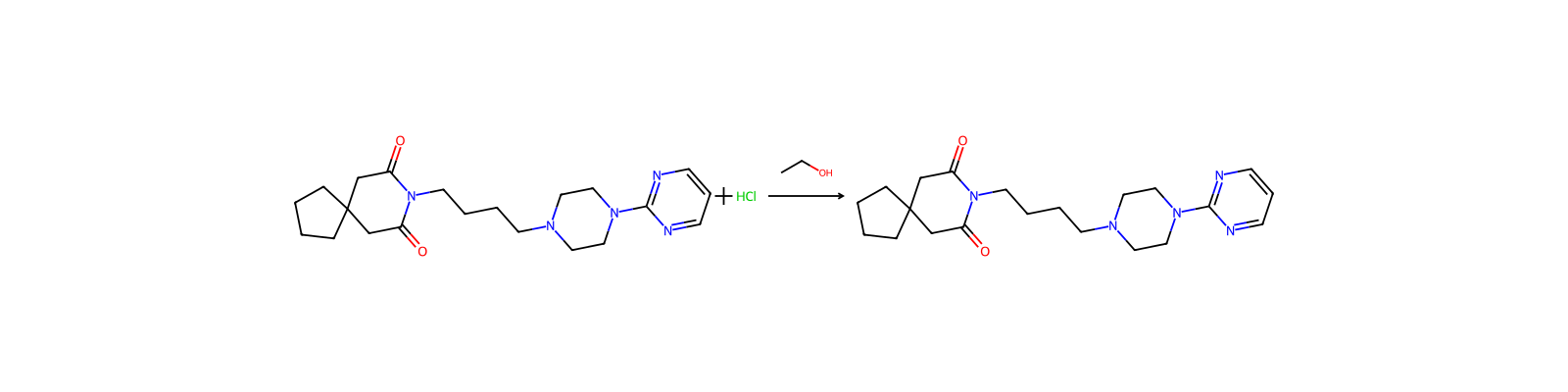
生产方法2-氨基嘧啶、浓盐酸和二氯甲烷混合,搅拌下加入氯化锌,冷却至5~10℃,分批加入亚硝酸钠,加毕继续反应。倾入冰水,静置,分出有机相。水相用二氯甲烷萃取3次,和有机相合并,干燥,蒸去大部分溶剂后析出浅黄色晶体,熔点63~65℃:,即为2-氯嘧啶。无水哌嗪、碳酸钠和水混合,在50~65℃和搅拌下分批加入2-氯嘧啶,加毕继续反应,慢慢冷至35℃。过滤除去1,4-二(2-嘧啶基)哌嗪,滤液用氯仿萃取3次。萃取液干燥,蒸去溶剂,减压蒸馏,收集115~117℃/133Pa(或118~120℃/270Pa)的馏分,即为1-(2-嘧啶基)哌嗪。环戊酮、氰基乙酸甲酯、氰基乙酰胺和甲酰胺混合,室温搅拌下慢慢加入三乙胺,反应。升温至60~65℃,慢慢加入水,再加入98%的硫酸至Ph值为1,冷却至5~10℃,过滤,水洗。得到的固体和硫酸一起于130℃加热,再加入水,于150℃回流,冷却,过滤,水洗,粗品用水和异丙醇重结晶,得白色针状结晶,熔点179~18l℃,为β,β-四亚甲基戊二酸。戊二酸衍生物和醋酐加热回流,过滤,浓缩至干,冰箱中放置过夜,析出白色片晶,过滤,干燥,得戊二酸酐衍生物,熔点64~66℃。戊二酸酐衍生物和浓氨水加热至溶解,迅速倒入瓷盘中,冷却,析出的鳞片状晶体即为戊二酰亚胺衍生物,熔点153~154℃。该亚胺和1,4-二溴丁烷及无水碳酸钾在甲苯中回流,过滤,收集160~1.70℃/13Pa的馏分,为溴丁基化的亚胺化合物。最后和1-(2-嘧啶基)哌嗪、无水碳酸钾、正丁醇一起回流,过滤,蒸去溶剂,得到的黄色固体用异丙醇重结晶,得丁螺环酮,再和等摩尔的5mol/L氯化氢的乙醇溶液成盐,无水乙醇重结晶,即得盐酸丁螺环酮。前述得到的1-(2-嘧啶基)哌嗪,可先和1,4-二溴丁烷、碳酸钠、乙腈一起回流,过滤。冷至0℃,过滤,干燥得浅黄色晶体,为1-(4-溴丁基)-4-(2-嘧啶基)哌嗪,熔点241.5~242.5℃(或238~242℃)。该二取代哌嗪和前面制备中得到的β,β-四亚甲基戊二酰亚胺、无水碳酸钾、甲苯一起回流。蒸去甲苯,冷却,滤集固体,用异丙醇重结晶,得白色晶体丁螺环酮。再和等摩尔的5mol/L氯化氢的乙醇溶液作用成盐,用无水乙醇重结晶,即得盐酸丁螺环酮。该法和前法的不同之处,仅在于丁基先引入哌嗪环,初看似无大的区别,但认为该法能把前法相应步骤的总收率从43.2%提高到72.9%提高的幅度可谓不小,且各中间体的用量降低,成本降低。
上下游产品信息
上游原料
试剂价格
- HY-B1115AR · 5 mg
- 丁螺环酮Buspirone (Standard) — 700元
- HY-B1115AR · 10 mg
- 丁螺环酮Buspirone (Standard) — 1100元
供应商50 家
湖北永阔科技有限公司027-59223108 15972152991 · [email protected]
上海策嵘生物科技有限公司[email protected]
艾吉析科技(上海)有限公司17717235263 · [email protected]
上海麦克林生化科技股份有限公司021-50706066 15221275939 · [email protected]
广州隽沐生物科技股份有限公司020-36607679; 13502246435 · [email protected]
LGM Pharma1-(800)-881-8210 · [email protected]
Syntechem Co.,Ltd[email protected]
武汉易泰科技有限公司上海分公司18930552037 · [email protected]
安耐吉化学&3A(安徽泽升科技有限公司)021-58432009 400-005-6266 · [email protected]
广东元丰化学试剂有限公司0751-2829979 13318593351 · [email protected]
希瓦生物科技(广州)有限公司13268215580 · [email protected]
淄博容纳生物科技有限公司+86-86-13583358881 +8618560316533 · [email protected]
United Life Science020-82099279 18988941402 · [email protected]
銳迪國際科技有限公司18024082417 · [email protected]
武汉丰泰威远科技有限公司+86-27-8746-5837 +86-18627785180 · [email protected]
天津狄克特科技有限公司22-58627059 13920586291 · [email protected]
武汉丰泰威远科技有限公司027-87465837 19945049750 · [email protected]
湖北恩星生物科技有限公司16621771607 · [email protected]
佛山宝诺生物科技有限公司0757-85921206 18520245316 · [email protected]
河北茹麒科技有限公司176-03256889 17603256889 · [email protected]
深圳菲斯生物科技有限公司0755-83725681-603
上海遐瑞医药科技有限公司+86 21 61551611
南京生利德生物科技有限公司025-57798810 18652991625 · [email protected]
山东博洛达生物科技有限公司0531-68659041 · [email protected]
Cato Research Chemicals Inc.020-81960175 · [email protected]
江苏艾康生物医药研发有限公司025-66028182 17714375163 · [email protected]
池州凯隆进出口贸易有限公司[email protected]
上海陶术生物科技股份有限公司+1-781-999-5354; +1-00000000000 · [email protected]
西安美川生物科技有限公司029-89275612 +8618991951683 · [email protected]
山东领海生物科技有限公司15092083467 · [email protected]
嘉兴市德亿化工有限公司0573-85866609 13325730825 · [email protected]
Hangzhou Hyper Chemicals Limited+86-0086-57187702781 +86-13675893055 · [email protected]
上海阿拉丁生化科技股份有限公司6206333 13167063860 · [email protected]
风咏生物(AbMole)021-10000000 13000000000 · [email protected]
上海炎泽化工有限公司15345144255 19901447308 · [email protected]
上海源叶生物科技有限公司13636370518 · [email protected]
成都标样生物科技有限公司028-81700200 13308200041 · [email protected]
深圳市洛克生化科技有限公司0755-83552066 15986688328 · [email protected]
上海林栎生物科技有限公司13761635123 · [email protected]
广州佳途科技股份有限公司020-81960175-877 18933936954 · [email protected]
杭州洁汉化工有限公司+86-571-86217390; +8618058761490 · [email protected]
河南天孚化工有限公司+86-0371-55170693 +86-19937530512 · [email protected]
厦门盈融达化工有限公司+86-0592-6210733 · [email protected]
career henan chemical co+86-0371-86658258 · [email protected]
陕西缔都医药化工有限公司029-88380327 17691182729 · [email protected]
深圳聚合生化科技有限公司+86-400-002-6226 · [email protected]
海蔚化学86-21-51086038 · [email protected]
武汉睿立达生物医药科技有限公司18201884268 · [email protected]
湖北摩科化学有限公司18627753421; 18627756402 · [email protected]
Aladdin Scientific[email protected]
相关反应
21 条






关联笔记
加载中…