
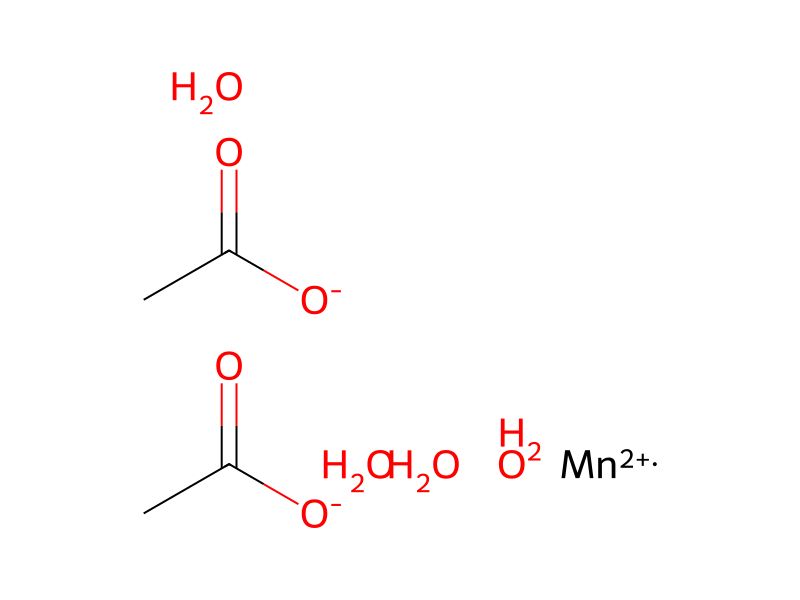
基本信息
- 标准SMILES
CC(=O)[O-].CC(=O)[O-].O.O.O.O.[Mn+2]- InChIKey
CESXSDZNZGSWSP-UHFFFAOYSA-L- 分子式
- C4H6MnO4 . 4H2O
- 平均分子量
- 245.09 g/mol
- 单同位素质量
- 245.00691251
概述
Manganese triacetate is a chemical compound of manganese. Manganese is a naturally occurring metal with the symbol Mn and the atomic number 25. It does not occur naturally in its pure form, but is found in many types of rocks in combination with other substances such as oxygen, sulfur, or chlorine. Manganese occurs naturally in most foods and small amounts are needed to stay healthy, as manganese ions act as cofactors for a number of enzymes. (L228, L229)
名称与标识
- 首选名称
- Manganese acetate tetrahydrate
- IUPAC
- manganese(2+);diacetate;tetrahydrate
- 中文名
- 四水合乙酸锰
- 英文名
- Manganese(II) acetate tetrahydrate
- 分子式
- C4H14MnO8
- 分子量
- 245.09
名称与别名
6156-78-1Manganese(II) acetate tetrahydrateManganese acetate tetrahydrateManganous acetate tetrahydrateManganese diacetate, tetrahydratemanganese diacetate tetrahydrateUNII-9TO51D176NDTXSID002105669TO51D176NMANGANUM ACETICUMDTXCID30133057RefChem:59029
展开更多名称
乙酸亚锰醋酸亚锰四水乙酸锰醋酸锰 四水四水合乙酸锰乙酸锰,四水四水合醋酸锰醋酸锰-66乙酸亚锰,四水乙酸通四水合物MANGANESE ACETATEMANGANESE(II) ACETATECo-MnManganeseAcetateAracetate tetrahydrateManganese acetate, GR 99%+MANGANESE(II) ACETATE 4 H2OTetrahydrate of acetic acid
manganese (II) acetate tetrahydrateC4H14MnO8Manganese(II); acetate tetrahydrateManganeseacetatetetrahydrateACETIC ACID, MANGANESE(2+) SALT, TETRAHYDRATEMANGANUM ACETICUM [HPUS]AKOS025243319Q27273200
数据库标识
- CAS
6156-78-1- PubChem CID
- 93021
- DTXSID
DTXSID00210566- UNII
- 9TO51D176N
- EC Number
- 612-176-1、927-058-8
性质
结构计算性质
- 极性表面积
- 84.3 Ų
- 氢键供体
- 4
- 氢键受体
- 8
- 可旋转键
- 0
- 重原子
- 13
- 形式电荷
- 0
- 复杂度
- 25.5
实验与物化性质
Chemical ClassesMetals -> Organic Acids, Metal Salts
Density1.59 @ 20°C
Melting Point80 °C
Physical DescriptionLight red transparent solid; [Merck Index] Light pink hygroscopic crystals; [Acros Organics MSDS]
物理化学性质
- 熔点
- 300 °C · >300 °C(lit.)
- 密度
- 1.589 g/mL · 1.589 g/mL at 25 °C(lit.)
- 堆积密度
- 700 kg/m3 · 700kg/m3
- 蒸气压
- 1 hPa · <1 hPa (25 °C)
- 储存条件
- 30 °C · Store below +30°C.
- 溶解度
- 233 g/l · 233g/l
- 形态
- Crystals
- 颜色
- Pink
- 比重
- 1.589 · 1.589
- PH值
- 7 · 7.0 (50g/l, H2O, 20℃)
- 水溶解性
- Soluble in water, methanol, ethanol, and acetic acid.
- 水解敏感性
- 4 · 4: no reaction with water under neutral conditions
- Merck
- 14 · 14,5724
- BRN
- 3730728 · 3730728
- 暴露限值
- 5 mg/m3NIOSH: · OSHA: Ceiling 5 mg/m3NIOSH: IDLH 500 mg/m3; TWA 1 mg/m3; STEL 3 mg/m3
- InChI
- 1S/2C2H4O2.Mn.4H2O/c2*1-2(3)4;;;;;/h2*1H3,(H,3,4);;4*1H2/q;;+2;;;;/p-2
- InChIKey
- SLMRUTJYVMZEPJ-UHFFFAOYSA-M
- SMILES
- [H]O[H].[H]O[H].[H]O[H].[H]O[H].CC(=O)O[Mn]OC(C)=O
- CAS 数据库
- 6156 · 6156-78-1(CAS DataBase Reference)
化学性质
淡红色结晶。 极易溶于水和乙醇。
安全与法规
GHS分类
GHS Classification
This chemical does not meet GHS hazard criteria for 35.1% (26 of 74) of reports.
Warning
H315 (63.5%): Causes skin irritation [Warning Skin corrosion/irritation]
P261, P264, P264+P265, P271, P280, P302+P352, P304+P340, P305+P351+P338, P319, P321, P332+P317, P337+P317, P362+P364, P403+P233, P405, and P501 (click each P-code to see the statement)
Aggregated GHS information provided per 74 reports by companies from 9 notifications to the ECHA C&L Inventory. Each notification may be associated with multiple companies.
Danger
危害信息
Regulatory Information
Chemical: Acetic acid, manganese(2+) salt, tetrahydrate
Acetic acid, manganese(2+) salt, tetrahydrate: Does not have an individual approval but may be used under an appropriate group standard
Other Safety InformationIMAP assessments - Soluble manganese compounds: Human health tier II assessment
Hazards SummaryAn irritant; Possible reproductive and fetal toxicant; [Acros Organics MSDS] See Manganese(II) acetate. See Manganese and linked occupational diseases.
Hazard Classes and Categories
Skin Irrit. 2 (63.5%)
Acute toxicity (ingestion) - category 4
安全与防护
Exposure Control and Personal Protection0.2 [mg/m3], as Mn (inhalable fraction), 0.02 mg/m3, as Mn (respirable fraction)[German Research Foundation (DFG)]
Minimum Risk LevelChronic Inhalation: 0.0003 mg/m3 (L134)
Threshold Limit Values (TLV)0.02 [mg/m3], as Mn (respirable fraction), 0.1 mg/m3, as Mn (inhalable fraction)
Protective Action Criteria (PAC)
13 [mg/m3]
22 [mg/m3]
740 [mg/m3]
毒理信息
Health Effects
Manganese mainly affects the nervous system and may cause behavioral changes and other nervous system effects, which include movements that may become slow and clumsy. This combination of symptoms when sufficiently severe is referred to as “manganism”. (L228)
Adverse EffectsNeurotoxin - Parkinsonism
Exposure RoutesOral (L228) ; inhalation (L228)
Toxicity Summary
Manganese is a cellular toxicant that can impair transport systems, enzyme activities, and receptor functions. It primarily targets the central nervous system, particularily the globus pallidus of the basal ganglia. It is believed that the manganese ion, Mn(II), enhances the autoxidation or turnover of various intracellular catecholamines, leading to increased production of free radicals, reactive oxygen species, and other cytotoxic metabolites, along with a depletion of cellular antioxidant defense mechanisms, leading to oxidative damage and selective destruction of dopaminergic neurons. In addition to dopamine, manganese is thought to perturbations other neurotransmitters, such as GABA and glutamate. In order to produce oxidative damage, manganese must first overwhelm the antioxidant enzyme manganese superoxide dismutase. The neurotoxicity of Mn(II) has also been linked to its ability to substitute for Ca(II) under physiological conditions. It can enter mitochondria via the calcium uniporter and inhibit mitochondrial oxidative phosphorylation. It may also inhibit the efflux of Ca(II), which can result in a loss of mitochondrial membrane integrity. Mn(II) has been shown to inhibit mitochondrial aconitase activity to a significant level, altering amino acid metabolism and cellular iron homeostasis. (L228)
Signs and Symptoms
Manganese mainly affects the nervous system and may cause behavioral changes and other nervous system effects, which include movements that may become slow and clumsy. This combination of symptoms when sufficiently severe is referred to as “manganism”. (L228)
Carcinogen ClassificationNo indication of carcinogenicity to humans (not listed by IARC).
安全数据
- wgk
- 2
- tsca
- Yes
- 毒性
- LD50 orally in Rabbit: 3730 mg/kg
- RTECS号
- AI5775000
- 存储类别
- 11 - Combustible Solids
- 安全说明
- 26-36
- 海关编码
- 29152990
- 危险品标志
- Xi
- 危险性类别
- Aquatic Chronic 3STOT RE 2 Inhalation
- 危险类别码
- 36/37/38
毒性防护
急性毒性口服- 大鼠 LD50: 3730 毫克/ 公斤
职业标准TWA 5 毫克/ 立方米
包装储运
可燃性危险特性可燃, 火场排出含锰辛辣刺激烟雾
储运特性库房低温, 通风, 干燥
灭火剂水, 二氧化碳, 干粉, 砂土
化学与工业
药理信息
Metabolism/Metabolites
Manganese is absorbed mainly via ingestion, but can also be inhaled. It binds to alpha-2-macroglobulin, albumin, or transferrin in the plasma and is distributed to the brain and all other mammalian tissues, though it tends to accumulate more in the liver, pancreas, and kidney. Manganese is capable of existing in a number of oxidation states and is believed to undergo changes in oxidation state within the body. Manganese oxidation state can influence tissue toxicokinetic behavior, and possibly toxicity. Manganese is excreted primarily in the faeces. (L228)
FDA Pharmacological Classification
MANGANESE ACETATE TETRAHYDRATE
Magnetic Resonance Contrast Activity [MoA]; Paramagnetic Contrast Agent [EPC]
MANGANUM ACETICUM
Osmotic Laxative [EPC]; Magnesium Ion Exchange Activity [MoA]; Inhibition Small Intestine Fluid/Electrolyte Absorption [PE]; Stimulation Large Intestine Fluid/Electrolyte Secretion [PE]; Increased Large Intestinal Motility [PE]; Calculi Dissolution Agent [EPC]; Osmotic Activity [MoA]; Inhibition Large Intestine Fluid/Electrolyte Absorption [PE]
用途与制造
Uses
Used as a mordant in dyeing, to make a brown pigment, and as a drying agent for paints and varnishes; [Merck Index]
Painting (Pigments, Binders, and Biocides) [Category: Paint]
应用领域
用途用作氧化催化剂和油漆催干剂
用途该品是聚酯树脂的原料—二甲苯高温氧化的催化剂。还可用作染色媒染剂,涂料、清漆的干燥剂,以及氧化过程的催化剂等。
制备方法
生产方法由锰与乙酸反应制得。先用5%的消酸将金属锰浸泡5min,再用蒸馏水漂洗数次,洗至pH值为8。然后,加入乙酸进行合成反应,先制得乙酸锰粗品,再加少量活性炭,以除去其中的铁、铅等金属离子。然后过滤,滤液用乙酸(化学纯)调节pH至3-4后,蒸发至相对密度为1.30,再冷却、结晶、离心分离、干燥(50℃以下),即得成品。原料消耗(kg/t)工酸(工业品) 1100金属锰(工业品) 380硝酸(工业品) 10
上下游产品信息
上游原料
下游产品
试剂价格
- 30112018 · 500G
- 乙酸亚锰,四水manganese(ⅱ) acetate tetrahydrate;manganous acetate — 71元
- 012351 · 100g
- 四水乙酸锰(II), Mn 22% (通常)Manganese(II) acetate tetrahydrate, Mn 22% (typical) — 290元
供应商50 家
国药集团化学试剂有限公司86-21-63210123 · [email protected]
上海阿拉丁生化科技股份有限公司400-6206333 13167063860 · [email protected]
Shandong chuangyingchemical Co., Ltd.18853181302 · [email protected]
上海康朗生物科技有限公司021-61998208 18217752821 · [email protected]
武汉欣扬瑞和化学科技有限公司13720274133 · [email protected]
合肥翰刚医药科技有限公司+8618062405514 · [email protected]
武汉欣扬瑞和化学科技有限公司153-07155313 15307155313 · [email protected]
山东欣合新材料有限公司15665828542 15662672320 · [email protected]
Dayang Chem (Hangzhou) Co.,Ltd.+86-0571-88938639 17705817739 · [email protected]
南京兰亚化工贸易有限公司+86-25-8331-5620 · [email protected]
Hebei Yanxi Chemical Co., Ltd.+86-17531190177 · [email protected]
上海迈瑞尔生化科技有限公司4006356688 18621169109 · [email protected]
上海晶抗生物工程有限公司021-54721350 13524668266 · [email protected]
大连美仑生物技术有限公司0411-62910999 13889544652 · [email protected]
阿法埃莎(中国)化学有限公司400-6106006 · [email protected]
安耐吉化学&3A(安徽泽升科技股份有限公司)400-0056266 · [email protected]
武汉卡诺斯科技有限公司027-83238443 15327105076 · [email protected]
北京绿百草科技发展有限公司010-61136123 · [email protected]
上海瀚鸿科技股份有限公司021-54306202 13764082696 · [email protected]
山东洛克化工有限公司17653113209 13065062079 · [email protected]
上海钰康生物科技有限公司+86-18930848214 +86-021-56762820 · [email protected]
上海尚饮思生化医药有限公司021-021-57872719 13761402923 · [email protected]
天津金汇太亚化学试剂有限公司022-59582624 18622766592 · [email protected]
山东西亚化学有限公司13355009207 13355009207 · [email protected]
玛雅试剂+86 (573) 82222445 (0)18006601000 452520369 · [email protected]
天津希恩思生化科技有限公司400 638 7771 · [email protected]
Xiamen AmoyChem Co., Ltd+86-86-5926051114 · [email protected]
南京化学试剂股份有限公司025-58369808 17895012682 · [email protected]
武汉吉业升化工有限公司027-13545242311 13545242311 · [email protected]
斯百全化学(上海)有限公司021-021-021-67601398-809-809-809 15221380277 · [email protected]
艾科试剂4008-755-333 18080918076 · [email protected]
赛默飞世尔科技(中国)有限公司800-810-5118 · [email protected]
北京伊诺凯科技有限公司400-810-7969 010-59572699 · [email protected]
上海遐瑞医药科技有限公司+86 21 61551611
南京杜莱生物技术有限公司025-84699383-8003;025-846993838003-8003 18013301590 · [email protected]
HBCChem, Inc.+1-510-219-6317 · [email protected]
成都零六生物科技有限公司400-1166-196 13458535857 · [email protected]
上海麦克林生化科技股份有限公司15221275939 15221275939 · [email protected]
杭州杰恒化工有限公司0571-87396432 · [email protected]
康迪斯化工(湖北)有限公司13125172151 · [email protected]
四川海诺威科技有限公司13708085536 13708085536 · [email protected]
陕西缔都医药化工有限公司+86-29-87569262 +86-15003564040 · [email protected]
上海彤源化工有限公司021-021-69182866 13701855675 · [email protected]
上海容立化学科技有限公司021-69992220 13701886816 · [email protected]
池州凯隆进出口贸易有限公司[email protected]
Sigma-Aldrich西格玛奥德里奇(上海)贸易有限公司021-61415566 800-8193336 · [email protected]
桦特昇生物科技(武汉)有限公司027-59207879 1972026995 18140587686 · [email protected]
九鼎化学(上海)科技有限公司4009209199 · [email protected]
Henan Alfa Chemical Co., Ltd+8618339805032 · [email protected]
杭州鼎燕化工有限公司0571-87157530-8003 18267553885 · [email protected]
相关反应
46 条







关联笔记
加载中…