化工社化工社化学信息打印报告 · 仅供科研参考
四水合乙酸锰
乙酸亚锰 · 醋酸亚锰 · 四水乙酸锰 · 醋酸锰 四水 · 四水合乙酸锰 · 乙酸锰,四水 · 四水合醋酸锰 · 醋酸锰-66
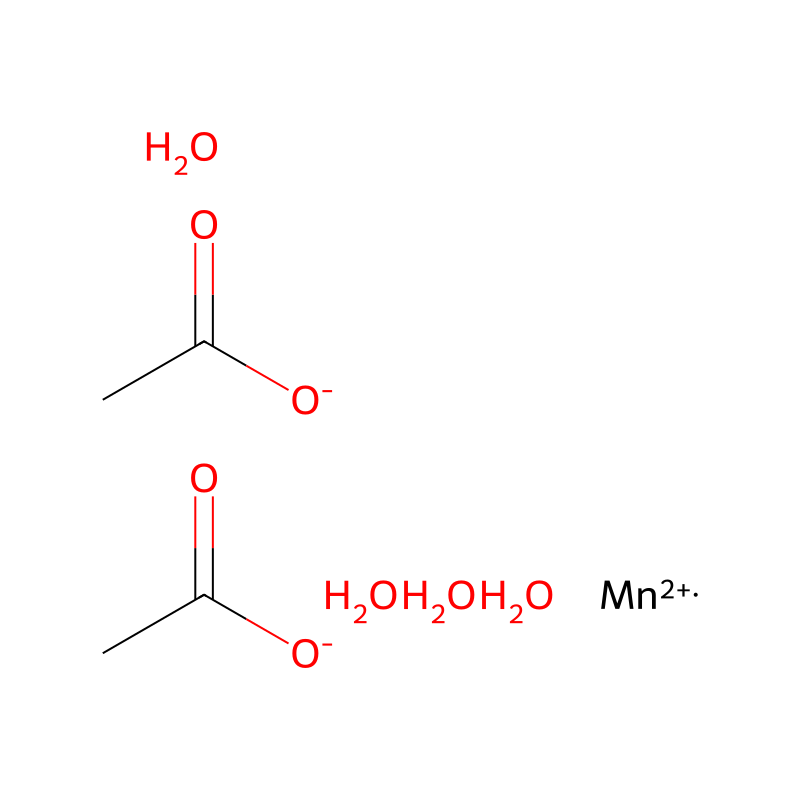
标识与物理属性
| CAS No. | 6156-78-1 |
|---|---|
| 分子式 | C4H6MnO4 . 4H2O |
| 平均分子量 | 245.09 g/mol |
| 单同位素质量 | 245.00691251 g/mol |
| SMILES | CC(=O)[O-].CC(=O)[O-].O.O.O.O.[Mn+2] |
| InChIKey | CESXSDZNZGSWSP-UHFFFAOYSA-L |
| PubChem CID | 93021 |
| EC No. | 612-176-1 |
| DTXSID | DTXSID00210566 |
| 中文名 | 四水合乙酸锰 |
化学与物理性质
| 极性表面积 | 84.3 |
|---|---|
| 氢键供体 | 4 |
| 氢键受体 | 8 |
| 可旋转键 | 0 |
| 重原子 | 13 |
| 形式电荷 | 0 |
| 复杂度 | 25.5 |
| 物质类别 | Metals -> Organic Acids, Metal Salts |
| 密度 | 1.59 @ 20°C1.589 g/mL at 25 °C(lit.) |
| 熔点 | 80 °C>300 °C(lit.) |
| Physical Description | Light red transparent solid[Merck Index] Light pink hygroscopic crystals[Acros Organics MSDS] |
| 堆积密度 | 700kg/m3 |
| 蒸气压 | <1 hPa (25 °C) |
| 储存条件 | Store below +30°C. |
| 溶解性 | 233g/lSoluble in water, methanol, ethanol, and acetic acid. |
| 形态 | Crystals |
| 颜色 | Pink |
| 比重 | 1.589 |
| pH | 7.0 (50g/l, H2O, 20℃) |
| 水解敏感性 | 4: no reaction with water under neutral conditions |
| Merck | 14,5724 |
| BRN | 3730728 |
| 暴露限值 | OSHA: Ceiling 5 mg/m3NIOSH: IDLH 500 mg/m3TWA 1 mg/m3STEL 3 mg/m3 |
| InChI | 1S/2C2H4O2.Mn.4H2O/c2*1-2(3)4/h2*1H3,(H,3,4)4*1H2/q+2/p-2 |
| InChIKey | SLMRUTJYVMZEPJ-UHFFFAOYSA-M |
| SMILES | [H]O[H].[H]O[H].[H]O[H].[H]O[H].CC(=O)O[Mn]OC(C)=O |
| CAS 数据库 | 6156-78-1(CAS DataBase Reference) |
化学性质
淡红色结晶。 极易溶于水和乙醇。
安全与法规
| GHS 分类 | This chemical does not meet GHS hazard criteria for 35.1% (26 of 74) of reports.WarningH315 (63.5%): Causes skin irritation [Warning Skin corrosion/irritation]P261, P264, P264+P265, P271, P280, P302+P352, P304+P340, P305+P351+P338, P319, P321, P332+P317, P337+P317, P362+P364, P403+P233, P405, and P501 (click each P-code to see the statement)Aggregated GHS information provided per 74 reports by companies from 9 notifications to the ECHA C&L Inventory. Each notification may be associated with multiple companies.Danger |
|---|---|
| 法规信息 | Chemical: Acetic acid, manganese(2+) salt, tetrahydrateAcetic acid, manganese(2+) salt, tetrahydrate: Does not have an individual approval but may be used under an appropriate group standard |
| 其他安全信息 | IMAP assessments - Soluble manganese compounds: Human health tier II assessment |
| 危害概述 | An irritantPossible reproductive and fetal toxicant[Acros Organics MSDS] See Manganese(II) acetate. See Manganese and linked occupational diseases. |
| Hazard Classes and Categories | Skin Irrit. 2 (63.5%)Acute toxicity (ingestion) - category 4 |
| 暴露控制与个人防护 | 0.2 [mg/m3], as Mn (inhalable fraction), 0.02 mg/m3, as Mn (respirable fraction)[German Research Foundation (DFG)] |
| Minimum Risk Level | Chronic Inhalation: 0.0003 mg/m3 (L134) |
| Threshold Limit Values (TLV) | 0.02 [mg/m3], as Mn (respirable fraction), 0.1 mg/m3, as Mn (inhalable fraction) |
| Protective Action Criteria (PAC) | 13 [mg/m3]22 [mg/m3]740 [mg/m3] |
| 健康影响 | Manganese mainly affects the nervous system and may cause behavioral changes and other nervous system effects, which include movements that may become slow and clumsy. This combination of symptoms when sufficiently severe is referred to as “manganism”. (L228) |
| 不良影响 | Neurotoxin - Parkinsonism |
| 暴露途径 | Oral (L228)inhalation (L228) |
| 毒性概述 | Manganese is a cellular toxicant that can impair transport systems, enzyme activities, and receptor functions. It primarily targets the central nervous system, particularily the globus pallidus of the basal ganglia. It is believed that the manganese ion, Mn(II), enhances the autoxidation or turnover of various intracellular catecholamines, leading to increased production of free radicals, reactive oxygen species, and other cytotoxic metabolites, along with a depletion of cellular antioxidant defense mechanisms, leading to oxidative damage and selective destruction of dopaminergic neurons. In addition to dopamine, manganese is thought to perturbations other neurotransmitters, such as GABA and glutamate. In order to produce oxidative damage, manganese must first overwhelm the antioxidant enzyme manganese superoxide dismutase. The neurotoxicity of Mn(II) has also been linked to its ability to substitute for Ca(II) under physiological conditions. It can enter mitochondria via the calcium uniporter and inhibit mitochondrial oxidative phosphorylation. It may also inhibit the efflux of Ca(II), which can result in a loss of mitochondrial membrane integrity. Mn(II) has been shown to inhibit mitochondrial aconitase activity to a significant level, altering amino acid metabolism and cellular iron homeostasis. (L228) |
| Signs and Symptoms | Manganese mainly affects the nervous system and may cause behavioral changes and other nervous system effects, which include movements that may become slow and clumsy. This combination of symptoms when sufficiently severe is referred to as “manganism”. (L228) |
| Carcinogen Classification | No indication of carcinogenicity to humans (not listed by IARC). |
| 水危害等级(WGK) | 2 |
| TSCA 清单状态 | Yes |
| 毒性 | LD50 orally in Rabbit: 3730 mg/kg |
| RTECS 号 | AI5775000 |
| 储存类别 | 11 - Combustible Solids |
| 安全说明(S) | 26-36 |
| 海关编码 | 29152990 |
| 危险品标志 | Xi |
| 危险类别 | Aquatic Chronic 3STOT RE 2 Inhalation |
| 危险类别码(R) | 36/37/38 |
急性毒性
口服- 大鼠 LD50: 3730 毫克/ 公斤
职业标准
TWA 5 毫克/ 立方米
可燃性危险特性
可燃, 火场排出含锰辛辣刺激烟雾
储运特性
库房低温, 通风, 干燥
灭火剂
水, 二氧化碳, 干粉, 砂土
用途与应用
用途
用作氧化催化剂和油漆催干剂
用途
该品是聚酯树脂的原料—二甲苯高温氧化的催化剂。还可用作染色媒染剂,涂料、清漆的干燥剂,以及氧化过程的催化剂等。
制备与合成方法
生产方法
由锰与乙酸反应制得。先用5%的消酸将金属锰浸泡5min,再用蒸馏水漂洗数次,洗至pH值为8。然后,加入乙酸进行合成反应,先制得乙酸锰粗品,再加少量活性炭,以除去其中的铁、铅等金属离子。然后过滤,滤液用乙酸(化学纯)调节pH至3-4后,蒸发至相对密度为1.30,再冷却、结晶、离心分离、干燥(50℃以下),即得成品。原料消耗(kg/t)工酸(工业品) 1100金属锰(工业品) 380硝酸(工业品) 10