乙酰氯 → 3-acetyl-2-(2,5-diacetyloxyphenyl)-1,3-thiazolidine-4-carboxylic Acid
HRID 1069042
反应方程式
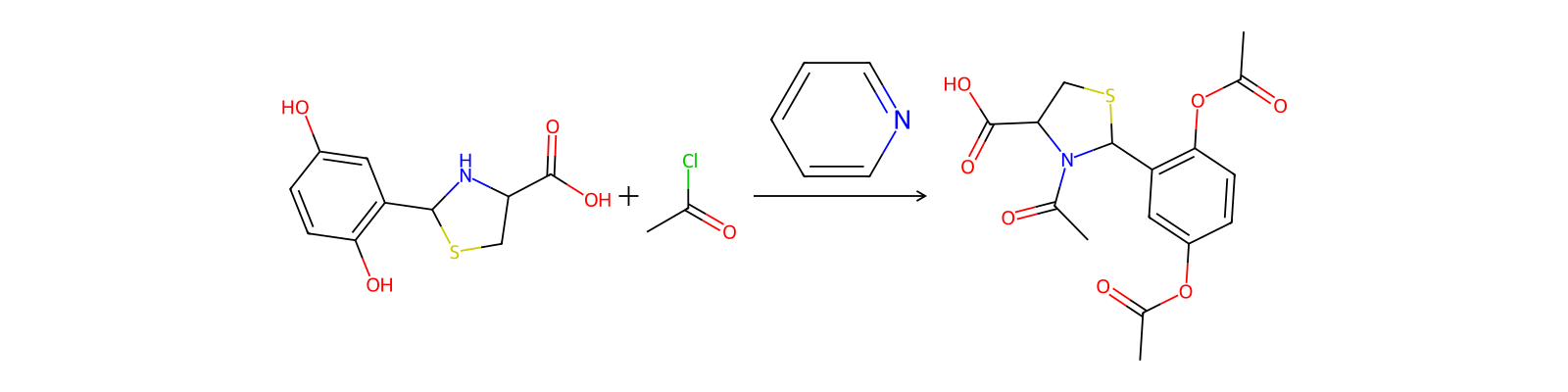
[OH:1][C:2]1[CH:7]=[CH:6][C:5]([OH:8])=[CH:4][C:3]=1[CH:9]1[NH:13][CH:12]([C:14]([OH:16])=[O:15])[CH2:11][S:10]1.[C:17](Cl)(=[O:19])[CH3:18]>N1C=CC=CC=1>[C:17]([N:13]1[CH:12]([C:14]([OH:16])=[O:15])[CH2:11][S:10][CH:9]1[C:3]1[CH:4]=[C:5]([O:8][C:2](=[O:1])[CH3:3])[CH:6]=[CH:7][C:2]=1[O:1][C:5](=[O:8])[CH3:4])(=[O:19])[CH3:18]参与物
4



反应条件
- 温度
- -30 °C
实验过程
To a solution of 0.241 g (0.85 mmol) of 2-(2,5-dihydroxyphenyl)-1,3-thiazolidine-4-carboxylic acid (1:1 mixture of isomers at C2) was added 3 mL of pyridine, and the solution was cooled to −30° C. with a dry ice acetone bath. To the heterogeneous mixture was added 0.34 mL of acetyl chloride under constant stirring. The cooling bath was removed and the reaction mixture was allowed to warm up gradually to room temperature. After overnight stirring at room temperature, the solvent was removed under high vacuum. To the remaining oily residue were added 19 mL of water and 1 mL concentrated HCl. The precipitate was filtered and washed with 2×5 mL of water. After drying at high vacuum, 0.13 g of acetylated product (5) was obtained (34%), as a mixture of diastereoisomers and rotamers. 1H NMR (DMSO-d6) δ; 1.76 s, 1.79 s, 1.99 s, 2.03 s, 2.06 s, 2.26 s, 2.33 s, 2.34 s, 9H; 3.2-3.4m, 3H; 5.11 d, J=8 Hz and 5.36 d, J=8 Hz, 1H; 6.10 s, 6.20 s, 6.33 s and 6.36 s, 1H; 6.99-7.22 m, 2H; 12.95 bs, 1H.