乙酰乙酸乙酯 → 4-羟基-2-甲基喹啉
反应方程式
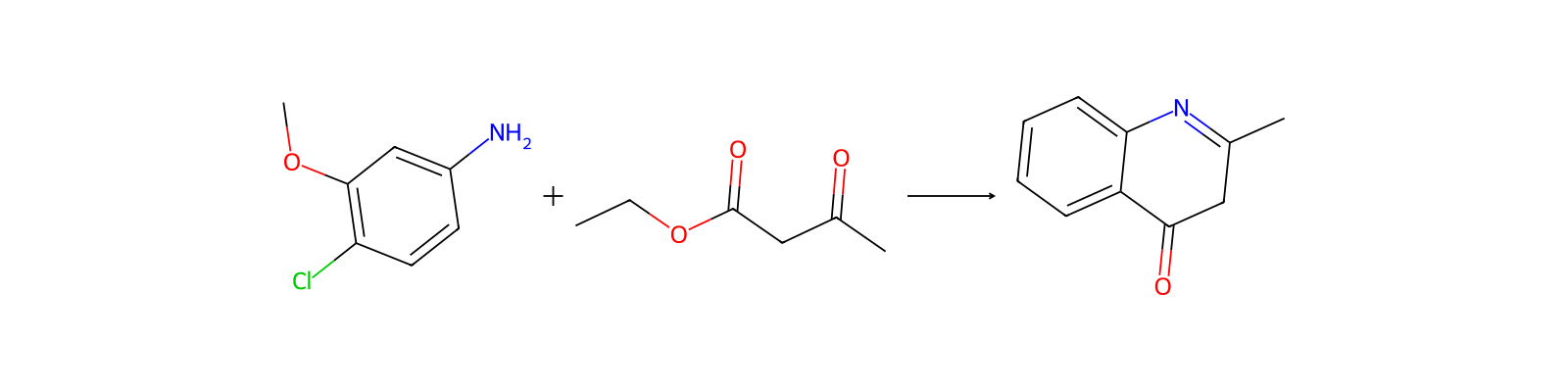
Cl[C:2]1[CH:8]=[CH:7][C:5]([NH2:6])=[CH:4][C:3]=1OC.[C:11](OCC)(=[O:16])[CH2:12][C:13]([CH3:15])=O>>[CH3:15][C:13]1[CH2:12][C:11](=[O:16])[C:4]2[C:5](=[CH:7][CH:8]=[CH:2][CH:3]=2)[N:6]=1参与物
3


实验过程
Condensation of 4-chloro-3-methoxy aniline and ethyl acetoacetate followed by thermal cyclization provided 2-methyl-4-quinolone 1 via Conrad-Limpach synthesis. Iodination of 1 with iodine in saturated aqueous potassium iodide solution and n-butylamine provided the 3-iodo-4-quinolone 2. Copper-mediated coupling of 4-bromophenol and 4-trifluoromethoxyphenyl boronic acid with Hunig's base and pyridine afforded the diaryl ether 4. Reaction of the lithium anion of 4 with boron triisopropoxide followed by acidic hydrolysis of the resulting boronic ester provided the boronic acid 5. Suzuki-Miyaura reaction of the 3-iodo-4-quinolone 2 with the boronic acid 5 resulted in difficult to separate mixtures of quinolone starting material and product. This difficulty in separation was likely the result of a combination of pi-stacking and intermolecular hydrogen bonding typical of 4-quinolones. A functional group protection strategy involving the 4-position alcohol was devised that would alleviate this problem by mitigating intermolecular hydrogen bonding. To this end 4-O-carbonates and 4-O-acetates were prepared, but these were found to be labile under Suzuki-Miyaura reaction conditions. A more robust protecting group, a 4-O-ethyl ether, was shown to be stable under these reaction conditions, yet reactive enough to be selectively removed in the presence of an aryl methoxy moiety. The 3-iodo-quinolone 2 was reacted with ethyl iodide and potassium carbonate to give the corresponding ethyl ether 3. Suzuki-Miyaura coupling of 3 with 4-phenoxyphenylboronic acid using palladium tetrakis triphenylphosphine and aqueous potassium carbonate provided 3 in very good yield. ELQ-300 was obtained in quantitative yield by heating the ethyl ether 3 in 30% hydrobromic acid in acetic acid.