盐酸 → 4-[4,4-Bis(4-fluorophenyl)butyl]-2-piperazinemethanol
HRID 35331
反应方程式
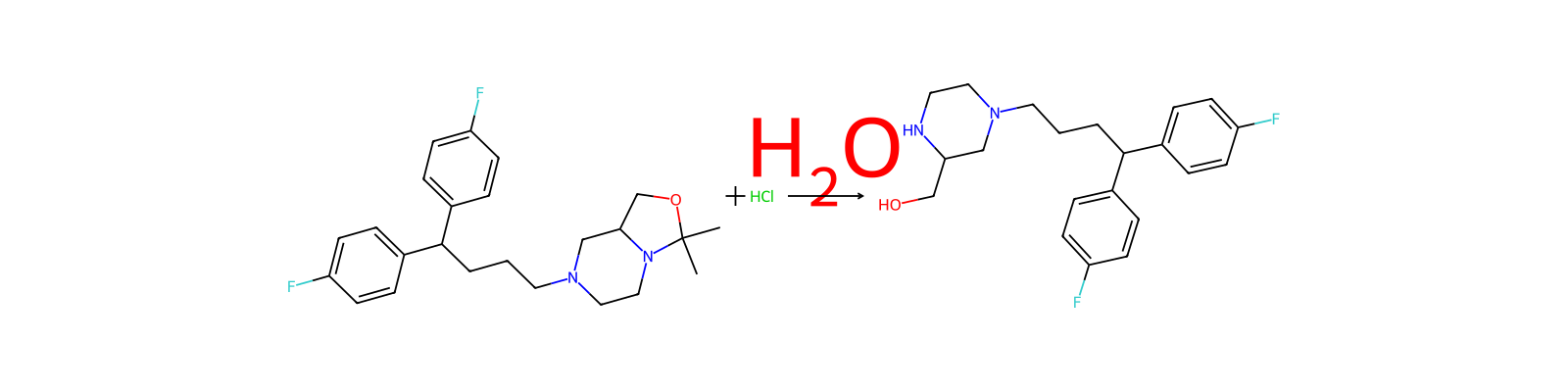
[F:1][C:2]1[CH:7]=[CH:6][C:5]([CH:8]([C:23]2[CH:28]=[CH:27][C:26]([F:29])=[CH:25][CH:24]=2)[CH2:9][CH2:10][CH2:11][N:12]2[CH2:17][CH2:16][N:15]3C(C)(C)[O:19][CH2:20][CH:14]3[CH2:13]2)=[CH:4][CH:3]=1.Cl>O>[F:1][C:2]1[CH:7]=[CH:6][C:5]([CH:8]([C:23]2[CH:24]=[CH:25][C:26]([F:29])=[CH:27][CH:28]=2)[CH2:9][CH2:10][CH2:11][N:12]2[CH2:17][CH2:16][NH:15][CH:14]([CH2:20][OH:19])[CH2:13]2)=[CH:4][CH:3]=1参与物
4




实验过程
A mixture of 34 parts of 7-[4,4-bis(4-fluorophenyl)butyl]hexahydro-3,3-dimethyl-1H-oxazolo[3,4-a]pyrazine and 272 parts of a hydrochloric acid solution 0.5N in water was stirred and refluxed for 2 hours. The reaction mixture was cooled to room temperature and the product was extracted twice with 1,1'-oxybisethane. The aqueous phase was separated, alkalized and salted out with sodium carbonate. The product was extracted with trichloromethane. The extract was dried, filtered and evaporated. The residue was purified by column-chromatography over silica gel using a mixture of trichloromethane and methanol (85:15 by volume), saturated with ammonia as eluent. The pure fractions were collected and the eluent was evaporated, yielding 17.0 parts of 4-[4,4-bis(4-fluorophenyl)butyl]-2-piperazinemethanol as an oily residue (intermediate 100).