二氯甲烷 → 4-Chloro-alpha-[(1-methyl-1H-benzimidazol-2-yl)thio]-benzeneacetic acid
HRID 463542
反应方程式
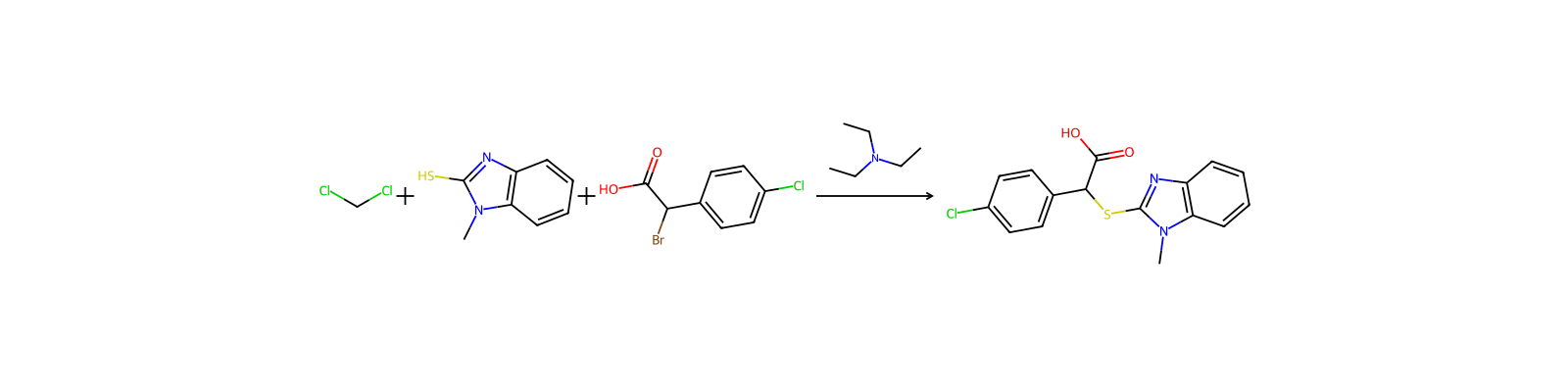
C(Cl)Cl.[SH:4][C:5]1[N:9]([CH3:10])[C:8]2[CH:11]=[CH:12][CH:13]=[CH:14][C:7]=2[N:6]=1.Br[CH:16]([C:20]1[CH:25]=[CH:24][C:23]([Cl:26])=[CH:22][CH:21]=1)[C:17]([OH:19])=[O:18]>C(N(CC)CC)C>[Cl:26][C:23]1[CH:22]=[CH:21][C:20]([CH:16]([S:4][C:5]2[N:9]([CH3:10])[C:8]3[CH:11]=[CH:12][CH:13]=[CH:14][C:7]=3[N:6]=2)[C:17]([OH:19])=[O:18])=[CH:25][CH:24]=1参与物
5




实验过程
A methylene chloride solution of 3.3 g (0.02M) of 2-mercapto-1-methyl-1H-benzimidazole, 5.0 g (0.02M) of α-bromo-(p-chlorophenyl)acetic acid and 4.0 g (0.04M) of triethylamine is heated to reflux overnight. The reaction mixture is neutralized with a diluted HCL solution. The layers are separated and the organic layer is dried over anhydrous magnesium sulfate. After removal of methylene chloride the residue is recrystallized from acetonitrile. The recrystallized material weighs 4.1 g (41% yield) and has a melting point of 161°-3° C. dec.