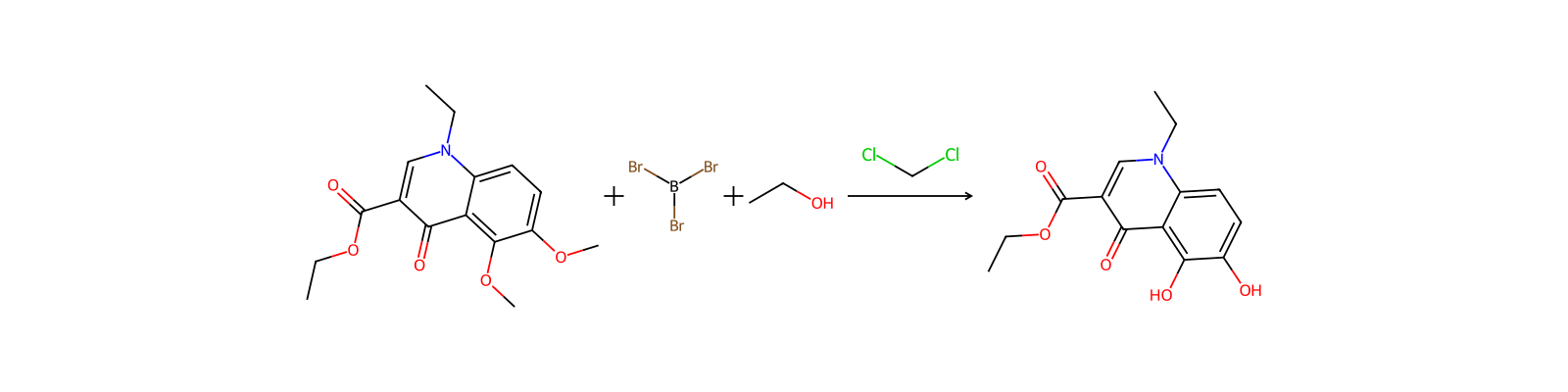
[CH2:1]([N:3]1[C:12]2[C:7](=[C:8]([O:15]C)[C:9]([O:13]C)=[CH:10][CH:11]=2)[C:6](=[O:17])[C:5]([C:18]([O:20][CH2:21][CH3:22])=[O:19])=[CH:4]1)[CH3:2].B(Br)(Br)Br.CCO>ClCCl>[CH2:1]([N:3]1[C:12]2[C:7](=[C:8]([OH:15])[C:9]([OH:13])=[CH:10][CH:11]=2)[C:6](=[O:17])[C:5]([C:18]([O:20][CH2:21][CH3:22])=[O:19])=[CH:4]1)[CH3:2]To a brown solution of ethyl 1-ethyl-5,6-dimethoxy-4-oxo-1,4-dihydroquinoline-3-carboxylate (6 g, 19.65 mmol) in Dichloromethane (DCM) (100 mL) was added BBr3 (6.13 mL, 64.8 mmol) dropwise and the mixture was stirred at r.t. overnight. The resulting mixture was carefully poured into EtOH (50 mL) at −40° C. and the mixture was stirred at r.t. over the weekend. The precipitates were collected by filtration and washed with DCM and MeOH. The filtrate was concentrated a bit, the precipitates were collected and washed by DCM. The solids were combined to afford ethyl 1-ethyl-5,6-dihydroxy-4-oxo-1,4-dihydroquinoline-3-carboxylate (5 g, 9.02 mmol, 45.9% yield) as a yellow solid that contained also some 1-ethyl-5,6-dihydroxy-4-oxo-1,4-dihydroquinoline-3-carboxylic acid. This mixture was directly used in the next step without further purification. LCMS: (M+H)+: 278.4 (ester); 250.3 (acid).