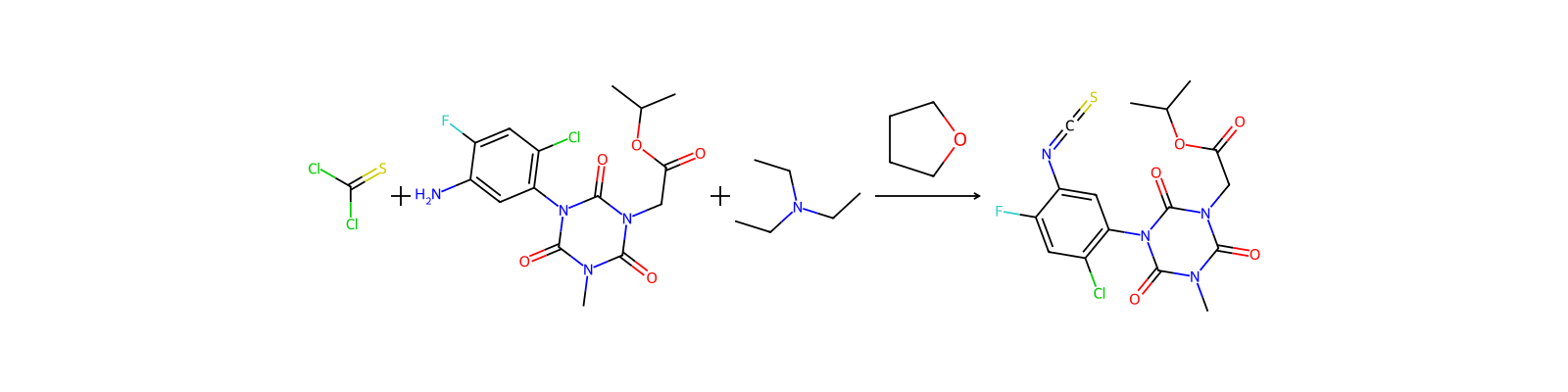
HRID 1476As reactant

463-71-8S=C(Cl)ClZWZVWGITAAIFPS-UHFFFAOYSA-NThiophosgene appears as a reddish liquid. Boiling point 73.5 °C. A severe eye irritant. May severely burn skin on contact. Very toxic by inhalation and by skin absorption.
463-71-8DTXSID2060046CHEBI:29366Toxic Gases & Vapors -> Other Toxic Gases & Vapors
Corrosives
Sharp choking odor
Malodorous
1.513 at 68 °F (USCG, 1999) - Denser than water; will sink
1.508 @ 15 °C
Reddish liquid
Reddish-yellow liquid
Corrodes metals in presence of moisture
Corrosive lachrymator and moisture sensitive compound.
Safety information is for reference only and does not replace the supplier’s Safety Data Sheet (SDS), applicable regulations, or professional assessment.
Danger
H302: Harmful if swallowed [Warning Acute toxicity, oral]
P261, P264, P264+P265, P270, P271, P280, P301+P317, P302+P352, P304+P340, P305+P351+P338, P316, P319, P321, P330, P332+P317, P337+P317, P362+P364, P403+P233, P405, and P501 (click each P-code to see the statement)
Danger
H302 (100%): Harmful if swallowed [Warning Acute toxicity, oral]
P261, P264, P264+P265, P270, P271, P280, P301+P317, P302+P352, P304+P340, P305+P351+P338, P316, P319, P321, P330, P332+P317, P337+P317, P362+P364, P403+P233, P405, and P501 (click each P-code to see the statement)
Chemical: Carbonothioic dichloride
REACH registered substance: Thiocarbonyl chloride (EC: 207-341-6)
Thiophosgene: HSNO Approval: HSR003934 Approved with controls
The New Jersey Worker and Community Right to Know Act requires public and private employers to provide information about hazardous substances at their workplaces. (N.J.S.A. 34:5A-1 et. seq.)
Special Hazards of Combustion Products: Toxic phosgene, hydrogen chloride, and sulfur dioxide may be generated in a fire.
· Combustible material: may burn but does not ignite readily.
Inhalation causes irritation of respiratory system and delayed pulmonary edema. Vapor irritates eyes. Liquid burns skin and eyes. Ingestion causes irritation of mouth and stomach. (USCG, 1999)
No production in U.S. but available as a reagent in small ampules; [HSDB]
Organic synthesis
There is no full-scale U.S. commercial production of thiophosgene, but it is available in glass ampuls from laboratory reagent suppliers.
UsesThiophosgene is a photo degradation product of the agricultural fungicide Folpet (F402000).
General DescriptionA reddish liquid. Boiling point 73.5°C. A severe eye irritant. May severely burn skin on contact. Very toxic by inhalation and by skin absorption.




163 °F at 760 mmHg (USCG, 1999)
163 °F
73 °C
Decomposes above 200 °C to carbon disulfide (very flammable) and carbon tetrachloride.
When heated to decomposition it emits very toxic fumes of /chlorides/ Cl- and /sulfur oxides/ SOx.
· TOXIC and/or CORROSIVE; inhalation, ingestion or contact (skin, eyes) with vapors, dusts or substance may cause severe injury, burns or death.
Thiophosgene hydrolyzes (more slowly than phosgene) into CO2, H2S, and HCl. A corrosive lachrymator; [HSDB] Can cause severe burns and delayed pulmonary edema; [CAMEO]
The major hazards encountered in the use and handling of thiophosgene stem from its toxicologic properties. Toxic by all routes (ie, inhalation, ingestion, and dermal contact), exposure to this sharp-smelling, reddish liquid may occur from its use in organic synthesis. Effects from exposure may include contact burns to the skin and eyes, respiratory irritation, pulmonary edema, and death. In activities and situations where over-exposure may occur, wear a self-contained breathing apparatus, and protective clothing specifically recommended by the shipper or producer. If contact should occur, immediately flush affected skin or eyes with running water for at least 15 minutes, and remove contaminated clothing and shoes at the site. While thiophosgene does not ignite easily, it may burn with the production of poisonous gases (eg, phosgene). In addition, thiophosgene decomposes above 200 °C to carbon disulfide (very flammable) and carbon tetrachloride. Containers may explode violently in the heat of a fire. Fires involving thiophosgene may be extinguished with dry chemical, CO2, Halon, water spray, fog, or standard foam. Fight the fire from as far a distance as possible. Thiophosgene may be shipped via air (cargo only), rail (cargo only), road, and water, in containers bearing the label, "Poison". Small spills of thiophosgene may be taken up with sand or other noncombustible absorbent and placed into containers for later disposal. Large spills should be diked far ahead of the spill area to prevent thiophosgene from entering water sources and sewers. Spilled material may be neutralized with crushed limestone, soda ash, or lime. Before implementing land disposal of waste thiophosgene, consult with environmental regulatory agencies for guidance.
THIOPHOSGENE is incompatible with acids, diazo and azo compounds, halocarbons, isocyanates, aldehydes, alkali metals, nitrides, hydrides, and other strong reducing agents. Reactions with these materials generate heat and in many cases hydrogen gas. Liberates hydrogen sulfide upon reaction with acids.
If ... THERE IS NO FIRE, go directly to the Table of Initial Isolation and Protective Action Distances /(see table below)/ ... to obtain initial isolation and protective action distances. IF THERE IS A FIRE, or IF A FIRE IS INVOLVED, go directly to the appropriate guide /(see guide(s) below)/ and use the evacuation information shown under PUBLIC SAFETY.
/GUIDE 157: SUBSTANCES - TOXIC AND/OR CORROSIVE (NON-COMBUSTIBLE/WATER -SENSITIVE)/ Health: TOXIC; inhalation, ingestion or contact (skin, eyes) with vapors, dusts or substance may cause severe injury, burns, or death. Reaction with water or moist air will release toxic, corrosive or flammable gases. Reaction with water may generate much heat which will increase the concentration of fumes in the air. Fire will produce irritating, corrosive and/or toxic gases. Runoff from fire control or dilution water may be corrosive and/or toxic and cause pollution.
/GUIDE 157: SUBSTANCES - TOXIC AND/OR CORROSIVE (NON-COMBUSTIBLE/WATER -SENSITIVE)/ Fire or Explosion: Non-combustible, substance itself does not burn but may decompose upon heating to produce corrosive and/or toxic fumes. Vapors may accumulate in confined areas (basement, tanks, hopper/tank cars etc.). Substance will react with water (some violently), releasing corrosive and/or toxic gases. Contact with metals may evolve flammable hydrogen gas. Containers may explode when heated or contaminated with water.
/GUIDE 157: SUBSTANCES - TOXIC AND/OR CORROSIVE (NON-COMBUSTIBLE/WATER -SENSITIVE)/ Public Safety: CALL Emergency Response Telephone Number ... . As an immediate precautionary measure, isolate spill or leak area in all directions for at least 50 meters (150 feet) for liquids and at least 25 meters (75 feet) for solids. Keep unauthorized personnel away. Stay upwind. Keep out of low areas. Ventilate enclosed areas.
For more DOT Emergency Guidelines (Complete) data for THIOPHOSGENE (9 total), please visit the HSDB record page.
Thiophosgene
UN2474
Div 6.1 Poisonous materials (49 eCFR § 173.132)
PG I: the degree of danger presented by the material is great
Symbol +: Fixes the proper shipping name, hazard class and packing group for that entry
· CALL 911. Then call emergency response telephone number on shipping paper. If shipping paper not available or no answer, refer to appropriate telephone number listed on the inside back cover.
· ELIMINATE all ignition sources (no smoking, flares, sparks or flames) from immediate area.
Get medical attention at once after any exposure to this compound.
General First Aid:
· Wear positive pressure self-contained breathing apparatus (SCBA).
TIH (Toxic Inhalation Hazard) - Term used to describe gases and volatile liquids that are toxic when inhaled. Some are TIH materials themselves, e.g., chlorine, and some release TIH gases when spilled in water, e.g., chlorosilanes. [ERG 2016].
If material involved in fire Extinguish fire using agent suitable for type of surrounding fire. (Material itself does not burn or burns with difficulty.) Use foam, dry chemical, or carbon dioxide. Cool all affected containers with flooding quantities of water. Do not use water on material itself. If large quantities of combustibles are involved, use water in flooding quantities as spray and fog. Use water spray to knock down vapors.
SRP: At the time of review, criteria for land treatment or burial (sanitary landfill) disposal practices are subject to significant revision. Prior to implementing land disposal of waste residue (including waste sludge), consult with environmental regulatory agencies for guidance on acceptable disposal practices.
Personnel protection Avoid breathing vapors. Keep upwind. ... Avoid bodily contact with the material. Do not handle broken packages unless wearing appropriate personal protective equipment. Wash away any material which may have contacted the body with copious amounts of water or soap and water.
SRP: Contaminated protective clothing should be segregated in such a manner so that there is no direct personal contact by personnel who handle, dispose, or clean the clothing. Quality assurance to ascertain the completeness of the cleaning procedures should be implemented before the decontaminated protective clothing is returned for reuse by the workers. Contaminated clothing should not be taken home at end of shift, but should remain at employee's place of work for cleaning.
If material not involved in fire: Keep material out of water sources and sewers. Build dikes to contain flow as necessary. Use water spray to knock down vapors. Do not use water on material itself. Neutralize spilled material with crushed limestone, soda ash, or lime.
SRP: The scientific literature for the use of contact lenses in industry is conflicting. The benefit or detrimental effects of wearing contact lenses depend not only upon the substance, but also on factors including the form of the substance, characteristics and duration of the exposure, the uses of other eye protection equipment, and the hygiene of the lenses. However, there may be individual substances whose irritating or corrosive properties are such that the wearing of contact lenses would be harmful to the eye. In those specific cases, contact lenses should not be worn. In any event, the usual eye protection equipment should be worn even when contact lenses are in place.
Excerpt from ERG Guide 156 [Substances - Toxic and/or Corrosive (Combustible / Water-Sensitive)]:
Immediate precautionary measure
Small spill:
Small spill:
Self-contained breathing apparatus or organic canister mask; goggles or face shield; rubber gloves (USCG, 1999)
/Wear a/ self contained breathing apparatus or organic canister mask; goggles or face shield; rubber gloves.
Basic treatment: Establish a patent airway. Suction if necessary. Watch for signs of respiratory insufficiency and assist ventilations if necessary. Administer oxygen by nonrebreather mask at 10 to 15 L/min. Monitor for pulmonary edema and treat if necessary ... . Anticipate seizures and treat if necessary ... . For eye contamination, flush eyes immediately with water. Irrigate each eye continuously with normal saline during transport ... . Do not use emetics. For ingestion, rinse mouth and administer 5 m1/kg up to 200 ml of water for dilution if the patient can swallow, has a strong gag reflex, and does not drool ... . Cover skin burns with dry sterile dressings after decontamination ... . /Phosgene and related compounds/
Advanced treatment: Consider orotracheal or nasotracheal intubation for airway control in the patient who is unconscious, has severe pulmonary edema, or is in respiratory arrest. Positive-pressure ventilation techniques with a bag-valve-mask device may be beneficial. Monitor cardiac rhythm and treat arrhythmias if necessary ... . Start an IV with D5W /SRP: "To keep open", minimal flow rate/. Use lactated Ringer's if signs of hypovolemia are present. Watch for signs of fluid overload. Consider drug therapy for pulmonary edema ... . Treat seizures with diazepam (Valium) ... . Use proparacaine hydrochloride to assist eye irrigation ... . /Phosgene and related compounds/
LD50 Mouse iv 100 mg/kg
LD50 Rat oral 929 mg/kg
DefinitionChEBI: Thiophosgene is a thiocarbonyl compound and a one-carbon compound.