Reaction equation
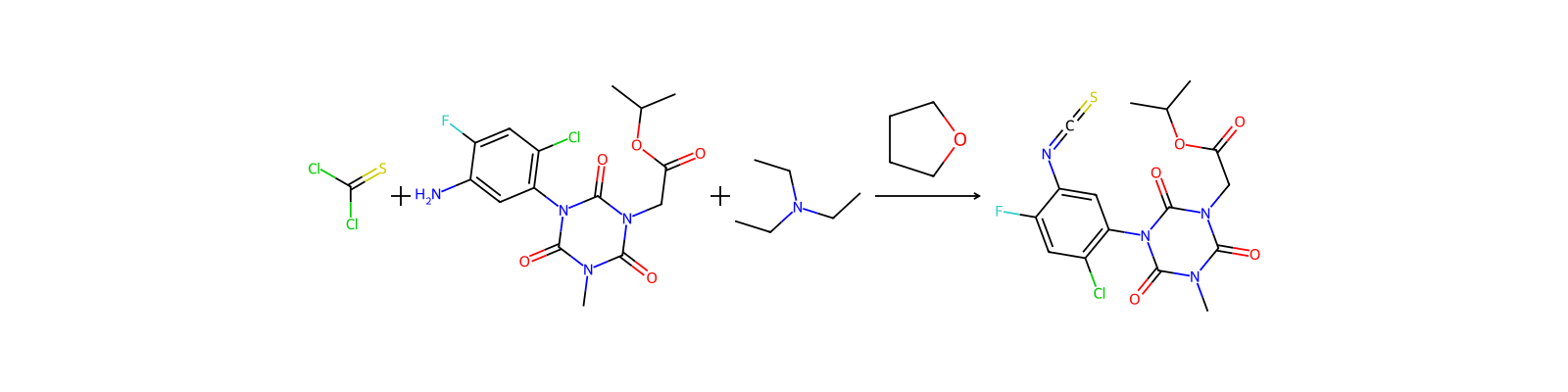
[C:1](Cl)(Cl)=[S:2].[NH2:5][C:6]1[C:7]([F:30])=[CH:8][C:9]([Cl:29])=[C:10]([N:12]2[C:17](=[O:18])[N:16]([CH3:19])[C:15](=[O:20])[N:14]([CH2:21][C:22]([O:24][CH:25]([CH3:27])[CH3:26])=[O:23])[C:13]2=[O:28])[CH:11]=1.C(N(CC)CC)C>O1CCCC1>[Cl:29][C:9]1[CH:8]=[C:7]([F:30])[C:6]([N:5]=[C:1]=[S:2])=[CH:11][C:10]=1[N:12]1[C:17](=[O:18])[N:16]([CH3:19])[C:15](=[O:20])[N:14]([CH2:21][C:22]([O:24][CH:25]([CH3:27])[CH3:26])=[O:23])[C:13]1=[O:28]Participants
5
Reactant 3



Product 1

Reagents, catalysts & solvents 1

Procedure
Thiophosgene (0.50 mL, 6.5 mmol) is added over 45 minutes to a solution of isopropyl 3-(5-amino-2-chloro-4-fluorophenyl)tetrahydro-5-methyl-2,4,6-trioxo-s-triazine-1(2H)-acetate (2.5 g, 6.5 mmol), and triethylamine (1.8 mL, 13.0 mmol) in tetrahydrofuran. The reaction mixture is stirred at room temperature for 4 hours, diluted with tetrahydrofuran, and filtered. The filtrate is concentrated in vacuo to give the title product as an orange oil which is identified by NMR spectral analyses, Using essentially the same procedure, but using the appropriately substituted 3-(5-amino-2-chloro-4-fluorophenyl)tetrahydro-2,4,6-trioxo-s-triazine, the following compounds are obtained:
Workup
- filtrationfiltered
- concentrationThe filtrate is concentrated in vacuo
Sources & evidence
- ORD record
- ord-abde48b4f1894595a808afe5690eeb6d
- Source dataset
- uspto-grants-1998_03
- Patent number
- US05726126
Linked notes
Loading…