
Training data from https://doi.org/10.1039/C8SC04228D (2/10) · 10.1039/C8SC04228D
查看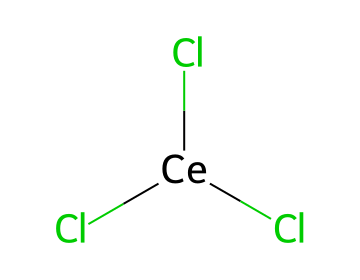
IDENTITY
COMPUTED
PROPERTIES
3.97 @25 °C
807 °C
CBI; Liquid
Fine powder, soluble in water; Heptahydrate: Colorless to yellow deliquescent crystals; [Merck Index]
GHS
This chemical does not meet GHS hazard criteria for 0.4% (1 of 246) of reports.
Danger
H314 (43.1%): Causes severe skin burns and eye damage [Danger Skin corrosion/irritation];H315 (56.5%): Causes skin irritation [Warning Skin corrosion/irritation];H318 (43.9%): Causes serious eye damage [Danger Serious eye damage/eye irritation];H319 (55.7%): Causes serious eye irritation [Warning Serious eye damage/eye irritation];H335 (55.3%): May cause respiratory irritation [Warning Specific target organ toxicity, single exposure; Respiratory tract irritation];H400 (43.1%): Very toxic to aquatic life [Warning Hazardous to the aquatic environment, acute hazard];H410 (43.1%): Very toxic to aquatic life with long lasting effects [Warning Hazardous to the aquatic environment, long-term hazard]
P260, P261, P264, P264+P265, P271, P273, P280, P301+P330+P331, P302+P352, P302+P361+P354, P304+P340, P305+P351+P338, P305+P354+P338, P316, P317, P319, P321, P332+P317, P337+P317, P362+P364, P363, P391, P403+P233, P405, and P501 (click each P-code to see the statement)
Aggregated GHS information provided per 246 reports by companies from 14 notifications to the ECHA C&L Inventory. Each notification may be associated with multiple companies.;Reported as not meeting GHS hazard criteria per 1 of 246 reports by companies.;There are 13 notifications provided by 245 of 246 reports by companies with hazard statement code(s).;Information may vary between notifications depending on impurities, additives, and other factors. The percentage value in parenthesis indicates the notified classification ratio from companies that provide hazard codes. Only hazard codes with percentage values above 10% are shown. For more detailed information, please visit ECHA C&L website.
HAZARDS
Chemical: Cerium chloride (CeCl3)
Cerium chloride (CeCl3) is listed on the EPA's Chemical Data Reporting (CDR) system. Manufacturers and importers of Cerium chloride (CeCl3) are required to report information about their production and use of this chemical to the EPA under the Toxic Substances Control Act (TSCA). (40 eCFR Part 711)
Status: Active Update: 08-01-2015 https://echa.europa.eu/registration-dossier/-/registered-dossier/5704
Cerium chloride (CeCl3): Does not have an individual approval but may be used under an appropriate group standard
See Cerium. See RARE EARTH METALS and linked occupational diseases.
Skin Corr. 1C (43.1%);Skin Irrit. 2 (56.5%);Eye Dam. 1 (43.9%);Eye Irrit. 2 (55.7%);STOT SE 3 (55.3%);Aquatic Acute 1 (43.1%);Aquatic Chronic 1 (43.1%)
SAFETY
6.3 [mg/m3]
70 [mg/m3]
420 [mg/m3]
TOXICITY
Fibrogenic - Inducing tissue injury and fibrosis (scarring).
REGULATORY
Chemical: Cerium chloride (CeCl3)
Cerium chloride (CeCl3) is listed on the EPA's Chemical Data Reporting (CDR) system. Manufacturers and importers of Cerium chloride (CeCl3) are required to report information about their production and use of this chemical to the EPA under the Toxic Substances Control Act (TSCA). (40 eCFR Part 711)
Status: Active Update: 08-01-2015 https://echa.europa.eu/registration-dossier/-/registered-dossier/5704
Cerium chloride (CeCl3): Does not have an individual approval but may be used under an appropriate group standard
USES
Used to make cerium and cerium salts; Used as a polymerization catalyst; [Merck Index] Used for incandescent gas mantles and spectography; [Hawley]
2023: 1,000,000 - <2,500,000 lb;2022: 250,000 - <400,000 lb;2021: 250,000 - <400,000 lb;2020: 700,000 - <850,000 lb
Solids separation (precipitating) agent, not otherwise specified
Other;Solids separation (precipitating) agent, not otherwise specified;Flocculating agent
Mining (except Oil and Gas) and support activities;All Other Basic Inorganic Chemical Manufacturing;Wholesale and Retail Trade
Cerium chloride (CeCl3): ACTIVE
ALIASES
REACTIONS
Training data from https://doi.org/10.1039/C8SC04228D (2/10) · 10.1039/C8SC04228D
查看
Training data from https://doi.org/10.1039/C8SC04228D (2/10) · 10.1039/C8SC04228D
查看
Training data from https://doi.org/10.1039/C8SC04228D (9/10) · 10.1039/C8SC04228D
查看
Training data from https://doi.org/10.1039/C8SC04228D (9/10) · 10.1039/C8SC04228D
查看
Training data from https://doi.org/10.1039/C8SC04228D (6/10) · 10.1039/C8SC04228D
查看
Training data from https://doi.org/10.1039/C8SC04228D (6/10) · 10.1039/C8SC04228D
查看
Training data from https://doi.org/10.1039/C8SC04228D (8/10) · 10.1039/C8SC04228D
查看
Training data from https://doi.org/10.1039/C8SC04228D (8/10) · 10.1039/C8SC04228D
查看