
uspto-grants-2006_08 · 10.6084/m9.figshare.5104873.v1 · US07084166B2
查看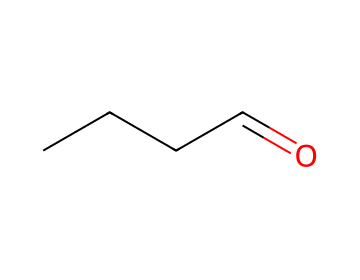
IDENTITY
COMPUTED
PROPERTIES
log Kow = 0.88
0.88
0.88
Characteristic, pungent, aldehyde odor
0.803 at 68 °F (USCG, 1999) - Less dense than water; will float
0.8016 g/cu cm 20 °C
0.8 g/cm³
0.797-0.802
.802 @ 20°C
0.45 cP at 20 °C
Liquid
Water-white liquid
less than 1 mg/mL at 66 °F (NTP, 1992)
Miscible with ethanol, ether, ethyl acetate, acetone, toluene, many other organic solvents andoils
Soluble in water; miscible with ethanol; very olubl ein acetone, benzene; slightly soluble in chloroform
In water, 7.10X10+4 mg/L at 25 °C
71 mg/mL at 25 °C
Solubility in water, g/100ml: 7
20 °F (NTP, 1992)
20 °F
-8 °F (-22 °C) (CLOSED CUP)
-12 °C c.c.
167 °F at 760 mmHg (NTP, 1992)
74.8 °C
74.00 to 75.00 °C. @ 760.00 mm Hg
74.8 °C
74.8 °C
74.7 °C @760 [mm Hg]
When heated to decomposition it emits acrid smoke and fumes.
-146 °F (NTP, 1992)
-96.86 °C
-99 °C
-99 °C
-96.86 °C
2.5 (NTP, 1992) - Heavier than air; will sink (Relative to Air)
2.5 (Air = 1)
Relative vapor density (air = 1): 2.5
Odor Threshold Low: 0.005 [ppm];Odor Threshold High: 9.0 [ppm];Odor thresholds from AIHA
Odor threshold= 0.009 ppm
GHS
Danger
H225: Highly Flammable liquid and vapor [Danger Flammable liquids]
P210, P233, P240, P241, P242, P243, P280, P303+P361+P353, P370+P378, P403+P235, and P501 (click each P-code to see the statement)
Danger
HAZARDS
Chemical: Butanal
Butanal is listed on the EPA's Chemical Data Reporting (CDR) system. Manufacturers and importers of Butanal are required to report information about their production and use of this chemical to the EPA under the Toxic Substances Control Act (TSCA). (40 eCFR Part 711)
Status: Active Update: 11-04-2023 https://echa.europa.eu/registration-dossier/-/registered-dossier/15033
Butanal: HSNO Approval: HSR001105 Approved with controls
The New Jersey Worker and Community Right to Know Act requires public and private employers to provide information about hazardous substances at their workplaces. (N.J.S.A. 34:5A-1 et. seq.)
Flammable Liquid
Behavior in Fire: Vapors are heavier than air and may travel considerable distance to a source of ignition and flash back. Fires are difficult to control due to ease of reignition. (USCG, 1999)
· HIGHLY FLAMMABLE: Will be easily ignited by heat, sparks or flames.;· Vapors may form explosive mixtures with air.;· Vapors may travel to source of ignition and flash back.;· Most vapors are heavier than air. They will spread along the ground and collect in low or confined areas (sewers, basements, tanks, etc.).;· Vapor explosion hazard indoors, outdoors or in sewers.;· Those substances designated with a (P) may polymerize explosively when heated or involved in a fire.;· Runoff to sewer may create fire or explosion hazard.;· Containers may explode when heated.;· Many liquids will float on water.
Highly flammable. Vapour/air mixtures are explosive.
Highly flammable liquid.
Inhalation will cause irritation and possibly nausea, vomiting, headache, and loss of consciousness. Contact with eyes causes burns. Skin contact may be irritating. (USCG, 1999)
· May cause toxic effects if inhaled or absorbed through skin.;· Inhalation or contact with material may irritate or burn skin and eyes.;· Fire will produce irritating, corrosive and/or toxic gases.;· Vapors may cause dizziness or asphyxiation, especially when in closed or confined areas.;· Runoff from fire control or dilution water may cause environmental contamination.
If left on clothing, can cause reddening of skin; [CHRIS] Butyraldehyde is a skin irritant. [Quick CPC] May form explosive peroxides; May polymerize; A skin, eye, and respiratory tract irritant; [ICSC] May cause burns to skin and eyes; Inhalation may cause spasm, edema of the larynx and bronchi, chemical pneumonitis, and pulmonary edema; [HSDB] A severe irritant in animal experiments; In subchronic inhalation studies, 50 ppm was the no-observable-effect level and 117 ppm produced eye and upper respiratory tract irritation; Caused anesthetic effects in lethal concentration studies; [OECD SIDS] See ALDEHYDES.
1129 129P
Butyraldehyde is a food additive permitted for direct addition to food for human consumption as a synthetic flavoring substance and adjuvant in accordance with the following conditions: a) they are used in the minimum quantity required to produce their intended effect, and otherwise in accordance with all the principles of good manufacturing practice, and 2) they consist of one or more of the following, used alone or in combination with flavoring substances and adjuvants generally recognized as safe in food, prior-sanctioned for such use, or regulated by an appropriate section in this part.
Butyraldehyde is an indirect food additive for use only as a component of adhesives.
Aldehydes;Polymerizable Compounds
Symbol: F; R: 11; S: (2)-9-29-33
UN Hazard Class: 3; UN Pack Group: II
Pursuant to section 8(d) of TSCA, EPA promulgated a model Health and Safety Data Reporting Rule. The section 8(d) model rule requires manufacturers, importers, and processors of listed chemical substances and mixtures to submit to EPA copies and lists of unpublished health and safety studies. ??Chemical?? is included on this list. Effective date 12/16/88; Sunset date: 12/19/95.
SAFETY
Excerpt from ERG Guide 129 [Flammable Liquids (Water-Miscible / Noxious); polymerization hazard]:;CAUTION: The majority of these products have a very low flash point. Use of water spray when fighting fire may be inefficient.;SMALL FIRE: Dry chemical, CO2, water spray or alcohol-resistant foam. Do not use dry chemical extinguishers to control fires involving nitromethane (UN1261) or nitroethane (UN2842).;LARGE FIRE: Water spray, fog or alcohol-resistant foam. Avoid aiming straight or solid streams directly onto the product. If it can be done safely, move undamaged containers away from the area around the fire.;FIRE INVOLVING TANKS, RAIL TANK CARS OR HIGHWAY TANKS: Fight fire from maximum distance or use unmanned master stream devices or monitor nozzles. Cool containers with flooding quantities of water until well after fire is out. Withdraw immediately in case of rising sound from venting safety devices or discoloration of tank. ALWAYS stay away from tanks in direct contact with flames. For massive fire, use unmanned master stream devices or monitor nozzles; if this is impossible, withdraw from area and let fire burn. (ERG, 2024)
Use foam, powder, carbon dioxide. In case of fire: keep drums, etc., cool by spraying with water.
Fresh air, rest.
Remove contaminated clothes. Rinse skin with plenty of water or shower.
First rinse with plenty of water for several minutes (remove contact lenses if easily possible), then refer for medical attention.
Rinse mouth. Rest.
· CALL 911. Then call emergency response telephone number on shipping paper. If shipping paper not available or no answer, refer to appropriate telephone number listed on the inside back cover.;· Keep unauthorized personnel away.;· Stay upwind, uphill and/or upstream.;· Ventilate closed spaces before entering, but only if properly trained and equipped.
· ELIMINATE all ignition sources (no smoking, flares, sparks or flames) from immediate area.;· All equipment used when handling the product must be grounded.;· Do not touch or walk through spilled material.;· Stop leak if you can do it without risk.;· Prevent entry into waterways, sewers, basements or confined areas.;· A vapor-suppressing foam may be used to reduce vapors.;· Absorb or cover with dry earth, sand or other non-combustible material and transfer to containers.;· Use clean, non-sparking tools to collect absorbed material.;Large Spill;· Dike far ahead of liquid spill for later disposal.;· Water spray may reduce vapor, but may not prevent ignition in closed spaces.
EYES: First check the victim for contact lenses and remove if present. Flush victim's eyes with water or normal saline solution for 20 to 30 minutes while simultaneously calling a hospital or poison control center. Do not put any ointments, oils, or medication in the victim's eyes without specific instructions from a physician. IMMEDIATELY transport the victim after flushing eyes to a hospital even if no symptoms (such as redness or irritation) develop.;SKIN: IMMEDIATELY flood affected skin with water while removing and isolating all contaminated clothing. Gently wash all affected skin areas thoroughly with soap and water. IMMEDIATELY call a hospital or poison control center even if no symptoms (such as redness or irritation) develop. IMMEDIATELY transport the victim to a hospital for treatment after washing the affected areas.;INHALATION: IMMEDIATELY leave the contaminated area; take deep breaths of fresh air. If symptoms (such as wheezing, coughing, shortness of breath, or burning in the mouth, throat, or chest) develop, call a physician and be prepared to transport the victim to a hospital. Provide proper respiratory protection to rescuers entering an unknown atmosphere. Whenever possible, Self-Contained Breathing Apparatus (SCBA) should be used; if not available, use a level of protection greater than or equal to that advised under Protective Clothing.;INGESTION: DO NOT INDUCE VOMITING. Corrosive chemicals will destroy the membranes of the mouth, throat, and esophagus and volatile chemicals have a high risk of being aspirated into the victim's lungs during vomiting. Thus, the risk of increasing the medical problems by inducing vomiting of a volatile corrosive chemical is very high. If the victim is conscious and not convulsing, give 1 or 2 glasses of water to dilute the chemical and IMMEDIATELY call a hospital or poison control center. IMMEDIATELY transport the victim to a hospital. If the victim is convulsing or unconscious, do not give anything by mouth, ensure that the victim's airway is open and lay the victim on his/her side with the head lower than the body. DO NOT INDUCE VOMITING. IMMEDIATELY transport the victim to a hospital. (NTP, 1992)
General First Aid:;· Call 911 or emergency medical service.;· Ensure that medical personnel are aware of the material(s) involved, take precautions to protect themselves and avoid contamination.;· Move victim to fresh air if it can be done safely.;· Administer oxygen if breathing is difficult.;· If victim is not breathing:;-- DO NOT perform mouth-to-mouth resuscitation; the victim may have ingested or inhaled the substance.;-- If equipped and pulse detected, wash face and mouth, then give artificial respiration using a proper respiratory medical device (bag-valve mask, pocket mask equipped with a one-way valve or other device).;-- If no pulse detected or no respiratory medical device available, provide continuous compressions. Conduct a pulse check every two minutes or monitor for any signs of spontaneous respirations.;· Remove and isolate contaminated clothing and shoes.;· For minor skin contact, avoid spreading material on unaffected skin.;· In case of contact with substance, remove immediately by flushing skin or eyes with running water for at least 20 minutes.;· For severe burns, immediate medical attention is required.;· Effects of exposure (inhalation, ingestion, or skin contact) to substance may be delayed.;· Keep victim calm and warm.;· Keep victim under observation.;· For further assistance, contact your local Poison Control Center.;· Note: Basic Life Support (BLS) and Advanced Life Support (ALS) should be done by trained professionals.;Specific First Aid:;· Wash skin with soap and water.
Fireproof. Separated from incompatible materials. See Chemical Dangers. Cool. Keep in the dark. Store in an area without drain or sewer access.
May accumulate static electrical charges, and may cause ignition of its vapors.
Flammable liquid. Forms explosive peroxides. Vapors are heavier than air and may travel to a source of ignition and flash back. Combustion may produce irritants and toxic gases. Closed containers may rupture violently when heated.
· Wear positive pressure self-contained breathing apparatus (SCBA).;· Structural firefighters' protective clothing provides thermal protection but only limited chemical protection.
If material on fire or involved in fire: Do not extinguish fire unless flow can be stopped. Use water in flooding quantities as fog. Solid streams of water may spread fire. Cool all affected containers with flooding quantities of water. Apply water from as far a distance as possible. Use foam, dry chemical, or carbon dioxide.
Use dry chemical, foam, or carbon dioxide. Water may be ineffective but should be used to keep fire-exposed containers cool. Fight fire from protected location or maximum possible distance.
Fight fire from protected location or maximum possible distance. Use dry chemical, foam, carbon dioxide. Water may be ineffective. Use water spray to keep fire-exposed containers cool.
On contact with air butyraldehyde is oxidized readily to the butyric acids. Therefore, storage under inert gas is mandatory.
Store in cool, dry, well ventilated location. Separate from oxidizing materials, amines, strong alkalies, acids, and other reactive hazards. Inside storage should be in a standard flammable liquids storage warehouse, room, or cabinet. Bulk storage should be blanketed with inert gas.
Outside or detached storage is preferred. ...Metal containers involving the transfer of this chemical should be grounded and bonded. Drums must be equipped with self-closing valves, pressure vacuum bungs, and flame arresters. Use only non-sparking tools and equipment, especially when opening and closing containers of this chemical. Sources of ignition such as smoking and open flames, are prohibited where this chemical is used, handled, or stored ina manner that could create a potential fire or explosion hazard.
Contaminated wastewaters containing butyraldehyde are produced during the MFR of poly(vinyl butyral) and poly(vinyl formal ethylal). On tha basis of lab tests, a scheme for treating wastewater is recommended. After neutralization with sodium hydroxide or calcium oxide, the organic fraction is distilled from the wastewater and incinerated.
Eliminate all ignition sources. Stop or control the leak, if this can be done without undue risk. Use water spray to cool and disperse vapors and protect personnel. Control runoff and isolate discharged material for proper disposal.
Environmental considerations water spill: Use natural barriers or oil spill control booms to limit spill travel Remove trapped material with suction hoses.
Environmental considerations air spill: Apply water spray or mist to knock down vapors.
For more Cleanup Methods (Complete) data for BUTYRALDEHYDE (6 total), please visit the HSDB record page.
Excerpt from ERG Guide 129 [Flammable Liquids (Water-Miscible / Noxious); polymerization hazard]:;ELIMINATE all ignition sources (no smoking, flares, sparks or flames) from immediate area. All equipment used when handling the product must be grounded. Do not touch or walk through spilled material. Stop leak if you can do it without risk. Prevent entry into waterways, sewers, basements or confined areas. A vapor-suppressing foam may be used to reduce vapors. Absorb or cover with dry earth, sand or other non-combustible material and transfer to containers. Use clean, non-sparking tools to collect absorbed material.;LARGE SPILL: Dike far ahead of liquid spill for later disposal. Water spray may reduce vapor, but may not prevent ignition in closed spaces. (ERG, 2024)
SRP: The most favorable course of action is to use an alternative chemical product with less inherent propensity for occupational exposure or environmental contamination. Recycle any unused portion of the material for its approved use or return it to the manufacturer or supplier. Ultimate disposal of the chemical must consider: the material's impact on air quality; potential migration in soil or water; effects on animal, aquatic, and plant life; and conformance with environmental and public health regulations.
The following wastewater treatment technology has been investigated for butyraldehyde: Concentration process: Activated carbon.
Butyraldehyde is a waste chemical stream constituent which may be subjected to ultimate disposal by controlled incineration.
TOXICITY
Butyraldehyde was detected not quantified in 6 of 12 samples of human milk collected from volunteers in Bayonne, NJ, Jersey City, NJ, Bridgeville, PA, and Baton Rouge, LA(1).
EC50; Species: Pseudokirchneriella subcapitata (Green algae, exponential growth phase, 15000 cells/mL, UTEX 1648); Conditions: static, 24 °C, dissolved oxygen 1-2 mg/L; Concentration: 23560 ug/L for 48 hr; Effect: decreased population growth rate
EC50; Species: Pseudokirchneriella subcapitata (Green algae, exponential growth phase, 15000 cells/mL, UTEX 1648); Conditions: static, 24 °C, dissolved oxygen 1-2 mg/L; Concentration: 1480 ug/L for 48 hr; Effect: decreased photosynthesis
EC50; Species: Chlorococcales (Green algae order); Conditions: freshwater, static; Concentration: 380000 ug/L for 24 hr; Effect: physiology, assimilation efficiency
LC50; Species: Daphnia magna (Water flea, age < or =24 hr); Conditions: freshwater, static, 20-22 °C, pH 7.6-7.7; Concentration: 340000 ug/L for 24 hr; Effect: intoxication, immobilization
For more Ecotoxicity Values (Complete) data for BUTYRALDEHYDE (6 total), please visit the HSDB record page.
TERRESTRIAL FATE: Based on a classification scheme(1), an estimated Koc value of 72(SRC), determined from a log Kow of 0.88(2) and a regression-derived equation(3), indicates that butyraldehyde is expected to have high mobility in soil(SRC). Volatilization of butyraldehyde from moist soil surfaces is expected to be an important fate process(SRC) given a Henry's Law constant of 1.15X10⁻⁴ atm-cu m/mole(4). Butyraldehyde is expected to volatilize from dry soil surfaces(SRC) based upon a vapor pressure of 111 mm Hg(5). A theoretical BOD of 100% in 2 weeks using an activated sludge in the Japanese MITI test(6), suggests that biodegradation is an important environmental fate process in soil(SRC). Under anaerobic conditions, butanal underwent 99% degradation (7 day lag period) using the Hungate serum bottle technique(7).
AQUATIC FATE: Based on a classification scheme(1), an estimated Koc value of 72(SRC), determined from a log Kow of 0.88(2) and a regression-derived equation(3), indicates that butyraldehyde is not expected to adsorb to suspended solids and sediment(SRC). Volatilization from water surfaces is expected(3) based upon a Henry's Law constant of 1.15X10⁻⁴ atm-cu m/mole(4). Using this Henry's Law constant and an estimation method(3), volatilization half-lives for a model river and model lake are 9 hrs and 5 days, respectively(SRC). The rate constant for the reaction between photochemically produced hydroxyl radicals in water and butyraldehyde is 3.9X10+9 L/mole-sec(5); at an aquatic concentration of 1X10-17 mole/L of hydroxyl radicals(6), the half-life would be about 206 days(SRC). According to a classification scheme(7), an estimated BCF of 3(SRC), from its log Kow(2) and a regression-derived equation(8), suggests the potential for bioconcentration in aquatic organisms is low(SRC). A theoretical BOD of 100% in 2 weeks using an activated sludge in the Japanese MITI test(9), suggests that biodegradation is an important environmental fate process in water(SRC).Under anaerobic conditions, butanal underwent 99% degradation (7 day lag period) using the Hungate serum bottle technique(10).
ATMOSPHERIC FATE: According to a model of gas/particle partitioning of semivolatile organic compounds in the atmosphere(1), butyraldehyde, which has a vapor pressure of 111 mm Hg at 25 °C(2), is expected to exist solely as a vapor in the ambient atmosphere. Vapor-phase butyraldehyde is degraded in the atmosphere by reaction with photochemically-produced hydroxyl radicals(SRC); the half-life for this reaction in air is estimated to be 16 hrs(SRC), calculated from its rate constant of 2.35X10⁻¹¹ cu cm/molecule-sec at 25 °C(3). The rate constant for the vapor-phase reaction of butyraldehyde with nitrate radical has been experimentally determined to be 1.15X10⁻¹⁴ cu cm/sec(4), which corresponds to an atmospheric half-life of about 2.9 days(SRC). Butyraldehyde absorbs solar radiation (> 290 nm); direct photooxidation products include carbon monoxide, ethene, ethanal and carbon dioxide(5).
Butyraldehyde has been detected not quantified as a volatile component of raw chicken breast muscle(1) and fried chicken(2).
Neurotoxin - Other CNS neurotoxin;Dermatotoxin - Skin burns.;Toxic Pneumonitis - Inflammation of the lungs induced by inhalation of metal fumes or toxic gases and vapors.
The substance can be absorbed into the body by inhalation of its vapour and by ingestion.
ENVIRONMENTAL: Butyraldehyde was detected not quantified in 6 of 12 samples of human milk collected from volunteers in Bayonne, NJ, Jersey City, NJ, Bridgeville, PA, and Baton Rouge, LA(1).
Butyraldehyde was emitted from rape during the blooming period at a rate of 0.042-2.87 and 0.030-3.41 ppbv during May 8 and 9, 1998(1).
Cough. Sore throat.
Redness.
Redness. Pain.
Burning sensation.
The following link will take the user to the National Toxicology Program (NTP) Test Agent Search Results page, which tabulates all of the "Standard Toxicology & Carcinogenesis Studies", "Developmental Studies", and "Genetic Toxicity Studies" performed with this chemical. Clicking on the "Testing Status" link will take the user to the status (i.e., in review, in progress, in preparation, on test, completed, etc.) and results of all the studies that the NTP has done on this chemical.[Available from: http://ntp-apps.niehs.nih.gov/ntp_tox/index.cfm?fuseaction=ntpsearch.searchresults&searchterm=123-72-8]
A butyraldehyde concentration of 42 ppb was detected in an aqueous effluent from a coal gasification facility in Morgantown, WV(1). Butyraldehyde emission rates of 0.01-0.90 g/kg wood have been detected in emissions from fireplaces burning jack pine and red oak wood(2). Butyraldehyde was detected in 2 of 63 effluents (concn < 100 ppb) collected from chemical manufacturing plants across the US(3). The emission rate of butyraldehyde from particle board/carpet degassing is 0.047 mg/sq m-hr(4). Butyraldehyde was released as fireplace emissions at 80.22 and 22.48 mg/kg of fuel burnt for soft and hard wood, respectively(5). Butyraldehyde was found in emissions from a wood stove using hardwood at 36.49 mg/kg and using synthetic fuel at 9.06 mg/kg(5).
Butyraldehyde was identified, not quantified, in rush hour traffic air samples taken at the Oakland-San Francisco Bay Bridge toll plaza 4/23/2001, 5-7 pm, 4/24/2001, 6-10 am, and 3-7 pm(1). The emission rate of butyraldehyde in the gas-phase from medium duty diesel trucks is 1300 ug/km driven(2). Butyraldehyde was found in highway tunnels in Tuscarora; light duty trucks emitted 0.062 mg/km traveled or 0.916 mg/L fuel used, heavy duty trucks emitted 0.220 mg/km traveled or 0.693 mg/L fuel used(3). Butyraldehyde concentrations from automobile exhaust were 2.2-49 ppbv in models from 1971, 1975 and 1977(4). Butyraldehyde emissions from a two stroke engine (chainsaw) using aliphatic gasoline, regular gasoline, and ethanol were 0.045-0.077, 0.038-0.052, and 0.016-0.038 g/kWh, respectively(5). Using the same two stroke engine, emissions of butyraldehyde from aliphatic gasoline mixed with ethanol at 15, 50, and 85% were 0.045-0.076, 0.036-0.066, and 0.025-0.052 g/kWh, respectively, and regular gasoline mixed with ethanol at 15, 50, and 85% were 0.041-0.058, 0.037-0.073, and 0.026-0.052 g/kWh, respectively(5). Butyraldehyde emissions from an automobile running on Swedish environmental classified diesel fuel were 2.9 mg/km and the same automobile running on European program emissions fuel were 3.4 mg/km(6).
Butyraldehyde/isobutyraldehyde was measured in the emissions of gasoline powered motor vehicles at a rate of 370 ug/km and 31,000 ug/km for catalyst equipped engines and non-catalyst equipped engines(1). Butyraldehyde/isobutyraldehyde was given off six new vehicle interiors at an average of 19 ug/hr in new vehicles, 7.2 ug/hr in 20 day old vehicles and 7.2 ug/hr in 40 day old vehicles(2). Butyraldehyde/isobutyraldehyde was measured in the emissions of burnt wood at 96, 62, and 31 mg/kg of pine, oak, and eucalyptus, respectively(3).
The substance is harmful to aquatic organisms.
REGULATORY
Chemical: Butanal
Butanal is listed on the EPA's Chemical Data Reporting (CDR) system. Manufacturers and importers of Butanal are required to report information about their production and use of this chemical to the EPA under the Toxic Substances Control Act (TSCA). (40 eCFR Part 711)
Status: Active Update: 11-04-2023 https://echa.europa.eu/registration-dossier/-/registered-dossier/15033
Butanal: HSNO Approval: HSR001105 Approved with controls
The New Jersey Worker and Community Right to Know Act requires public and private employers to provide information about hazardous substances at their workplaces. (N.J.S.A. 34:5A-1 et. seq.)
Butyraldehyde is a food additive permitted for direct addition to food for human consumption as a synthetic flavoring substance and adjuvant in accordance with the following conditions: a) they are used in the minimum quantity required to produce their intended effect, and otherwise in accordance with all the principles of good manufacturing practice, and 2) they consist of one or more of the following, used alone or in combination with flavoring substances and adjuvants generally recognized as safe in food, prior-sanctioned for such use, or regulated by an appropriate section in this part.
Butyraldehyde is an indirect food additive for use only as a component of adhesives.
Pursuant to section 8(d) of TSCA, EPA promulgated a model Health and Safety Data Reporting Rule. The section 8(d) model rule requires manufacturers, importers, and processors of listed chemical substances and mixtures to submit to EPA copies and lists of unpublished health and safety studies. ??Chemical?? is included on this list. Effective date 12/16/88; Sunset date: 12/19/95.
This action promulgates standards of performance for equipment leaks of Volatile Organic Compounds (VOC) in the Synthetic Organic Chemical Manufacturing Industry (SOCMI). The intended effect of these standards is to require all newly constructed, modified, and reconstructed SOCMI process units to use the best demonstrated system of continuous emission reduction for equipment leaks of VOC, considering costs, non air quality health and environmental impact and energy requirements. n-Butyraldehyde is produced, as an intermediate or a final product, by process units covered under this subpart.
PHARMACOLOGY
Inhibition of intercellular communication is an important feature in the tumor promotion phase of a multistage carcinogenesis model. In atherosclerosis inhibition of cell-cell communication by atherogenic compounds, e.g., low density lipoproteins (LDL), also seems to be important. For testing atherogenic compounds we used an atherosclerosis relevant cell type, namely human smooth muscle cells. In order to investigate which part of the LDL particle would be involved in inhibition of metabolic co-operation between human smooth muscle cells in culture ... several fatty acids and their breakdown products /were tested/, namely aldehydes. Unsaturated C-18 fatty acids markedly influenced gap-junctional intercellular communication (GJIC), whereas saturated (C18:0, C16:0) and unsaturated fatty acids with > 20 carbon atoms did not inhibit GJIC. In the case of oleic and elaidic acid, orientation seemed important; however, after exposure to palmitoleic and palmitelaidic acid no differences were found. The most potent inhibitor of GJIC was linoleic acid, which inhibited GJIC by 75%. No correlation was found between degrees of unsaturation and ability to inhibit GJIC. Of the tested aldehydes, hexanal, propanal, butanal and 4-hydroxynonenal did significantly inhibit GJIC, while pentanal had no effect. Since modification of LDL was shown to be important in order for LDL to inhibit GJIC, these results show that fatty acids and their oxidative breakdown products may be of importance for the inhibition of GJIC by LDL.
Blood;Skeletal Muscle
Mitochondria
USES
Used to make rubber accelerators, solvents, synthetic resins, high polymers, plasticizers, and other chemicals; [HSDB] Used as a flavoring agent and generally recognized as safe by the FDA; [AIHA] Nearly all manufacturing, processing, and use confined to enclosed processes, with more than 90% being used as on-site reactant (making butanol, butyric acid, and 2-ethylhexanol); [OECD SIDS]
Welding Over Coatings [Category: Weld]
For Butyraldehyde (USEPA/OPP Pesticide Code: 202500) there are 0 labels match. /SRP: Not registered for current use in the U.S., but approved pesticide uses may change periodically and so federal, state and local authorities must be consulted for currently approved uses./
Chiefly in manufacturing of rubber accelerators, synthetic resins, solvents, plasticizers.
Reported uses (ppm): (FEMA, 2005);Table: Reported uses (ppm): (FEMA, 2005) [Table#4173]
Use to manufacture 1-butanol, 2-ethylhexanol, poly(vinyl butyral), 2-ethylhexanal, trimethylolpropane, methyl amyl ketone, and butyric acid.
Dry butyraldehyde will undergo some polymerization during storage to form parabutyraldehyde.
(1984) 3.77X10+7 g
2023: 2,500,000,000 - <4,000,000,000 lb;2022: 2,500,000,000 - <4,000,000,000 lb;2021: 2,500,000,000 - <4,000,000,000 lb;2020: 2,500,000,000 - <4,000,000,000 lb
(1984) 5.64X10+11 g
(1991) 2.19X10+9 lbs
(1989) Capacity, 9.63X10+5 tons
Butanal is listed as a High Production Volume (HPV) chemical (65FR81686). Chemicals listed as HPV were produced in or imported into the U.S. in >1 million pounds in 1990 and/or 1994. The HPV list is based on the 1990 Inventory Update Rule. (IUR) (40 CFR part 710 subpart B; 51FR21438).
Production volumes for non-confidential chemicals reported under the Inventory Update Rule. [Table#4172]
(1988) 1-butanol and 2-ethylhexanol (92%); poly(vinyl butyral), 2-ethylhexanal, trimethylolpropane, methyl amyl ketone, and butyric acid (8%).
Used chiefly as an intermediate (1978 Data)
Not Known or Reasonably Ascertainable
Monomers;Intermediate;Not Known or Reasonably Ascertainable
From butyryl chloride; by redn of corresponding nitrile; by alkali aluminum hydride redn of methyl butyrate. Usually mfr by catalytic dehydrogenation of butanol, catalytic hydrogenation of crotonaldehyde, or by the oxo process from propene.
By dry distillation of calcium butyrate & calcium formate.
The most widely used manufacturing technique for butyraldehyde is the oxo process, in which propylene, carbon monoxide, and hydrogen are combined with a suitable catalyst, usually a cobalt compound, at about 130-160 °C and 100-200 atm pressure. Butyraldehyde can also be produced from 2-butenal (crotonaldehyde) formed by the Aldol condensation of acetaldehyde. This process was a major source of butyraldehyde until about 1970.
Propylene + synthesis gas (hydroformylation; coproduced with isobutylaldehyde)
For more Methods of Manufacturing (Complete) data for BUTYRALDEHYDE (6 total), please visit the HSDB record page.
Grades: Technical (93% minimum).
98% Liquid grade ...
Available commercially as a 55% aqueous solution
Fragrance Ingredients
Flavouring Agent -> FLAVOURING_AGENT -> JECFA Functional Classes
Flavoring Agents -> JECFA Flavorings Index
Flavouring Agent -> FLAVOURING_AGENT -> JECFA Functional Classes
Pesticide, Fertilizer, and Other Agricultural Chemical Manufacturing;Plastics Material and Resin Manufacturing;All Other Basic Organic Chemical Manufacturing
Butanal: ACTIVE
Butyraldehyde became a commercial chemical in the decade following World War II.
ALIASES
REACTIONS
uspto-grants-2006_08 · 10.6084/m9.figshare.5104873.v1 · US07084166B2
查看
uspto-grants-2006_08 · 10.6084/m9.figshare.5104873.v1 · US07084166B2
查看
uspto-grants-2006_08 · 10.6084/m9.figshare.5104873.v1 · US07084166B2
查看
uspto-grants-2006_08 · 10.6084/m9.figshare.5104873.v1 · US07084166B2
查看
uspto-grants-2006_08 · 10.6084/m9.figshare.5104873.v1 · US07084166B2
查看
uspto-grants-2006_08 · 10.6084/m9.figshare.5104873.v1 · US07087599B2
查看
uspto-grants-2006_08 · 10.6084/m9.figshare.5104873.v1 · US07087599B2
查看
uspto-grants-2006_08 · 10.6084/m9.figshare.5104873.v1 · US07087599B2
查看