
Training data from https://doi.org/10.1039/C8SC04228D (2/10) · 10.1039/C8SC04228D
查看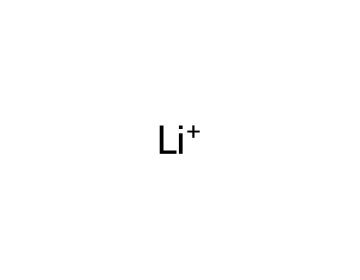
IDENTITY
COMPUTED
PROPERTIES
Violent reaction
1336
180.5
190 °C
Solid
PHARMACOLOGY
Although lithium has been used for over 50 years in treatment of bipolar disorder, the mechanism of action is still unknown. Lithium's therapeutic action may be due to a number of effects, ranging from inhibition of enzymes such as glycogen synthase kinase 3, inositol phosphatases, or modulation of glutamate receptors.
The precise mechanism of action of Li+ as a mood-stabilizing agent is currently unknown. It is possible that Li+ produces its effects by interacting with the transport of monovalent or divalent cations in neurons. An increasing number of scientists have come to the conclusion that the excitatory neurotransmitter glutamate is the key factor in understanding how lithium works. Lithium has been shown to change the inward and outward currents of glutamate receptors (especially GluR3), without a shift in reversal potential. Lithium has been found to exert a dual effect on glutamate receptors, acting to keep the amount of glutamate active between cells at a stable, healthy level, neither too much nor too little. It is postulated that too much glutamate in the space between neurons causes mania, and too little, depression. Another mechanism by which lithium might help to regulate mood include the non-competitive inhibition of an enzyme called inositol monophosphatase. Alternately lithium's action may be enhanced through the deactivation of the GSK-3B enzyme. The regulation of GSK-3B by lithium may affect the circadian clock. GSK-3 is known for phosphorylating and thus inactivating glycogen synthase. GSK-3B has also been implicated in the control of cellular response to damaged DNA. GSK-3 normally phosphorylates beta catenin, which leads to beta catenin degratation. When GSK-3 is inhibited, beta catenin increases and transgenic mice with overexpression of beta catenin express similar behaviour to mice treated with lithium. These results suggest that increase of beta catenin may be a possible pathway for the therapeutic action of lithium.
8H8Z5UER66
LITHIUM CATION
Established Pharmacologic Class [EPC] - Mood Stabilizer
Lithium cation is a Mood Stabilizer.
ALIASES
REACTIONS
Training data from https://doi.org/10.1039/C8SC04228D (2/10) · 10.1039/C8SC04228D
查看
Training data from https://doi.org/10.1039/C8SC04228D (2/10) · 10.1039/C8SC04228D
查看
Training data from https://doi.org/10.1039/C8SC04228D (2/10) · 10.1039/C8SC04228D
查看
Training data from https://doi.org/10.1039/C8SC04228D (2/10) · 10.1039/C8SC04228D
查看
Training data from https://doi.org/10.1039/C8SC04228D (2/10) · 10.1039/C8SC04228D
查看
Training data from https://doi.org/10.1039/C8SC04228D (2/10) · 10.1039/C8SC04228D
查看
Training data from https://doi.org/10.1039/C8SC04228D (2/10) · 10.1039/C8SC04228D
查看
Training data from https://doi.org/10.1039/C8SC04228D (2/10) · 10.1039/C8SC04228D
查看