HomeMCPWorkbenchSkills
HomeWorkbenchNotificationsMe
llms.txt · MCP GuidePrivacy Policy · Terms of Service · Supportv1.8.3
  1. Home
  2. /Compound

Buspirone Hydrochloride

HCID 36431
New reaction
Print
Basic informationOverviewNames & identifiersPropertiesSafety & regulationChemistry & industryRelated reactionsCompound notes
Substructure searchFind similar structures

Basic information

CAS
33386-08-2
Standard SMILES
Cl.O=C1CC2(CCCC2)CC(=O)N1CCCCN1CCN(c2ncccn2)CC1
InChIKey
RICLFGYGYQXUFH-UHFFFAOYSA-N
Molecular formula
C21H32ClN5O2
Average molar mass
422 g/mol
Monoisotopic mass
421.224453

Overview

Buspirone hydrochloride is a hydrochloride salt resulting from the reaction of equimolar amounts of buspirone and hydrogen chloride. It has a role as an anxiolytic drug, a sedative, a serotonergic agonist and an EC 3.4.21.26 (prolyl oligopeptidase) inhibitor. It contains a buspirone(1+).

Names & identifiers

Preferred name
Buspirone Hydrochloride
IUPAC
8-[4-(4-pyrimidin-2-ylpiperazin-1-yl)butyl]-8-azaspiro[4.5]decane-7,9-dione;hydrochloride
English name
Buspirone hydrochloride
Molecular formula
C21H32ClN5O2
Molecular weight
421.96

Names & synonyms

Buspirone hydrochloride33386-08-2Buspirone HCLSpamilanMJ 9022-1NSC-751138NSC-759571207LT9J9OCAPD405MJ-9022-1APD-405Hydrochloride, Buspirone
Show more names
NarolbesparaxorentravinAnsialcensparlucelanAnsicedbuspinol
N-(4-(4-(2-Pyrimidinyl)-1-piperazinyl)butyl)-1,1-cyclopentanediacetamide monohydrochlorideCHEBI:3224DTXSID10371938-[4-(4-pyrimidin-2-ylpiperazin-1-yl)butyl]-8-azaspiro[4.5]decane-7,9-dione hydrochloride8-Azaspiro[4.5]decane-7,9-dione, 8-[4-[4-(2-pyrimidinyl)-1-piperazinyl]butyl]-, monohydrochloride8-(4-(4-pyrimidin-2-ylpiperazin-1-yl)butyl)-8-azaspiro(4.5)decane-7,9-dione hydrochlorideN-[4-[4-(2-Pyrimidinyl)-1-piperazinyl]butyl]-1,1-cyclopentanediacetamide monohydrochloride8-Azaspiro(4.5)decane-7,9-dione, 8-(4-(4-(2-pyrimidinyl)-1-piperazinyl)butyl)-, monohydrochloride

Database identifiers

CAS
33386-08-2
PubChem CID
36431
DTXSID
DTXSID1037193
ChEMBL
CHEMBL1200399

Properties

Computed structural properties

Topological polar surface area
69.6 Ų
Hydrogen bond donors
1
Hydrogen bond acceptors
6
Rotatable bonds
6
Heavy atoms
29
Formal charge
0
Complexity
529

Experimental & physicochemical properties

Human Drugs · 2 items

FDA approved drugs -> Active ingredient

FDA approved drugs -> Active ingredient

Collision Cross Section197.7 Ų [M+H]+ [CCS Type: TW; Method: calibrated with polyalanine and drug standards]

Physicochemical properties

Melting point
201.5 · 201.5-202.50C
Flash point
9 ℃ · 9℃
storage temp.
2 · 2-8°C
solubility
Freely soluble in water and in methanol, practically insoluble in acetone.
form
Solid
color
White to off-white
Water Solubility
Soluble in methanol (50 mg/ml), water (partly), DMSO (100 mM).
Major Application
pharmaceutical
InChI
InChI=1S/C21H31N5O2.ClH/c27-18-16-21(6-1-2-7-21)17-19(28)26(18)11-4-3-10-24-12-14-25(15-13-24)20-22-8-5-9-23-20;/h5,8-9H,1-4,6-7,10-17H2;1H

Safety & regulation

Safety information is for reference only and does not replace the supplier’s Safety Data Sheet (SDS), applicable regulations, or professional assessment.

GHS classification

GHS Classification · 4 items

Danger

H301 (100%): Toxic if swallowed [Danger Acute toxicity, oral]

P264, P270, P301+P316, P321, P330, P405, and P501 (click each P-code to see the statement)

Aggregated GHS information provided per 47 reports by companies from 4 notifications to the ECHA C&L Inventory.

Hazard information

Regulatory InformationBuspirone hydrochloride: Does not have an individual approval but may be used under an appropriate group standard
Hazard Classes and CategoriesAcute Tox. 3 (100%)

Toxicology

Treatment · 1 item

General symptomatic and supportive measures should be used along with immediate gastric lavage. Respiration, pulse, and blood pressure should be monitored as in all cases of drug overdosage. No specific antidote is known to buspirone, and dialyzability of buspirone has not been determined. (L1712)

Exposure RoutesOral. Rapidly absorbed in man. Bioavailability is low and variable (approximately 5%) due to extensive first pass metabolism.
Toxicity Summary · 1 item

Buspirone binds to 5-HT type 1A serotonin receptors on presynaptic neurons in the dorsal raphe and on postsynaptic neurons in the hippocampus, thus inhibiting the firing rate of 5-HT-containing neurons in the dorsal raphe. Buspirone also binds at dopamine type 2 (DA2) receptors, blocking presynaptic dopamine receptors. Buspirone increases firing in the locus ceruleus, an area of brain where norepinephrine cell bodies are found in high concentration. The net result of buspirone actions is that serotonergic activity is suppressed while noradrenergic and dopaminergic cell firing is enhanced.

Chemistry & industry

Pharmacology

Metabolism/Metabolites · 1 item

Metabolized hepatically, primarily by oxidation by cytochrome P450 3A4 producing several hydroxylated derivatives and a pharmacologically active metabolite, 1-pyrimidinylpiperazine (1-PP) Route of Elimination: In a single-dose study using 14C-labeled buspirone, 29% to 63% of the dose was excreted in the urine within 24 hours, primarily as metabolites; fecal excretion accounted for 18% to 38% of the dose. Half Life: 2-3 hours (although the action of a single dose is much longer than the short halflife indicates).

MeSH Pharmacological Classification · 2 items

Agents that alleviate ANXIETY, tension, and ANXIETY DISORDERS, promote sedation, and have a calming effect without affecting clarity of consciousness or neurologic conditions. ADRENERGIC BETA-ANTAGONISTS are commonly used in the symptomatic treatment of anxiety but are not included here.

Endogenous compounds and drugs that bind to and activate SEROTONIN RECEPTORS. Many serotonin receptor agonists are used as ANTIDEPRESSANTS; ANXIOLYTICS; and in the treatment of MIGRAINE DISORDERS.

Uses & manufacturing

UsesFor the management of anxiety disorders or the short-term relief of the symptoms of anxiety, and also as an augmention of SSRI-treatment against depression.
Applications · 5 items

DescriptionBuspirone hydrochloride is an anxiolytic agent indicated for the management of anxiety disorders with or without accompanying depression. In contrast to the benzodiazepines, buspirone does not interact with alcohol, and lacks sedative, anticonvulsant, and muscle relaxant effects, and abuse potential.

UsesNon-benzodiazepine anxiolitic; 5-hydroxytryptamine (5-HT1) receptor agonist.

Usesanxiolitic;serotonin receptor agonist

Related reactions

8 records
New reaction record
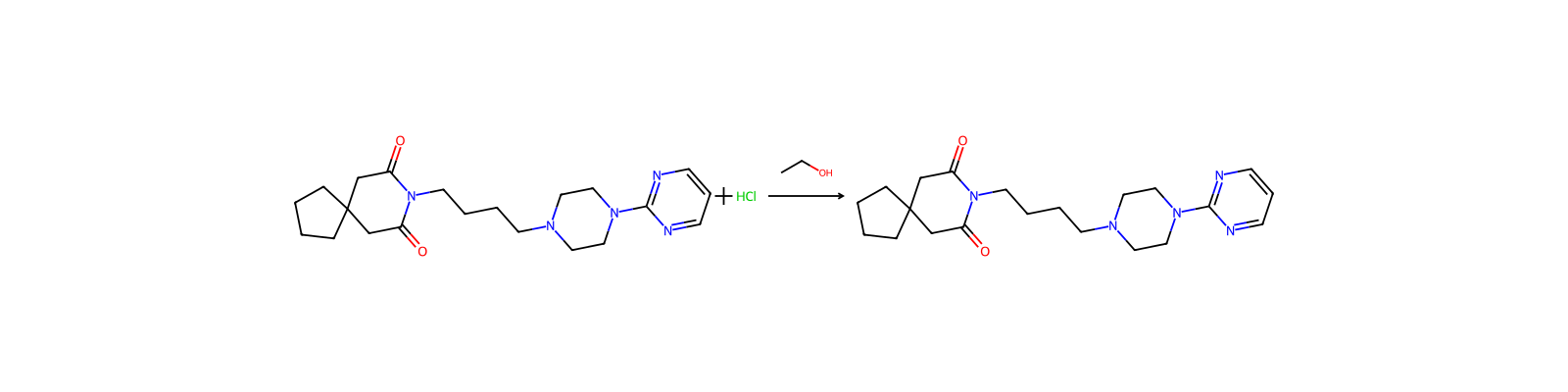
HRID 1402639 reaction equation
HRID 1402639As reactant
HRID 1783273 reaction equation
HRID 1783273As reactant
HRID 2259410 reaction equation
HRID 2259410As product
HRID 2259411 reaction equation
HRID 2259411As product
HRID 2259414 reaction equation
HRID 2259414As product
HRID 2259415 reaction equation
HRID 2259415As product
HRID 2259416 reaction equation
HRID 2259416As product
HRID 2259417 reaction equation
HRID 2259417As product

Compound notes

On this pageBasic informationOverviewNames & identifiersPropertiesSafety & regulationChemistry & industryRelated reactionsCompound notes
ChEBI
CHEBI:3224
UNII
207LT9J9OC
EC Number
251-489-4
InChIKey
RICLFGYGYQXUFH-UHFFFAOYSA-N
SMILES
C12(CCCC1)CC(N(CCCCN1CCN(C3=NC=CC=N3)CC1)C(=O)C2)=O.Cl
CAS DataBase Reference
33386 · 33386-08-2(CAS DataBase Reference)
FDA UNII
207 LT9J9OC · 207LT9J9OC
NCI Drug Dictionary
buspirone hydrochloride
UNSPSC Code
41116107 · 41116107
NACRES
77 · NA.77
Protein binding
95 % · 95%
Volume of distribution
2.69 · 2.69-7.91(L/kg)
Biological half-life
2 · 2-11 / 4-131
Symbol(GHS)
6 · GHS06
Signal word
Danger
Hazard statements
301 · H301
Precautionary statements
264 · P264-P270-P301+P310-P405-P501
Hazard Codes
T,Xn,F
Risk Statements
25 · 25-36/37/38-20/21/22-39/23/24/25-23/24/25-11
Safety Statements
45 · 45-36-26-36/37-16
RIDADR
2811 · UN 2811 6.1/PG 3
WGK Germany
3 · 3
RTECS
9915000 · CL9915000
HazardClass
6.1 · 6.1
HS Code
29335995 · 29335995
Storage Class
6.1 C · 6.1C - Combustible acute toxic Cat.3toxic compounds or compounds which causing chronic effects
Hazard Classifications
3 Oral · Acute Tox. 3 Oral
Toxicity
50 i.p · LD50 i.p. in rats: 136 mg/kg (Allen)
Signs and SymptomsSymptoms of overdose include dizziness, drowsiness, nausea or vomiting, severe stomach upset, and unusually small pupils.
Carcinogen ClassificationNo indication of carcinogenicity to humans (not listed by IARC).
Drug Induced Liver Injury · 6 items

Drug Induced Liver Injury Rank (DILIrank 2.0)

Buspirone hydrochloride

Ambiguous-DILI-concern

3

Adverse reactions

DOI:10.1016/j.drudis.2016.02.015

Toxicity DataLD50: 136 mg/kg (Oral, rat)

Safety data

wgk
3
rtecs
CL9915000
ridadr
UN 2811 6.1/PG 3
hs_code
29335995
Toxicity
LD50 i.p. in rats: 136 mg/kg (Allen)
risk_code
25-36/37/38-20/21/22-39/23/24/25-23/24/25-11
Signal word
Danger
Symbol(GHS)
GHS06
hazard_code
T,Xn,F
safety_code
45-36-26-36/37-16
hazard_class
6.1
Storage Class
6.1C - Combustible acute toxic Cat.3toxic compounds or compounds which causing chronic effects
Hazard statements
H301
Hazard Classifications
Acute Tox. 3 Oral
Precautionary statements
P264-P270-P301+P310-P405-P501

UsesNon-benzodiazepine anxiolytic; 5-hydroxytryptamine (5-HT1) receptor agonist.

General DescriptionPharmaceutical secondary standards for application in quality control provide pharma laboratories and manufacturers with a convenient and cost-effective alternative to the preparation of in-house working standards

Upstream & downstream products

Upstream raw materials

3,3-TetramethyleneglutarimideN,N-DimethylformamidePiperazine2-ChloropyrimidineHydrochloric acid1,4-DibromobutaneDichloromethaneMethanolSodium hydroxideIsopropyl alcoholSodium carbonateHydrazine hydrateCyclohexane3-Chloropropiononitrile2-(1-Piperazinyl)pyrimidineAluminium-nickel

Additional notes

DefinitionChEBI: A hydrochloride salt resulting from the reaction of equimolar amounts of buspirone and hydrogen chloride.