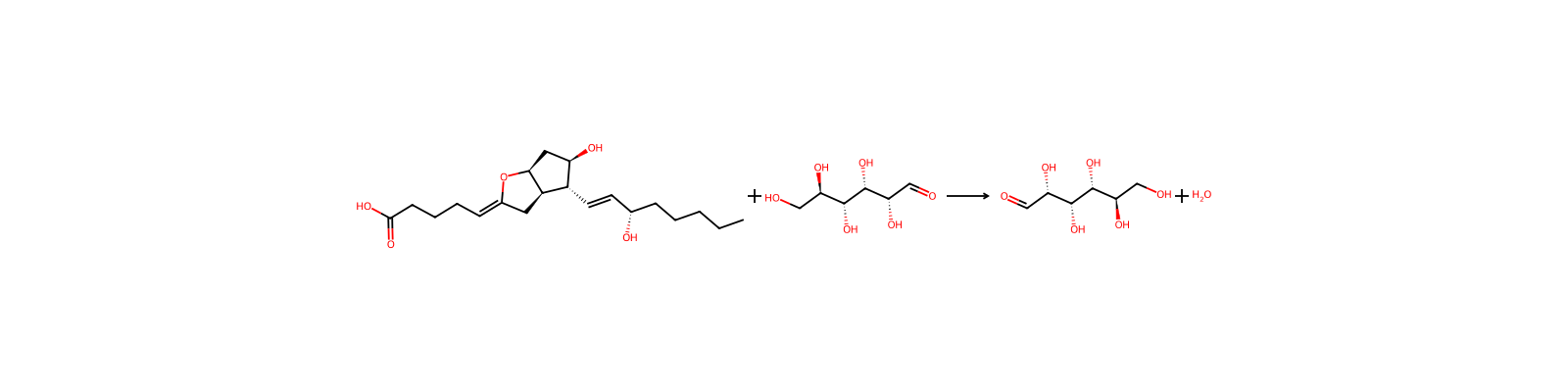
HRID 483261As reactant
Completing data — refresh the page later to see the latest
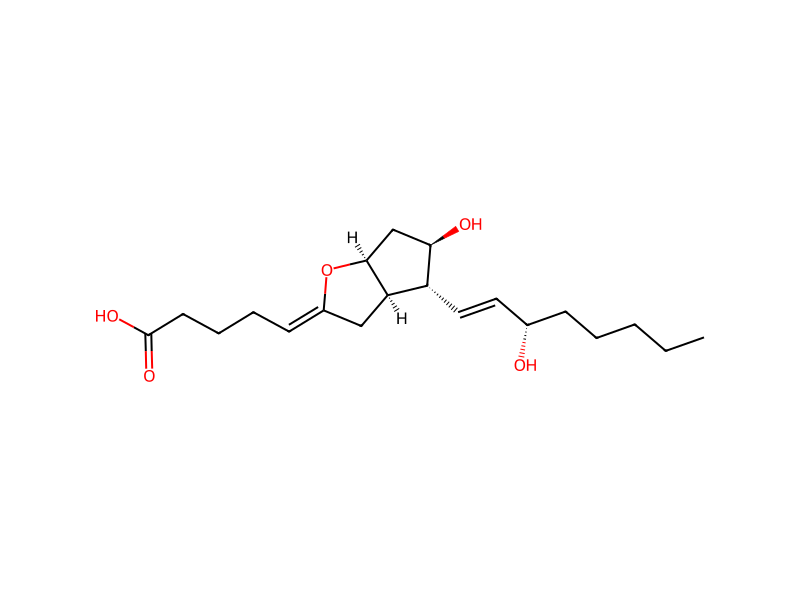
35121-78-9CCCCC[C@H](O)/C=C/[C@@H]1[C@H]2C/C(=C/CCCC(=O)O)O[C@H]2C[C@H]1OKAQKFAOMNZTLHT-OZUDYXHBSA-NProstaglandin I2 is a prostaglandins I. It has a role as a mouse metabolite. It is a conjugate acid of a prostaglandin I2(1-).
35121-78-9DTXSID5022988198.6 Ų [M+H]+ [CCS Type: DT; Method: single field calibrated with Agilent tune mix (Agilent)]
201.3 Ų [M+H]+ [CCS Type: DT; Method: stepped-field]
199.8 Ų [M+H]+
Safety information is for reference only and does not replace the supplier’s Safety Data Sheet (SDS), applicable regulations, or professional assessment.
B01AC09
B - Blood and blood forming organs
QB - Blood and blood forming organs
Epoprostenol has two major pharmacological actions: (1) direct vasodilation of pulmonary and systemic arterial vascular beds, and (2) inhibition of platelet aggregation. In animals, the vasodilatory effects reduce right and left ventricular afterload and increase cardiac output and stroke volume. The effect of epoprostenol on heart rate in animals varies with dose. At low doses, there is vagally mediated brudycardia, but at higher doses, epoprostenol causes reflex tachycardia in response to direct vasodilation and hypotension. No major effects on cardiac conduction have been observed. Additional pharmacologic effects of epoprostenol in animals include bronchodilation, inhibition of gastric acid secretion, and decreased gastric emptying. No available chemical assay is sufficiently sensitive and specific to assess the in vivo human pharmacokinetics of epoprostenol.
Prostaglandins are present in most body tissues and fluids and mediate many biological functions. Epoprostenol (PGI2) is a member of the family of prostaglandins that is derived from arachidonic acid. The major pharmacological actions of epoprostenol is ultimately inhibition of platelet aggregation. Prostacycline (PGI2) from endothelial cells activate G protein-coupled receptors on platelets and endothelial cells. This activation causes adenylate cyclase to produce cyclic AMP which inhibits further platelet activation and activates protein kinase A. Cyclic AMP also prevents coagulation by preventing an increase in intracellular calcium from thromboxane A2 binding. PKA then continues the cascade by phosphorylating and inhibiting myosin light-chain kinase which leads to smooth muscle relaxation and vasodilation. Notably, PGI2 and TXA2 work as physiological antagonists.
CHEMBL1139CHEBI:15552Epoprostenol is metabolized to 2 primary metabolites: 6-keto-PGF1α (formed by spontaneous degradation) and 6,15-diketo-13,14-dihydro-PGF1α (enzymatically formed), both of which have pharmacological activity orders of magnitude less than epoprostenol in animal test systems. Fourteen additional minor metabolites have been isolated from urine, indicating that epoprostenol is extensively metabolized in humans.
DCR9Z582X0
EPOPROSTENOL
Established Pharmacologic Class [EPC] - Prostacycline Vasodilator
Chemical Structure [CS] - Prostaglandins I
Physiologic Effects [PE] - Vasodilation
Epoprostenol is a Prostacycline Vasodilator. The physiologic effect of epoprostenol is by means of Vasodilation.
Drugs used in the treatment of acute or chronic vascular HYPERTENSION regardless of pharmacological mechanism. Among the antihypertensive agents are DIURETICS; (especially DIURETICS, THIAZIDE); ADRENERGIC BETA-ANTAGONISTS; ADRENERGIC ALPHA-ANTAGONISTS; ANGIOTENSIN-CONVERTING ENZYME INHIBITORS; CALCIUM CHANNEL BLOCKERS; GANGLIONIC BLOCKERS; and VASODILATOR AGENTS.
Drugs or agents which antagonize or impair any mechanism leading to blood platelet aggregation, whether during the phases of activation and shape change or following the dense-granule release reaction and stimulation of the prostaglandin-thromboxane system.
Epoprostenol is metabolized to 2 primary metabolites: 6-keto-PGF1α (formed by spontaneous degradation) and 6,15-diketo-13,14-dihydro-PGF1α (enzymatically formed), both of which have pharmacological activity orders of magnitude less than epoprostenol in animal test systems. Fourteen additional minor metabolites have been isolated from urine, indicating that epoprostenol is extensively metabolized in humans.
357 mL/kg
UsesInhibitor (platelet). [Names previously used: Prostacyclin, PGI2, Prostagland in I2, Prostaglandin X, PGX].
DefinitionChEBI: Prostaglandin I2 is a prostaglandins I. It has a role as a mouse metabolite. It is a conjugate acid of a prostaglandin I2(1-).