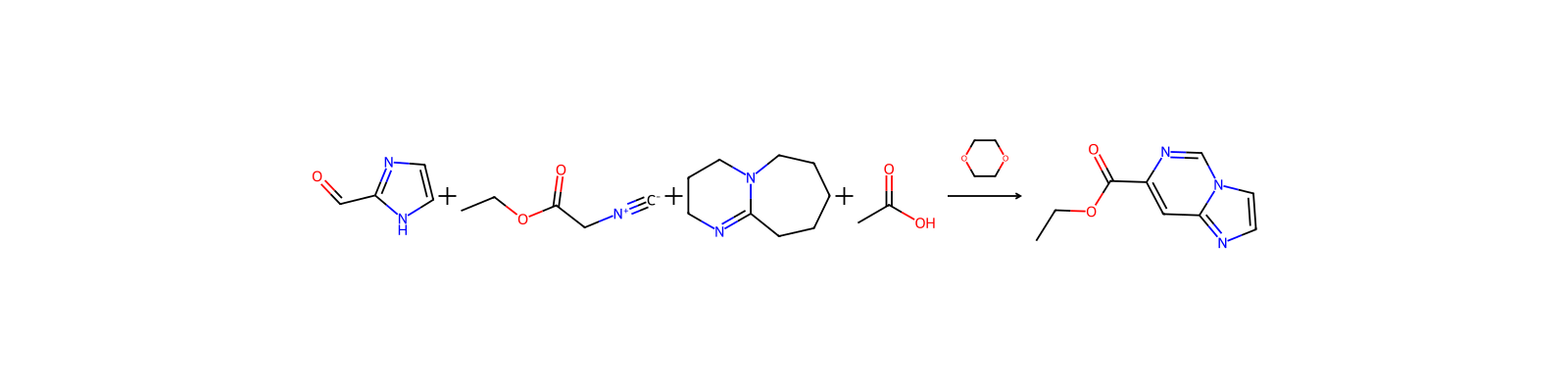
HRID 10154As reactant

2999-46-4[C-]#[N+]CC(=O)OCCFPULFENIJDPZBX-UHFFFAOYSA-N2999-46-4DTXSID20184078Safety information is for reference only and does not replace the supplier’s Safety Data Sheet (SDS), applicable regulations, or professional assessment.
This chemical does not meet GHS hazard criteria for 1.8% (1 of 55) of reports.
Danger
H302 (89.1%): Harmful if swallowed [Warning Acute toxicity, oral]
P261, P262, P264, P264+P265, P270, P271, P280, P301+P317, P302+P352, P304+P340, P305+P351+P338, P316, P317, P319, P321, P330, P332+P317, P337+P317, P361+P364, P362+P364, P403+P233, P405, and P501 (click each P-code to see the statement)
Aggregated GHS information provided per 55 reports by companies from 11 notifications to the ECHA C&L Inventory. Each notification may be associated with multiple companies.
UsesEthyl Isocyanoacetate, is a cyclization synthon used to prepare pyrroles, oxazolines, benzodiazepines, oxazoles and imidazoles. Ethyl isocyanoacetate can be used to prepare pyrroles,1,2 oxazolines, benzodiazepines, oxazoles and imidazoles.
UsesEthyl isocyanoacetate is used in the syntheses of 7-aza-tetrahydroindoles, oxazolines, benzodiazepines, imidazoles and oxazoles. For example, it is involved in the synthesis of 1H-indole-2-carboxylate by condensing with 2-bromo benzenealdehyde using CuI as a catalyst. It is a precursor used in the preparation of ethyl thiazole-4-carboxylate upon reaction with O-ethyl thioformate.
General DescriptionMaterial may darken upon storage
Preparationsynthesis of ethyl isocyanoacetate A solution containing N-formyl glycine ethyl ester (1, 1.31 g, 10 mmol), DIPEA (2.62 g, 20 mmol) and DMAP (0.45 g, 3 mmol) in dry DCM (10 mL) was loaded in a sample loop and combined with a second stream containing triphosgene (2, 0.98 g, 3.3 mmol) also dissolved in dry DCM (10 mL) at individual channel flow rates of 0.5 mL/min. The combined stream was directed into two linked 10 mL FEP reactor vessels to achieve a 20 minutes residence time at ambient temperature. The output was collect and the solvent was carefully evaporated to 80% of its total volume. The crude material was filtered through silica (5 g) and washed with DCM (2 × 10 mL) to obtain the salt-free product. The desired product 3 was obtained as dark yellow oil after evaporation of the organic phase (1.03 g, 91 % isolated yield, >97% purity by 1H NMR).