
uspto-grants-2013_02 · 10.6084/m9.figshare.5104873.v1 · US08383632B2
查看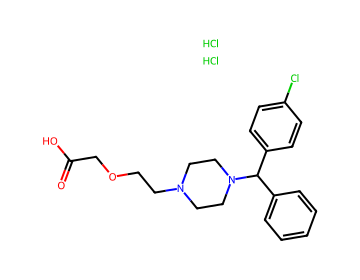
IDENTITY
COMPUTED
PROPERTIES
198.3 Ų [M+H]+ [CCS Type: TW; Method: calibrated with polyalanine and drug standards]
GHS
Danger
H302 (99.4%): Harmful if swallowed [Warning Acute toxicity, oral];H317 (39.8%): May cause an allergic skin reaction [Warning Sensitization, Skin];H360 (39.8%): May damage fertility or the unborn child [Danger Reproductive toxicity]
P203, P261, P264, P270, P272, P280, P301+P317, P302+P352, P318, P321, P330, P333+P317, P362+P364, P405, and P501 (click each P-code to see the statement)
Aggregated GHS information provided per 161 reports by companies from 13 notifications to the ECHA C&L Inventory. Each notification may be associated with multiple companies.;Information may vary between notifications depending on impurities, additives, and other factors. The percentage value in parenthesis indicates the notified classification ratio from companies that provide hazard codes. Only hazard codes with percentage values above 10% are shown. For more detailed information, please visit ECHA C&L website.
HAZARDS
Acute Tox. 4 (99.4%);Skin Sens. 1B (39.8%);Repr. 1B (39.8%)
TOXICITY
Should overdose occur, treatment should be symptomatic or supportive, taking into account any concomitantly ingested medications. There is no known specific antidote to Cetirizine. (L1712)
Overdosage has been reported with ZYRTEC (cetirizine) . In one adult patient who took 150 mg of ZYRTEC (cetirizine) , the patient was somnolent but did not display any other clinical signs or abnormal blood chemistry or hematology results. In an 18 month old pediatric patient who took an overdose of ZYRTEC (cetirizine) (approximately 180 mg), restlessness and irritability were observed initially; this was followed by drowsiness. (L1712)
Oral; mean peak plasma concentration (Cmax) of 114 ng/mL at a time (Tmax) of 2.2 hours postdose was observed for cetirizine.
Cetirizine competes with histamine for binding at H<sub>1</sub>-receptor sites on the effector cell surface, resulting in suppression of histaminic edema, flare, and pruritus. The low incidence of sedation can be attributed to reduced penetration of cetirizine into the CNS as a result of the less lipophilic carboxyl group on the ethylamine side chain.
Somnolence (sleepiness or unusual drowsiness), restlessness, irritability.
No indication of carcinogenicity to humans (not listed by IARC).
Drug Induced Liver Injury Rank (DILIrank 2.0)
Cetirizine hydrochloride
vLess-DILI-concern
3
Adverse reactions
DOI:10.1016/j.drudis.2016.02.015
◉ Summary of Use during Lactation;Small occasional doses of cetirizine are acceptable during breastfeeding. Larger doses or more prolonged use may cause drowsiness and other effects in the infant or decrease the milk supply, particularly in combination with a sympathomimetic such as pseudoephedrine or before lactation is well established. International guidelines recommend cetirizine as an acceptable choice if an antihistamine is required during breastfeeding. Cetirizine has been used successfully in cases of persistent pain of the breast during breastfeeding.;Ophthalmic use of cetirizine by the mother should pose little risk to the breastfed infant. To substantially diminish the amount of drug that reaches the breastmilk after using eye drops, place pressure over the tear duct by the corner of the eye for 1 minute or more, then remove the excess solution with an absorbent tissue.;◉ Effects in Breastfed Infants;In one telephone follow-up study, mothers reported irritability and colicky symptoms 10% of infants exposed to various antihistamines and drowsiness was reported in 1.6% of infants. None of the reactions required medical attention.;A woman who was nursing (extent not stated) her newborn infant was treated for pemphigus with oral prednisolone 25 mg daily, with the dosage increased over 2 weeks to 60 mg daily. She was also taking cetirizine 10 mg daily and topical betamethasone 0.1% twice daily to the lesions. Because of a poor response, the betamethasone was changed to clobetasol propionate ointment 0.05%. She continued breastfeeding throughout treatment and her infant was developing normally at 8 weeks of age and beyond.;A woman with narcolepsy took sodium oxybate 4 grams each night at 10 pm and 2 am as well as fluoxetine 20 mg and cetirizine 5 mg daily throughout pregnancy and postpartum. She breastfed her infant except for 4 hours after the 10 pm oxybate dose and 4 hours after the 2 am dose. She either pumped breastmilk or breastfed her infant just before each dose of oxybate. The infant was exclusively breastfed or breastmilk fed for 6 months when solids were introduced. The infant was evaluated at 2, 4 and 6 months with the Ages and Stages Questionnaires, which were withing the normal range as were the infant's growth and pediatrician's clinical impressions regarding the infant's growth and development.;Three women taking long-term cetirizine 10 mg daily by mouth while exclusively breastfeeding their 5- to 6-month old infants. The mothers reported no adverse effects in their infants.;Thirty-one women taking cetirizine 10 mg (n = 29) or 20 mg (n = 2) daily reported no adverse effects in 61% of their infants and minor adverse effects fever, sedation, rash, poor feeding, bruising, refusing of the breast or constipation. But mothers attributed these effects to other causes such a cold, weaning or learning to crawl.;◉ Effects on Lactation and Breastmilk;Antihistamines in relatively high doses given by injection can decrease basal serum prolactin in nonlactating women and in early postpartum women. However, suckling-induced prolactin secretion is not affected by antihistamine pretreatment of postpartum mothers. Whether lower oral doses of cetirizine have the same effect on serum prolactin or whether the effects on prolactin have any consequences on breastfeeding success have not been studied. The prolactin level in a mother with established lactation may not affect her ability to breastfeed.;In a study of 31 women taking cetirizine 10 mg (n = 29) or 20 mg (n = 2) daily, 10 reported a perceived decrease in milk supply over the prior 3 days.
PHARMACOLOGY
Half Life: 8.3 hours
ALLERGY RELIEF
Increased Histamine Release [PE]; Cell-mediated Immunity [PE]; Histamine-1 Receptor Antagonist [EPC]; Histamine H1 Receptor Antagonists [MoA]; Allergens [CS]
CETIRIZINE HCL
Histamine H1 Receptor Antagonists [MoA]; Histamine-1 Receptor Antagonist [EPC]
CETIRIZINE HCL 10 MG
Histamine-1 Receptor Antagonist [EPC]; Histamine H1 Receptor Antagonists [MoA]
Agents that are used to treat allergic reactions. Most of these drugs act by preventing the release of inflammatory mediators or inhibiting the actions of released mediators on their target cells. (From AMA Drug Evaluations Annual, 1994, p475)
A class of non-sedating drugs that bind to but do not activate histamine receptors (DRUG INVERSE AGONISM), thereby blocking the actions of histamine or histamine agonists. These antihistamines represent a heterogenous group of compounds with differing chemical structures, adverse effects, distribution, and metabolism. Compared to the early (first generation) antihistamines, these non-sedating antihistamines have greater receptor specificity, lower penetration of BLOOD-BRAIN BARRIER, and are less likely to cause drowsiness or psychomotor impairment.
USES
For the relief of symptoms associated with seasonal allergic rhinitis, perennial allergic rhinitis and the treatment of the uncomplicated skin manifestations of chronic idiopathic urticaria
ALIASES
REACTIONS
uspto-grants-2013_02 · 10.6084/m9.figshare.5104873.v1 · US08383632B2
查看
uspto-grants-2013_02 · 10.6084/m9.figshare.5104873.v1 · US08383632B2
查看
uspto-grants-2013_02 · 10.6084/m9.figshare.5104873.v1 · US08383632B2
查看
uspto-grants-2005_06 · 10.6084/m9.figshare.5104873.v1 · US06908999B2
查看
uspto-grants-2005_06 · 10.6084/m9.figshare.5104873.v1 · US06908999B2
查看
uspto-grants-2005_06 · 10.6084/m9.figshare.5104873.v1 · US06908999B2
查看
uspto-grants-2005_06 · 10.6084/m9.figshare.5104873.v1 · US06908999B2
查看
uspto-grants-2005_06 · 10.6084/m9.figshare.5104873.v1 · US06908999B2
查看