HomeMCPWorkbenchSkills
HomeWorkbenchNotificationsMe
llms.txt · MCP GuidePrivacy Policy · Terms of Service · Supportv1.8.3
  1. Home
  2. /Compound

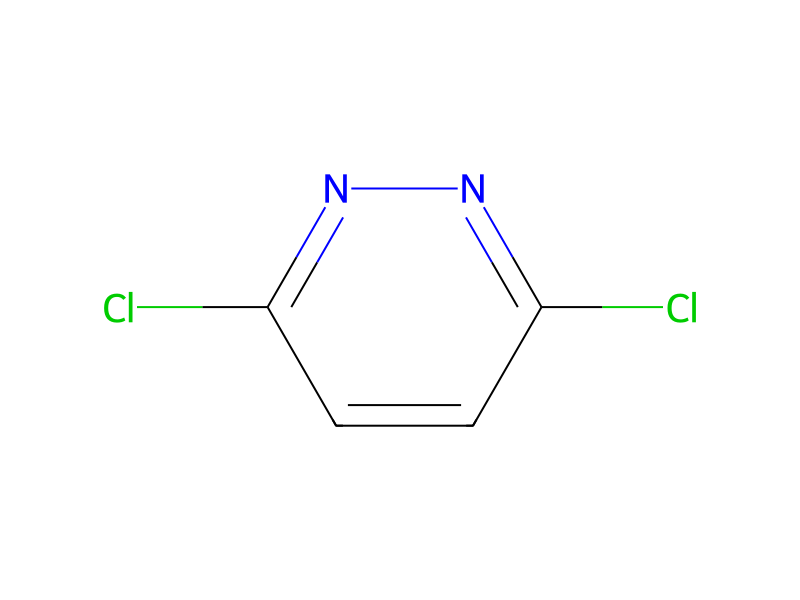
3,6-Dichloropyridazine

HCID 67331
New reaction
Print
Basic informationNames & identifiersPropertiesSafety & regulationChemistry & industryRelated reactionsCompound notes
Substructure searchFind similar structures

Basic information

CAS
141-30-0
Standard SMILES
Clc1ccc(Cl)nn1
InChIKey
GUSWJGOYDXFJSI-UHFFFAOYSA-N
Molecular formula
C4H2Cl2N2
Average molar mass
148.98 g/mol
Monoisotopic mass
147.9595035

Names & identifiers

Preferred name
3,6-Dichloropyridazine
IUPAC
3,6-dichloropyridazine
English name
3,6-Dichloropyridazine
Molecular formula
C4H2Cl2N2
Molecular weight
148.98

Names & synonyms

3,6-DichloropyridazinePyridazine, 3,6-dichloro-EINECS 205-478-6NSC 54498DTXSID4059704RefChem:91740Pyridazine, 3,6dichloroDTXCID0034568205-478-6GUSWJGOYDXFJSI-UHFFFAOYSA-NInChI=1/C4H2Cl2N2/c5-3-1-2-4(6)8-7-3/h1-2141-30-0
Show more names
3,6-dichlorpyridazine3,6-DichLAURORA KA-6560IFLAB-BB F1918-00766-Dichloropyridazine3,6-Dichloropyridazi3,6-Dichloro Pyridine3,6-dichloro-pyridazinLABOTEST-BB LT01148255
3,6-Dichloro-pyridazineResmetirom Impurity 1MFCD000064663,6-dichloropyridazinPyridazine,6-dichloro-ZINC1685243NSC-544983,6-dichloro pyridazine

Database identifiers

CAS
141-30-0
PubChem CID
67331
DTXSID
DTXSID4059704
UNII
TJY3UR6EDV
EC Number
205-478-6
Nikkaji
J52.353D

Properties

Computed structural properties

XLogP
1.7
Topological polar surface area
25.8 Ų
Hydrogen bond donors
0
Hydrogen bond acceptors
2
Rotatable bonds
0
Heavy atoms
8
Formal charge
0
Complexity
68.4

Experimental & physicochemical properties

Chemical ClassesNitrogen Compounds -> Other Aromatics (Nitrogen)
SpringerMaterials PropertiesSchoenflies notation
LogP0.93
Physical DescriptionSolid; [Sigma-Aldrich MSDS]

Physicochemical properties

Melting point
65 · 65-69 °C (lit.)
Boiling point
244.21 °C · 244.21°C (rough estimate)
Density
1.6445 · 1.6445 (rough estimate)
refractive index
1.63 · 1.6300 (estimate)
storage temp.
Keep in dark place,Sealed in dry,Room Temperature
solubility
0.0012 g/l · 0.0012g/l
pka
-1.18 · -1.18±0.10(Predicted)
form
Crystalline Powder

Safety & regulation

Safety information is for reference only and does not replace the supplier’s Safety Data Sheet (SDS), applicable regulations, or professional assessment.

GHS classification

GHS Classification · 6 items

Danger

H301 (81%): Toxic if swallowed [Danger Acute toxicity, oral]

P261, P264, P264+P265, P270, P271, P280, P301+P316, P302+P352, P304+P340, P305+P351+P338, P319, P321, P330, P332+P317, P337+P317, P362+P364, P403+P233, P405, and P501 (click each P-code to see the statement)

Aggregated GHS information provided per 58 reports by companies from 12 notifications to the ECHA C&L Inventory. Each notification may be associated with multiple companies.

Warning

H373: May causes damage to organs through prolonged or repeated exposure [Warning Specific target organ toxicity, repeated exposure]

Hazard information

Regulatory InformationREACH registered substance: 3,6-dichloropyridazine (EC: 205-478-6)
Hazards Summary · 1 item

Causes somnolence, ataxia, and weight loss in inhalation lethal-concentration studies of rats; Causes somnolence and muscle weakness in oral lethal-dose studies of rats; [RTECS] A skin and strong eye irritant; Toxic by ingestion; [Sigma-Aldrich MSDS] See Maleic hydrazide and Pyrazon.

Hazard Classes and Categories · 2 items

Acute Tox. 3 (81%)

Specific target organ toxicity - Repeated exposure - Category 2 (liver, kidney, testis)

Toxicology

Toxicity DataLC50 (rat) > 1,070 mg/m3/4hr

Safety data

PPE
dust mask type N95 (US), Eyeshields, Faceshields, Gloves

Chemistry & industry

Uses & manufacturing

General Manufacturing InformationPyridazine, 3,6-dichloro-: ACTIVE

Applications

Uses3,6-Dichloropyridazine is used as an intermediate in synthetic chemistry, especially in active pharmaceutical ingredients. It is used in the preparation of alfa-(halohetaroyl)-2-azahetarylacetonitriles.

Upstream & downstream products

Upstream raw materials

Hydrazinium hydroxide solutionMaleic anhydrideHydrazine hydrateMaleic hydrazidemaleohydrazide[1(6H),3'-Bipyridazin]-6-one,3,6'-dichloro-3-Trifluoromethylbenzenesulfinic acid sodium saltPyridazine, 3,6-dichloro-, 2-oxide3,6-Pyridazinedione6-Chloropyridazin-3-ol

Downstream products

3-Chloro-6-[(4,6-dimethylpyrimidin-2-yl)thio]pyridazine

Related reactions

447 records
New reaction record
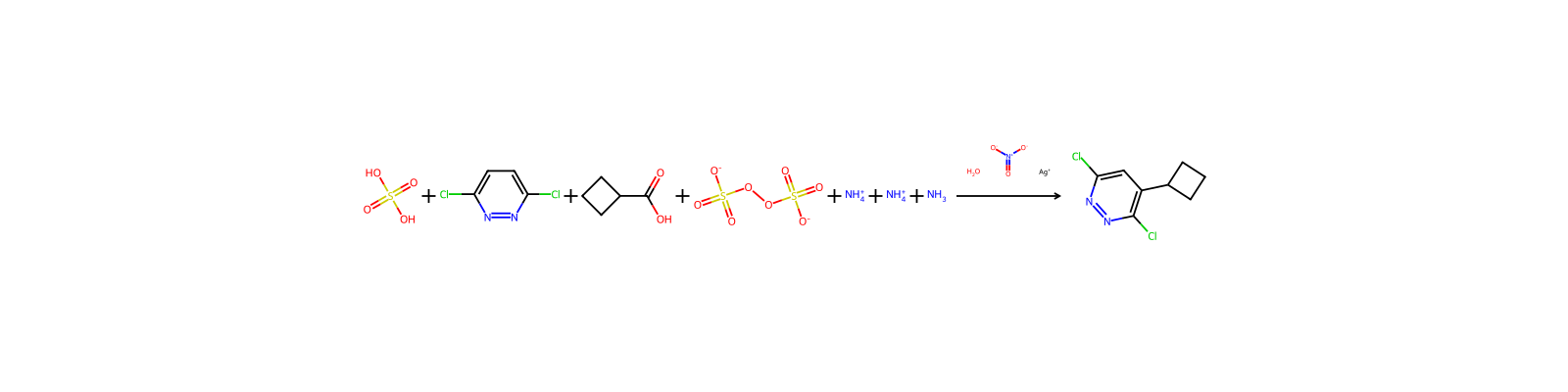
HRID 11225 reaction equation
HRID 11225As reactant
HRID 12443 reaction equation
HRID 12443As reactant
HRID 12964 reaction equation
HRID 12964As reactant
HRID 22760 reaction equation
HRID 22760As reactant
HRID 39304 reaction equation
HRID 39304As reactant
HRID 40383 reaction equation
HRID 40383As reactant
HRID 40385 reaction equation
HRID 40385As reactant
HRID 46205 reaction equation
HRID 46205As reactant
PreviousPage 1 of 56

Compound notes

On this pageBasic informationNames & identifiersPropertiesSafety & regulationChemistry & industryRelated reactionsCompound notes
color
White to almost white
Water Solubility
Soluble in chloroform. Insoluble in water.
BRN
111151 · 111151
InChI
InChI=1S/C4H2Cl2N2/c5-3-1-2-4(6)8-7-3/h1-2H
InChIKey
GUSWJGOYDXFJSI-UHFFFAOYSA-N
SMILES
C1(Cl)=NN=C(Cl)C=C1
CAS DataBase Reference
141 · 141-30-0(CAS DataBase Reference)
NIST Chemistry Reference
3 · Pyridazine, 3,6-dichloro-(141-30-0)
EPA Substance Registry System
3 · Pyridazine, 3,6-dichloro- (141-30-0)
UNSPSC Code
12352101 · 12352101
NACRES
22 · NA.22
Symbol(GHS)
7 · GHS07
Signal word
Warning
Hazard statements
302 · H302
Precautionary statements
264 · P264-P270-P301+P312-P501
PPE
95 · dust mask type N95 (US), Eyeshields, Faceshields, Gloves
Hazard Codes
Xi,T
Risk Statements
36 · 36/37/38-25-20
Safety Statements
26 · 26-37/39-45-22-36/39-36
RIDADR
2811 · 2811
WGK Germany
3 · 3
RTECS
5886250 · UR5886250
Hazard Note
Irritant
TSCA
TSCA listed
HazardClass
6.1 · 6.1
PackingGroup
III
HS Code
2933990099 · 2933990099
Storage Class
11 · 11 - Combustible Solids
Hazard Classifications
4 Oral · Acute Tox. 4 Oral
Toxicity
50 · rat,LC50,inhalation,> 1070mg/m3/4H (1070mg/m3),BEHAVIORAL: SOMNOLENCE (GENERAL DEPRESSED ACTIVITY)BEHAVIORAL: ATAXIA,National Technical Information Service. Vol. OTS0543107,
REACH Registrations
Active
wgk
3
tsca
TSCA listed
rtecs
UR5886250
ridadr
2811
hs_code
2933990099
Toxicity
rat,LC50,inhalation,> 1070mg/m3/4H (1070mg/m3),BEHAVIORAL: SOMNOLENCE (GENERAL DEPRESSED ACTIVITY)BEHAVIORAL: ATAXIA,National Technical Information Service. Vol. OTS0543107,
risk_code
36/37/38-25-20
Signal word
Warning
Symbol(GHS)
GHS07
hazard_code
Xi,T
hazard_note
Irritant
safety_code
26-37/39-45-22-36/39-36
hazard_class
6.1
Storage Class
11 - Combustible Solids
packing_group
III
Hazard statements
H302
REACH Registrations
Active
Hazard Classifications
Acute Tox. 4 Oral
Precautionary statements
P264-P270-P301+P312-P501
Pyridazin-3-amine
3-Aminopyridazine hydrochloride
Pyridazine-3,4-diamine
6-Chloropyridazin-3-amine
6-Chloro-[1,2,4]triazolo[4,3-b]pyridazine
3-Amino-6-phenylpyridazine
Sulfachloropyridazine
3-Amino-6-methoxypyridazine
N-Benzyl-6-chloro-N-methylpyridazin-3-amine
3,6-Dichloro-4-iodopyridazine
6-Chloropyridazine-3-thiol