
HomeMCPWorkbenchSkills
HomeWorkbenchNotificationsMe
llms.txt · MCP GuidePrivacy Policy · Terms of Service · Supportv1.8.3
  1. Home
  2. /Compound

Butanediol diacrylate

HCID 70613
New reaction
Print
Basic informationOverviewNames & identifiersPropertiesSafety & regulationChemistry & industryRelated reactionsCompound notes
Substructure searchFind similar structures

Basic information

CAS
1070-70-8
Standard SMILES
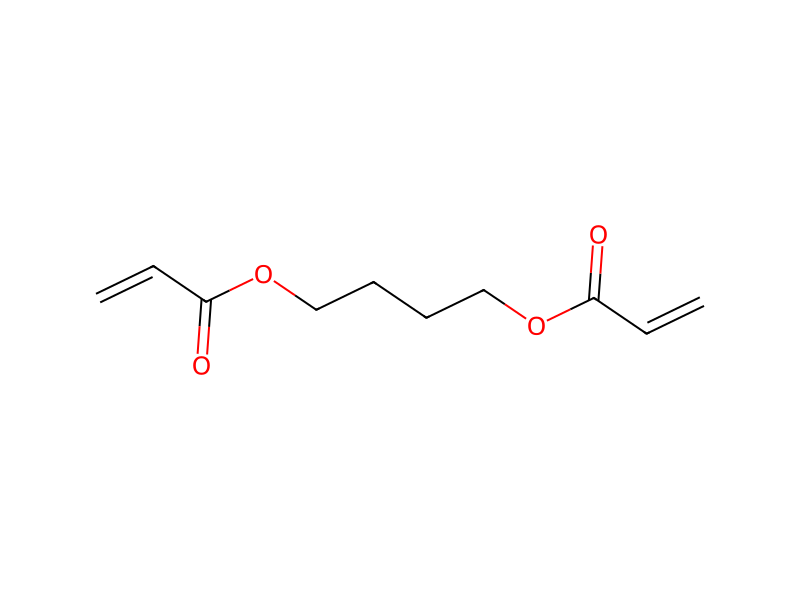
C=CC(=O)OCCCCOC(=O)C=C
InChIKey
JHWGFJBTMHEZME-UHFFFAOYSA-N
Molecular formula
C10H14O4
Average molar mass
198.22 g/mol
Monoisotopic mass
198.08920892

Overview

RN given is for 1,4-butanediol diacrylate; structure

Names & identifiers

Preferred name
Butanediol diacrylate
IUPAC
4-prop-2-enoyloxybutyl prop-2-enoate
English name
1,4-Butanediol diacrylate
Molecular formula
C10H14O4
Molecular weight
198.22

Names & synonyms

1,4-Butanediol diacrylate1070-70-8Butylene diacrylateButanediol diacrylateTetramethylene glycol diacrylate1,4-Butanediyl diacrylate52277-33-5Acrylic acid, tetramethylene ester2-Propenoic acid, 1,4-butanediyl ester2-Propenoic acid, 1,1'-(1,4-butanediyl) esterLAROMER BDDASR 213
Show more names
BDDA1,4-Butylene diacrylateButane-1,4-diyl diacrylate1,4-butylenediacrylateTetramethylene acrylate1,4-BIS(ACRYLOYLOXY)BUTANEsr213butylenediacrylatebutanedioldiacrylate
CCRIS 7042DTXSID6044779EINECS 213-979-62-Propenoic acid, butanediol diesterBRN 177748753P6JR1A3RVISCOAT 195VISCOAT V 195

Database identifiers

CAS
1070-70-8、31442-13-4、52277-33-5
PubChem CID
70613
DTXSID
DTXSID6044779
ChEMBL

Properties

Computed structural properties

XLogP
1.9
Topological polar surface area
52.6 Ų
Hydrogen bond donors
0
Hydrogen bond acceptors
4
Rotatable bonds
9
Heavy atoms
14
Formal charge
0
Complexity
196

Experimental & physicochemical properties

Physical DescriptionLiquid

Physicochemical properties

Melting point
-7 °C · -7°C
Boiling point
138 °C/13 · 138 °C/13 mmHg
Density
1.05 · 1.05
vapor pressure
0.83 hPa · 0.83 hPa (80 °C)
refractive index
1.46 · 1.46
Flash point
103 °C · 103 °C
storage temp.
2 · 2-8°C
solubility
16.3 g/l · 16.3g/l
form
clear liquid
color
Colorless to Light yellow to Light orange
Specific Gravity
1.055 · 1.055-1.105
explosive limit
1.3 · 1.3-7%(V)
Viscosity
8 cp · 8 cp (25C)

Safety & regulation

Safety information is for reference only and does not replace the supplier’s Safety Data Sheet (SDS), applicable regulations, or professional assessment.

GHS classification

GHS Classification · 6 items

Danger

H312: Harmful in contact with skin [Warning Acute toxicity, dermal]

P260, P261, P264, P272, P280, P301+P330+P331, P302+P352, P302+P361+P354, P304+P340, P305+P354+P338, P316, P317, P321, P333+P317, P362+P364, P363, P405, and P501 (click each P-code to see the statement)

Danger

H302 (59.2%): Harmful if swallowed [Warning Acute toxicity, oral]

P260, P261, P262, P264, P264+P265, P270, P271, P272, P273, P280, P301+P317, P301+P330+P331, P302+P352, P302+P361+P354, P304+P340, P305+P351+P338, P305+P354+P338, P316, P317, P321, P330, P333+P317, P337+P317, P361+P364, P362+P364, P363, P405, and P501 (click each P-code to see the statement)

Hazard information

Regulatory Information · 6 items

Chemical: Poly(oxy-1,4-butanediyl), .alpha.-(1-oxo-2-propenyl)-.omega.-[(1-oxo-2-propenyl)oxy]-

Chemical: 2-Propenoic acid, 1,4-butanediyl ester

2-Propenoic acid, 1,1'-(1,4-butanediyl) ester is listed on the EPA's Chemical Data Reporting (CDR) system. Manufacturers and importers of 2-Propenoic acid, 1,1'-(1,4-butanediyl) ester are required to report information about their production and use of this chemical to the EPA under the Toxic Substances Control Act (TSCA). (40 eCFR Part 711)

FRI - indicates a polymeric substance containing no free-radical initiator in its Inventory name but is considered to cover the designated polymer made with any free-radical initiator regardless of the amount used.

REACH registered substance: 1,4-butanediyl diacrylate (EC: 213-979-6)

1,4-Butanediol diacrylate: Does not have an individual approval but may be used under an appropriate group standard

Hazard Classes and Categories · 4 items

Acute Tox. 4 (59.2%)

Skin Irrit. 2 (100%)

Acute toxicity - category 4

Acute Tox. 4 *

Chemistry & industry

Uses & manufacturing

U.S. Production2023: <50,000 lb
Consumer UsesMonomers
Industry UsesMonomers
General Manufacturing Information · 4 items

Miscellaneous Manufacturing

2-Propenoic acid, 1,1'-(1,4-butanediyl) ester: ACTIVE

2-Propenoic acid, diester with butanediol: INACTIVE

Poly(oxy-1,4-butanediyl), .alpha.-(1-oxo-2-propen-1-yl)-.omega.-[(1-oxo-2-propen-1-yl)oxy]-: ACTIVE

Applications · 4 items

DescriptionA positive patch test was observed in a male process worker in a paint factory, sensitized to an epoxy diacrylate (1,4-butanediol diacrylate) contained in raw materials of UV -light-curable paint. The positive reaction was probably due to a cross reactivity.

Usescross-linking monomer for use in inks, adhesives, textile product modifiers, photo resists, etc.

Uses1,4-Butanediol diacrylate is used as a multifunctional crosslinker. It is used in drying technology for paintings, coatings, inks, resins and adhesives. It serves as an intermediate product for polymer synthesis in the chemical industry.

Uses1,4-Butanediol diacrylate may be used as a multifunctional crosslinker.

Upstream & downstream products

Upstream raw materials

1,4-ButanediolAcryloyl chlorideTriethylaminePyrogallol

Related reactions

1 records
New reaction record
HRID 593238 reaction equation
HRID 593238As reactant
Compound notes

On this pageBasic informationOverviewNames & identifiersPropertiesSafety & regulationChemistry & industryRelated reactionsCompound notes
CHEMBL3182145
UNII
53P6JR1A3R
EC Number
213-979-6、825-520-2
Nikkaji
J82.104G
Water Solubility
Immiscible with water.
InChI
1S/C10H14O4/c1-3-9(11)13-7-5-6-8-14-10(12)4-2/h3-4H,1-2,5-8H2
InChIKey
JHWGFJBTMHEZME-UHFFFAOYSA-N
SMILES
C=CC(=O)OCCCCOC(=O)C=C
LogP
1.9 at · 1.9 at 23℃
CAS DataBase Reference
1070 · 1070-70-8(CAS DataBase Reference)
EWG's Food Scores
2 · 2
FDA UNII
53 P6JR1A3R · 53P6JR1A3R
EPA Substance Registry System
1 · 1,4-Butanediol diacrylate (1070-70-8)
UNSPSC Code
12162002 · 12162002
NACRES
23 · NA.23
Symbol(GHS)
5 · GHS05,GHS06
Signal word
Danger
Hazard statements
302 · H302+H332-H311-H314-H317-H412
Precautionary statements
273 · P273-P280-P301+P312-P303+P361+P353-P304+P340+P310-P305+P351+P338
Hazard Codes
C
Risk Statements
21 · 21-34-43-23
Safety Statements
26 · 26-36/37/39-45
RIDADR
1760 · UN 1760 8/PG 2
WGK Germany
1 · 1
RTECS
3130000 · UD3130000
Autoignition Temperature
285 °C · 285 °C
TSCA
TSCA listed
HS Code
2916 · 2916 12 00
HazardClass
8 · 8
PackingGroup
II
Storage Class
6.1 A · 6.1A - Combustible acute toxic Cat. 1 and 2very toxic hazardous materials
Hazard Classifications
3 DermalAcute · Acute Tox. 3 DermalAcute Tox. 4 InhalationAcute Tox. 4 OralAquatic Chronic 3Eye Dam. 1Skin Corr. 1BSkin Sens. 1A
Toxicity
50 · mouse,LD50,oral,1gm/kg (1000mg/kg),Gigiena i Sanitariya. For English translation, see HYSAAV. Vol. 55(6), Pg. 86, 1990.
REACH Registrations
Active

Safety data

wgk
1
tsca
TSCA listed
rtecs
UD3130000
ridadr
UN 1760 8/PG 2
hs_code
2916 12 00
Toxicity
mouse,LD50,oral,1gm/kg (1000mg/kg),Gigiena i Sanitariya. For English translation, see HYSAAV. Vol. 55(6), Pg. 86, 1990.
risk_code
21-34-43-23
Signal word
Danger
Symbol(GHS)
GHS05,GHS06
hazard_code
C
safety_code
26-36/37/39-45
hazard_class
8
Storage Class
6.1A - Combustible acute toxic Cat. 1 and 2very toxic hazardous materials
packing_group
II
Hazard statements
H302+H332-H311-H314-H317-H412
REACH Registrations
Active
Hazard Classifications
Acute Tox. 3 DermalAcute Tox. 4 InhalationAcute Tox. 4 OralAquatic Chronic 3Eye Dam. 1Skin Corr. 1BSkin Sens. 1A
Autoignition Temperature
285 °C
Precautionary statements
P273-P280-P301+P312-P303+P361+P353-P304+P340+P310-P305+P351+P338
Benzene
4-Methoxyphenol
trans-Cinnamic acid
Methyl methacrylate
Acetylene
Acrylic acid
acrylic acid methyl ester
Acrolein
Benzoyl chloride

Downstream products

4-Hydroxybutyl acrylate