HomeMCPSkillsWorkbenchOpenChem
HomeWorkbenchNotificationsMe
llms.txt · skill.md · MCP GuidePrivacy Policy · Terms of Service · Supportv1.8.5
  1. Home
  2. /Compound

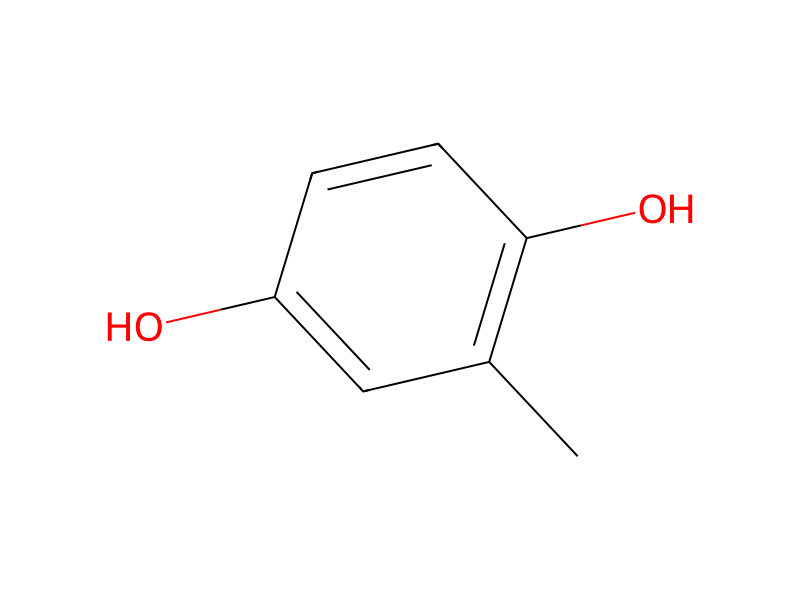
Methylhydroquinone

HCID 7253
New reaction
Print
Basic informationOverviewNames & identifiersPropertiesSafety & regulationChemistry & industryRelated reactionsCompound notes
Substructure searchFind similar structures

Basic information

CAS
95-71-6
Standard SMILES
Cc1cc(O)ccc1O
InChIKey
CNHDIAIOKMXOLK-UHFFFAOYSA-N
Molecular formula
C7H8O2
Average molar mass
124.14 g/mol
Monoisotopic mass
124.05242949

Overview

Toluquinol is a member of the class of hydroquinones that is hydroquinone in which one of the benzene hydrogens has been replaced by a methyl group. It has a role as an angiogenesis inhibitor, an anti-inflammatory agent and a Penicillium metabolite.

Names & identifiers

Preferred name
Methylhydroquinone
IUPAC
2-methylbenzene-1,4-diol
English name
2-Methylhydroquinone
Molecular formula
C7H8O2
Molecular weight
124.14

Names & synonyms

Methylhydroquinone95-71-62-Methylhydroquinone2-methylbenzene-1,4-diol2,5-DihydroxytolueneToluhydroquinonep-ToluhydroquinoneToluquinolp-Toluquinolp-ToluhydroquinolTolylhydroquinone2,5-Toluenediol
Show more names
THQ
2-Methyl-1,4-benzenediol1,4-Benzenediol, 2-methyl-1,4-Dihydroxy-2-methylbenzene2-Methyl-1,4-hydroquinoneDTXSID4020876332W51E0OCNSC-4962DTXCID00876

Database identifiers

CAS
95-71-6
PubChem CID
7253
DTXSID
DTXSID4020876
ChEMBL
CHEMBL450917
ChEBI
CHEBI:133842
UNII
332W51E0OC
EC Number
202-443-7
Nikkaji
J4.712K

Properties

Computed structural properties

XLogP
1
Topological polar surface area
40.5 Ų
Hydrogen bond donors
2
Hydrogen bond acceptors
2
Rotatable bonds
0
Heavy atoms
9
Formal charge
0
Complexity
92.9

Experimental & physicochemical properties

Chemical ClassesOther Classes -> Phenols
LogP0.91
Vapor Pressure0.0028 [mmHg]
Physical Description · 2 items

Dry Powder

Off-white solid with a slight odor; [Eastman Chemical MSDS]

Physicochemical properties

Melting point
128 · 128-130 °C(lit.)
Boiling point
285 °C · 285°C
Density
1.1006 · 1.1006 (rough estimate)
vapor pressure
0.004 Pa · 0.004Pa at 25℃
refractive index
1.4922 · 1.4922 (estimate)
Flash point
172 °C · 172 °C
storage temp.
30 °C · Store below +30°C.
solubility
77 g/l · 77g/l

Safety & regulation

Safety information is for reference only and does not replace the supplier’s Safety Data Sheet (SDS), applicable regulations, or professional assessment.

GHS classification

GHS Classification · 5 items

This chemical does not meet GHS hazard criteria for 1.1% (5 of 467) of reports.

Danger

H302 (94%): Harmful if swallowed [Warning Acute toxicity, oral]

P203, P261, P264, P264+P265, P270, P271, P272, P273, P280, P301+P317, P302+P352, P304+P340, P305+P351+P338, P305+P354+P338, P317, P318, P319, P321, P330, P332+P317, P333+P317, P337+P317, P362+P364, P391, P403+P233, P405, and P501 (click each P-code to see the statement)

Aggregated GHS information provided per 467 reports by companies from 28 notifications to the ECHA C&L Inventory. Each notification may be associated with multiple companies.

Hazard information

Regulatory Information · 4 items

Chemical: 1,4-Benzenediol, 2-methyl-

1,4-Benzenediol, 2-methyl- is listed on the EPA's Chemical Data Reporting (CDR) system. Manufacturers and importers of 1,4-Benzenediol, 2-methyl- are required to report information about their production and use of this chemical to the EPA under the Toxic Substances Control Act (TSCA). (40 eCFR Part 711)

REACH registered substance: 2-methylhydroquinone (EC: 202-443-7)

Methylhydroquinone: Does not have an individual approval but may be used under an appropriate group standard

Hazards SummaryA skin and eye irritant; Dust causes eye and respiratory tract irritation; Harmful by ingestion; [Eastman Chemical MSDS] See Hydroquinone.
Hazard Classes and CategoriesAcute Tox. 4 (94%)

Safety data

wgk
2
tsca
TSCA listed
rtecs
MX6700000

Chemistry & industry

Uses & manufacturing

UsesUsed as an inhibitor; [Eastman Chemical MSDS]
U.S. Production2023: 22,046 lb
Industry UsesCorrosion inhibitor
General Manufacturing Information · 2 items

All Other Chemical Product and Preparation Manufacturing

1,4-Benzenediol, 2-methyl-: ACTIVE

Applications · 4 items

UsesAntioxidant, polymerization inhibitor.

UsesMethylhydroquinone is used as stabilizer and antioxidant in aerylic monomers to prevent polymerization.

UsesMethylhydroquinone is a marine fungus metabolite, showing activity as an angiosupressor that interferes with the Akt pathway. Allows for screening of novel inhibitors of angiogenesis.

General DescriptionMethylhydroquinone is produced by the oxidation of o-cresol by the mutants G103S, G103S/A107G, and G103S/A107T.

Upstream & downstream products

Downstream products

2,5-Dimethoxybenzylamine3-Methyl-4-nitrophenolBenzoic acid, 4-[4-[(1-oxo-2-propenyl)oxy]butoxy]-, 2-Methyl-1,4-phenylene ester2,5-Dimethoxy-4-methylbenzaldehyde

Related reactions

67 records
New reaction record
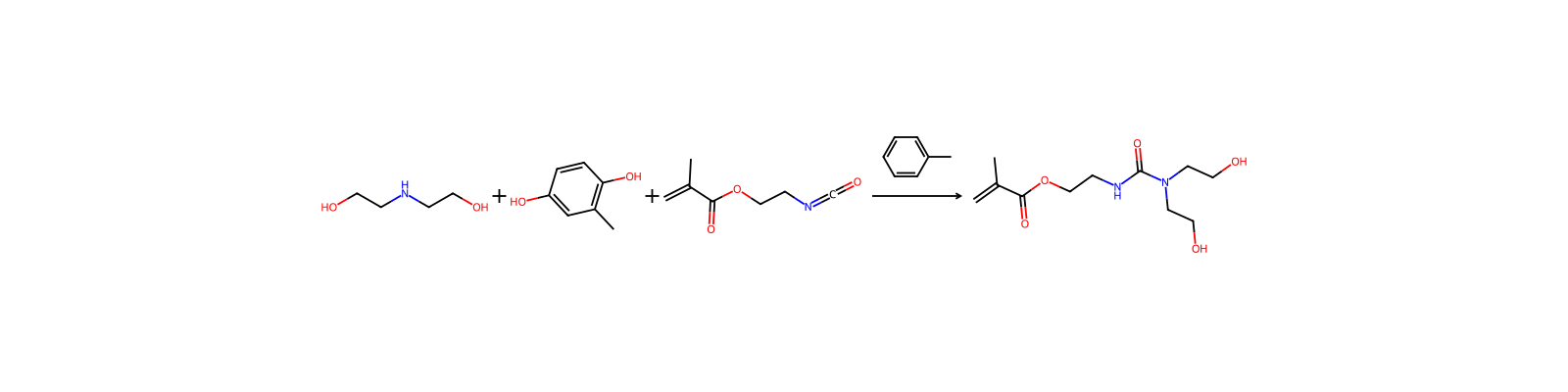
HRID 4694As reactant
HRID 131752As reactant
HRID 194586As reactant
HRID 214377As reactant
HRID 224470As reactant
HRID 277649As reactant
HRID 277650As reactant
HRID 324910As reactant
PreviousPage 1 of 9

Compound notes

On this pageBasic informationOverviewNames & identifiersPropertiesSafety & regulationChemistry & industryRelated reactionsCompound notes
pka
1 · pK1:10.03;pK2:11.62 (25°C)
form
Crystalline Powder
color
Grayish-white to light beige
Water Solubility
77 g/L · 77 g/L (25 ºC)
BRN
2041489 · 2041489
Stability
Stable. Combustible. Incompatible with oxidizing agents, strong bases.
InChI
1S/C7H8O2/c1-5-4-6(8)2-3-7(5)9/h2-4,8-9H,1H3
InChIKey
CNHDIAIOKMXOLK-UHFFFAOYSA-N
SMILES
Cc1cc(O)ccc1O
LogP
0.9 at · 0.9 at 27℃
CAS DataBase Reference
95 · 95-71-6(CAS DataBase Reference)
EWG's Food Scores
1 · 1
FDA UNII
332 W51E0OC · 332W51E0OC
NIST Chemistry Reference
1 · 1,4-Benzenediol, 2-methyl-(95-71-6)
EPA Substance Registry System
2 · 2-Methylhydroquinone (95-71-6)
UNSPSC Code
12352104 · 12352104
NACRES
24 · NA.24
Symbol(GHS)
7 · GHS07
Signal word
Warning
Hazard statements
302 · H302-H315-H319-H335-H312
Precautionary statements
280 · P280-P304+P340-P405-P501a-P301+P312+P330-P305+P351+P338-P261
target organs
Respiratory system
Hazard Codes
Xi,Xn
Risk Statements
36 · 36/37/38-22
Safety Statements
26 · 26-36
RIDADR
2811 · 2811
WGK Germany
2 · 2
RTECS
6700000 · MX6700000
Autoignition Temperature
851 °F · 851 °F
TSCA
TSCA listed
HazardClass
6.1 · 6.1(b)
PackingGroup
III
HS Code
2907299090 · 2907299090
Storage Class
8 A · 8A - Combustible corrosive hazardous materials
Hazard Classifications
1 Aquatic · Aquatic Acute 1Aquatic Chronic 1Eye Dam. 1Skin Corr. 1ASkin Sens. 1STOT SE 3
Toxicity
50 orally · LD50 orally in Rabbit: 200 - 400 mg/kg
REACH Registrations
Active
ridadr
2811
hs_code
2907299090
Toxicity
LD50 orally in Rabbit: 200 - 400 mg/kg
risk_code
36/37/38-22
Signal word
Warning
Symbol(GHS)
GHS07
hazard_code
Xi,Xn
safety_code
26-36
hazard_class
6.1(b)
Storage Class
8A - Combustible corrosive hazardous materials
packing_group
III
target organs
Respiratory system
Hazard statements
H302-H315-H319-H335-H312
REACH Registrations
Active
Hazard Classifications
Aquatic Acute 1Aquatic Chronic 1Eye Dam. 1Skin Corr. 1ASkin Sens. 1STOT SE 3
Autoignition Temperature
851 °F
Precautionary statements
P280-P304+P340-P405-P501a-P301+P312+P330-P305+P351+P338-P261
1,4-Benzenediethanol
3,4-Dimethoxytoluene
2,5-Di(Methoxy-d3)-4-Methylbenzaldehyde
1,4-Bis-[4-(6-acryloyloxyhexyloxy)benzoyloxy]-2-methylbenzene
1,4-Bis-[4-(3-acryloyloxypropyloxy)benzoyloxy]-2-methylbenzene

Additional notes

DefinitionChEBI: A member of the class of hydroquinones that is hydroquinone in which one of the benzene hydrogens has been replaced by a methyl group.