
HomeMCPWorkbenchSkills
HomeWorkbenchNotificationsMe
llms.txt · MCP GuidePrivacy Policy · Terms of Service · Supportv1.8.3
  1. Home
  2. /Compound

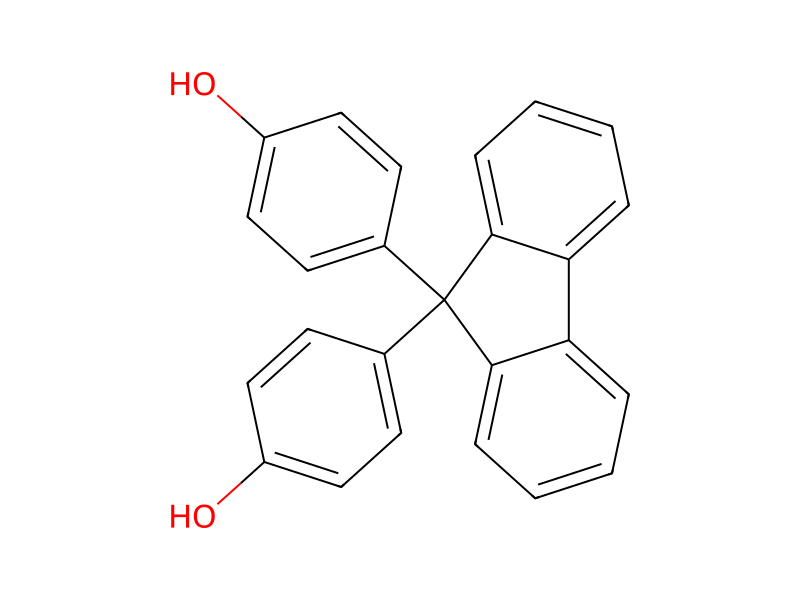
9,9-Bis(4-hydroxyphenyl)fluorene

HCID 76716
New reaction
Print
Basic informationOverviewNames & identifiersPropertiesSafety & regulationChemistry & industryRelated reactionsCompound notes
Substructure searchFind similar structures

Basic information

CAS
3236-71-3
Standard SMILES
Oc1ccc(C2(c3ccc(O)cc3)c3ccccc3-c3ccccc32)cc1
InChIKey
YWFPGFJLYRKYJZ-UHFFFAOYSA-N
Molecular formula
C25H18O2
Average molar mass
350.4 g/mol
Monoisotopic mass
350.13067981

Overview

9,9-bis(4-hydroxyphenyl)fluorene is a member of the class of fluorenes that is 9H-fluorene in which both of the hydrogens at position 9 have been replaced by p-hydroxyphenyl groups. It has a role as an anti-estrogen. It is a member of fluorenes and a polyphenol.


Names & identifiers

Preferred name
9,9-Bis(4-hydroxyphenyl)fluorene
IUPAC
4-[9-(4-hydroxyphenyl)fluoren-9-yl]phenol
English name
9,9-Bis(4-hydroxyphenyl)fluorene
Molecular formula
C25H18O2
Molecular weight
350.41

Names & synonyms

3236-71-39,9-Bis(4-hydroxyphenyl)fluoreneFluorene-9-bisphenolPhenol, 4,4'-(9H-fluoren-9-ylidene)bis-Bisphenol fluorenone4-[9-(4-hydroxyphenyl)-9H-fluoren-9-yl]phenol9,9-Bis(p-hydroxyphenyl)fluorene9,9'-Bis(4-hydroxyphenyl)fluorene4,4'-(9h-fluoren-9-ylidene)bisphenolCHEBI:136855EC 406-950-69,9-bis[4-hydroxyphenyl]fluorene
Show more names
BPFBPFLBISPHENOLFLUORENEfluorene-9-bispheno9,9-Bis(4-hydroxyphenyl)fluorene (purified by sublimation)BisP-FL4,4'-(9H-FL
4-(9-(4-hydroxyphenyl)-9H-fluoren-9-yl)phenolRefChem:548975406-950-6624-416-24,4'-(9H-fluorene-9,9-diyl)diphenol4,4'-(9-Fluorenylidene)diphenolbisphenol FL4-[9-(4-hydroxyphenyl)fluoren-9-yl]phenol

Database identifiers

CAS
3236-71-3
PubChem CID
76716
DTXSID
DTXSID5037731
ChEMBL
CHEMBL434829
ChEBI
CHEBI:136855
UNII
Q3VX5H3K3X
EC Number
406-950-6、624-416-2
Nikkaji
J111.264C

Properties

Computed structural properties

XLogP
6
Topological polar surface area
40.5 Ų
Hydrogen bond donors
2
Hydrogen bond acceptors
2
Rotatable bonds
2
Heavy atoms
27
Formal charge
0
Complexity
454

Experimental & physicochemical properties

Endocrine DisruptorsPotential endocrine disrupting compound
Collision Cross Section194.8 Ų [M-H]- [CCS Type: DT; Buffer gas: N2; Ionization: ESI-; Dataset: TOXCAST; Source Identifier: DTXSID5037731]

Physicochemical properties

Melting point
224 · 224-226 °C (lit.)
Boiling point
526.4 · 526.4±50.0 °C(Predicted)
Density
1.288 · 1.288±0.06 g/cm3(Predicted)
storage temp.
Sealed in dry,Room Temperature
Water Solubility
Insoluble in water
pka
9.58 · 9.58±0.30(Predicted)
form
solid
color
White to Almost white
BRN
2060986 · 2060986
Henry's Law Constant
8.4 · 8.4×108 mol/(m3Pa) at 25℃, Zhang et al. (2010)
InChI
InChI=1S/C25H18O2/c26-19-13-9-17(10-14-19)25(18-11-15-20(27)16-12-18)23-7-3-1-5-21(23)22-6-2-4-8-24(22)25/h1-16,26-27H
InChIKey
YWFPGFJLYRKYJZ-UHFFFAOYSA-N
SMILES
C1(C2=CC=C(O)C=C2)(C2=CC=C(O)C=C2)C2=C(C=CC=C2)C2=C1C=CC=C2
CAS DataBase Reference
3236 · 3236-71-3(CAS DataBase Reference)
EWG's Food Scores
1 · 1
EPA Substance Registry System
4 · Phenol, 4,4'-(9H-fluoren-9-ylidene)bis- (3236-71-3)
UNSPSC Code
12162002 · 12162002
NACRES
23 · NA.23
Symbol(GHS)
7 · GHS07,GHS09
Signal word
Warning
Hazard statements
315 · H315-H319-H410
Precautionary statements
264 · P264-P273-P280-P302+P352-P305+P351+P338-P332+P313
PPE
95 · dust mask type N95 (US), Eyeshields, Gloves
Hazard Codes
Xi,N
Risk Statements
36 · 36/38-50/53-36/37/38
Safety Statements
26 · 26-37-60-61-37/39
RIDADR
3077 · UN 3077 9/PG 3
WGK Germany
2 · 2
TSCA
TSCA listed
HazardClass
IRRITANT
PackingGroup
III
HS Code
2907299090 · 2907299090
Storage Class
11 · 11 - Combustible Solids
Hazard Classifications
1 Aquatic · Aquatic Acute 1Aquatic Chronic 1Eye Irrit. 2Skin Irrit. 2
REACH Registrations
Inactive
Limited Quantities
5 kg · 5.0 kg (11 lbs) (solid)
Excepted Quantities
Max Inner Pack (30g or 30ml) and Max Outer Pack (1Kg or 1L)

Safety & regulation

Safety information is for reference only and does not replace the supplier’s Safety Data Sheet (SDS), applicable regulations, or professional assessment.

GHS classification

GHS Classification · 6 items

Warning

H315: Causes skin irritation [Warning Skin corrosion/irritation]

P264, P264+P265, P273, P280, P302+P352, P305+P351+P338, P321, P332+P317, P337+P317, P362+P364, P391, and P501 (click each P-code to see the statement)

Warning

H315 (100%): Causes skin irritation [Warning Skin corrosion/irritation]

P264, P264+P265, P273, P280, P302+P352, P305+P351+P338, P321, P332+P317, P337+P317, P362+P364, P391, and P501 (click each P-code to see the statement)

Hazard information

Regulatory Information · 2 items

PMN - indicates a commenced PMN (Pre-Manufacture Notices) substance.

REACH registered substance: 9,9-bis(4-hydroxyphenyl)fluorene (EC: 406-950-6)

Hazard Classes and Categories · 4 items

Skin Irrit. 2 (100%)

Skin Irrit. 2 (100%)

Eye irritation - category 2

Skin Irrit. 2

Safety data

PPE
dust mask type N95 (US), Eyeshields, Gloves
wgk
2
tsca
TSCA listed
ridadr
UN 3077 9/PG 3
hs_code
2907299090
risk_code
36/38-50/53-36/37/38
Signal word
Warning
Symbol(GHS)
GHS07,GHS09
hazard_code
Xi,N
safety_code
26-37-60-61-37/39
hazard_class
IRRITANT
Storage Class
11 - Combustible Solids
packing_group
III
Hazard statements
H315-H319-H410
Limited Quantities
5.0 kg (11 lbs) (solid)
Excepted Quantities
Max Inner Pack (30g or 30ml) and Max Outer Pack (1Kg or 1L)
REACH Registrations
Inactive
Hazard Classifications
Aquatic Acute 1Aquatic Chronic 1Eye Irrit. 2Skin Irrit. 2
Precautionary statements
P264-P273-P280-P302+P352-P305+P351+P338-P332+P313

Chemistry & industry

Uses & manufacturing

General Manufacturing InformationPhenol, 4,4'-(9H-fluoren-9-ylidene)bis-: ACTIVE
Applications · 5 items

UsesIt can be used the intermediate of organic synthesis.

Uses9,9-Bis (4-Hydroxyphenyl) Fluorene is used in the production of polyarylene ethers and extensively used in the study of polymer electrolyte membranes with the potential for fuel cell application.

Uses4,4'-(9-fluorenylidene)diphenol be used for the synthesis of novel poly (arylene ether).

UsesBisphenol FL may be used as an analytical reference standard for the quantification of the analyte in: Human breast milk using gas chromatography-tandem mass spectrometry (GC-MS/MS). Wastewaters and surface water using gas chromatography-mass spectrometry (GC-MS).

General DescriptionBisphenol FL (BPFL) is a fluorinated derivative of bisphenol (BP), a wide group of chemicals with similar structures, recognized as environmental pollutants. Bisphenol A (BPA), and its structural analogs are widely used as plasticizers and monomers for synthetic materials, industrial and consumer products including fluorine rubber, food container linings, canned food, thermal receipts, etc.

Upstream & downstream products

Upstream raw materials

9-FluorenonePhenolZinc chlorideWaterHydrochloric acidIsopropyl alcohol

Downstream products

Bisphenoxyethanolfluorene
Additional notes · 1 item

DefinitionChEBI: 9,9-bis(4-hydroxyphenyl)fluorene is a member of the class of fluorenes that is 9H-fluorene in which both of the hydrogens at position 9 have been replaced by p-hydroxyphenyl groups. It has a role as an anti-estrogen. It is a member of fluorenes and a polyphenol.

Related reactions

20 records
New reaction record
HRID 789 reaction equation
HRID 789As reactant
HRID 35984 reaction equation
HRID 35984As reactant
HRID 373286 reaction equation
HRID 373286As reactant
HRID 467178 reaction equation
HRID 467178As reactant
HRID 467182 reaction equation
HRID 467182As reactant
HRID 1193537 reaction equation
HRID 1193537As reactant
HRID 1254813 reaction equation
HRID 1254813As reactant
HRID 1422330 reaction equation
HRID 1422330As reactant
PreviousPage 1 of 3

Compound notes

On this pageBasic informationOverviewNames & identifiersPropertiesSafety & regulationChemistry & industryRelated reactionsCompound notes