HomeMCPSkillsWorkbenchOpenChem
HomeWorkbenchNotificationsMe
llms.txt · skill.md · MCP GuidePrivacy Policy · Terms of Service · Supportv1.8.4
  1. Home
  2. /Compound

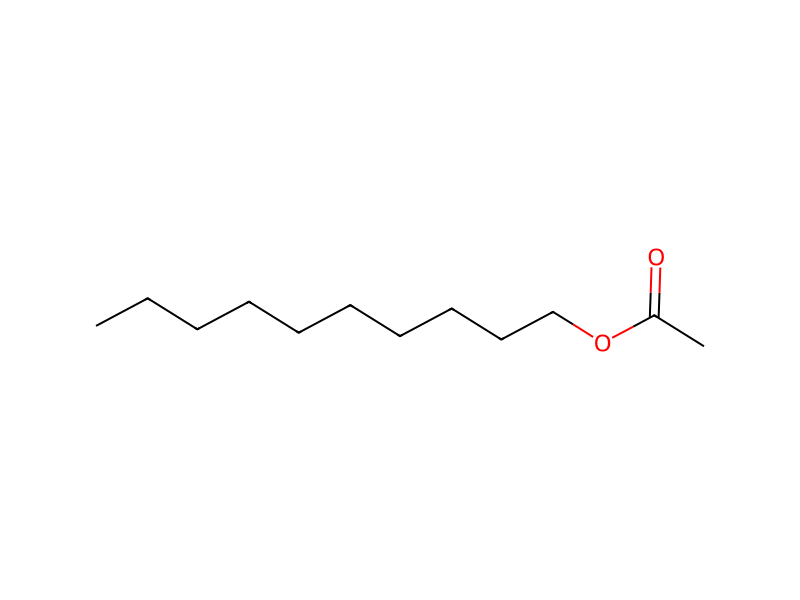
Decyl acetate

HCID 8167
New reaction
Print
Basic informationOverviewNames & identifiersPropertiesSafety & regulationChemistry & industryRelated reactionsCompound notes
Substructure searchFind similar structures

Basic information

CAS
112-17-4
Standard SMILES
CCCCCCCCCCOC(C)=O
InChIKey
NUPSHWCALHZGOV-UHFFFAOYSA-N
Molecular formula
C12H24O2
Average molar mass
200.32 g/mol
Monoisotopic mass
200.17763

Overview

Decyl acetate is a carboxylic ester.

Names & identifiers

Preferred name
Decyl acetate
IUPAC
decyl acetate
English name
N-DECYL ACETATE
Molecular formula
C12H24O2
Molecular weight
200.32

Names & synonyms

DECYL ACETATEn-Decyl acetateAcetic acid, decyl ester1-Decanol acetateAcetate C 10n-Decyl ethanoateDecyl ethanoate1-Decyl acetateDecanyl acetateAcetate C-10Decanol acetateDecyl alcohol, acetate
Show more names
decylFEMA 2367Decylacetat1-decylacetateCAPRYL ACETATE
FEMA No. 2367DTXSID8047189UNII-VNW56K9DYTVNW56K9DYTDecyl ester of acetic acidEINECS 203-942-2NSC 46131DECYLACETATE

Database identifiers

CAS
112-17-4
PubChem CID
8167
DTXSID
DTXSID8047189
ChEMBL
CHEMBL2228458
ChEBI
CHEBI:179750
UNII
VNW56K9DYT
EC Number
203-942-2
Nikkaji
J95.543D

Properties

Computed structural properties

XLogP
4.5
Topological polar surface area
26.3 Ų
Hydrogen bond donors
0
Hydrogen bond acceptors
2
Rotatable bonds
10
Heavy atoms
14
Formal charge
0
Complexity
132

Experimental & physicochemical properties

Chemical ClassesOther Classes -> Esters, Other
LipidsFatty Acyls [FA] -> Fatty esters [FA07] -> Short fatty esters [FA0710]
SpringerMaterials PropertiesBoiling point
FragrancesFragrance Ingredient (Decyl acetate) -> IFRA transparency List
Food AdditivesFLAVORING AGENT OR ADJUVANT -> FDA Substance added to food
Density0.861-0.866
Flavoring AgentsEU Flavoring substances
Solubility · 2 items

insoluble in water

1 ml in 2 ml 80% alcohol (in ethanol)

Boiling Point · 2 items

126.00 to 127.00 °C. @ 20.00 mm Hg

272 °C

Melting Point-15 °C

Safety & regulation

Safety information is for reference only and does not replace the supplier’s Safety Data Sheet (SDS), applicable regulations, or professional assessment.

GHS classification

GHS Classification · 3 items

This chemical does not meet GHS hazard criteria for 98.2% (1547 of 1576) of all reports.

Not Classified

Aggregated GHS information provided per 1576 reports by companies from 4 notifications to the ECHA C&L Inventory.

Hazard information

Regulatory Information · 3 items

Chemical: Acetic acid, decyl ester

REACH registered substance: Decyl acetate (EC: 203-942-2)

Decyl acetate: Does not have an individual approval but may be used under an appropriate group standard

Other Safety InformationEvaluation - Chemicals that are unlikely to require further regulation to manage risks to human health
Hazards SummarySafe when used as a flavoring agent in food; [JECFA] May cause irritation; [Alfa Aesar MSDS]
Hazard Classes and CategoriesNot Classified

Safety data

PPE
Eyeshields, Gloves
wgk
2
tsca
TSCA listed
rtecs
AG5235000
hs_code
2915390090
Toxicity
Both the acute oral LD50 value in rats and the acute dermal LD50 value in rabbits were reported as >5 g/kg(Levenstein, 1974).
Signal word
Warning
Symbol(GHS)
GHS09

Chemistry & industry

Pharmacology

Cellular LocationsExtracellular

Uses & manufacturing

UsesUsed as flavoring agent or adjuvant; [FDA]
Use Classification · 4 items

Fragrance Ingredients

Flavouring Agent -> FLAVOURING_AGENT -> JECFA Functional Classes

Flavoring Agents -> JECFA Flavorings Index

Flavouring Agent -> FLAVOURING_AGENT -> JECFA Functional Classes

General Manufacturing InformationAcetic acid, decyl ester: ACTIVE
Applications · 2 items

OccurrenceReported found in orange, lemon, melon, apple, plums, citrus peel oils, grapefruit, orange, grapefruit juice, strawberry fruit, blue cheese, cognac and cardamom.

UsesDecyl acetate finds little use in perfume compositions as a modifier for Linalyl acetate and generally as a ‘“fresh’” note in delicate florals (Muguet, etc. ) or in aldehydic top note compositions. It blends excellently with Dodecanal (Aldehyde C-1 2, Laurie). Finds some use in flavour compositions, mainly for imitation Apple, Berry, Honey, Orange, Peach, Plum, etc. and also in Rum flavours. The concentration of Decyl acetate in the functional product amounts usually to traces only.

Preparation methods

PreparationBy direct acetylation on n-decanol with acetic acid via azeotropic conditions or using acetic anhydride.

Upstream & downstream products

Upstream raw materials

Related reactions

2 records
New reaction record
HRID 949055As product
HRID 1730381As product

Compound notes

On this pageBasic informationOverviewNames & identifiersPropertiesSafety & regulationChemistry & industryRelated reactionsCompound notes
Vapor Pressure0.00347 [mmHg]
Refractive Index1.424-1.430

Physicochemical properties

Melting point
-15.03 °C · -15.03°C
Boiling point
248 °C · 248 °C
Density
0.87 · 0.87
vapor pressure
2.48 Pa · 2.48Pa at 25.9℃
FEMA
2367 · 2367 | DECYL ACETATE
refractive index
20 · n 20/D 1.427 (lit.)
FLAVIS Number
9.009 · 09.009 | Decyl acetate
Flash point
107.8 °C · 107.8 °C - closed cup
storage temp.
Sealed in dry,Room Temperature
solubility
Insoluble in water
form
clear liquid
color
Colorless to Almost colorless
Odor
100 % · at 100.00 %. waxy clean fresh laundered cloths citrus soapy
Odor Type
waxy
biological source
synthetic
Water Solubility
2.07 mg/L · 2.07mg/L at 20℃
Thermal Conductivity
0.148 W/ · 0.148 W/(m·K) at 25 ℃
JECFA Number
132 · 132
BRN
1762123 · 1762123
Henry's Law Constant
2.8 · 2.8×10-3 mol/(m3Pa) at 25℃, Yaws (2003)
Major Application
flavors and fragrances
Cosmetics Ingredients Functions
PERFUMING
InChI
1S/C12H24O2/c1-3-4-5-6-7-8-9-10-11-14-12(2)13/h3-11H2,1-2H3
InChIKey
NUPSHWCALHZGOV-UHFFFAOYSA-N
SMILES
CCCCCCCCCCOC(C)=O
LogP
5.6 at · 5.6 at 35℃
CAS DataBase Reference
112 · 112-17-4(CAS DataBase Reference)
Substances Added to Food (formerly EAFUS)
DECYL ACETATE
EWG's Food Scores
1 · 1
FDA UNII
56 K9DYT · VNW56K9DYT
NIST Chemistry Reference
Acetic acid, n-decyl ester(112-17-4)
EPA Substance Registry System
Acetic acid, decyl ester (112-17-4)
UNSPSC Code
12164502 · 12164502
NACRES
21 · NA.21
Symbol(GHS)
9 · GHS09
Signal word
Warning
Hazard statements
410 · H410
Precautionary statements
273 · P273-P391-P501
PPE
Eyeshields, Gloves
WGK Germany
2 · 2
RTECS
5235000 · AG5235000
TSCA
TSCA listed
HS Code
2915390090 · 2915390090
Storage Class
10 · 10 - Combustible liquids
Hazard Classifications
1 Aquatic · Aquatic Acute 1Aquatic Chronic 1
Toxicity
50 value · Both the acute oral LD50 value in rats and the acute dermal LD50 value in rabbits were reported as >5 g/kg(Levenstein, 1974).
REACH Registrations
Active
Storage Class
10 - Combustible liquids
Hazard statements
H410
REACH Registrations
Active
Hazard Classifications
Aquatic Acute 1Aquatic Chronic 1
Precautionary statements
P273-P391-P501
1-Decanoln-Capric acid n-decyl esterEthanol

Additional notes

DefinitionChEBI: Decyl acetate is a carboxylic ester.