Aqua regia
HCID 90477010
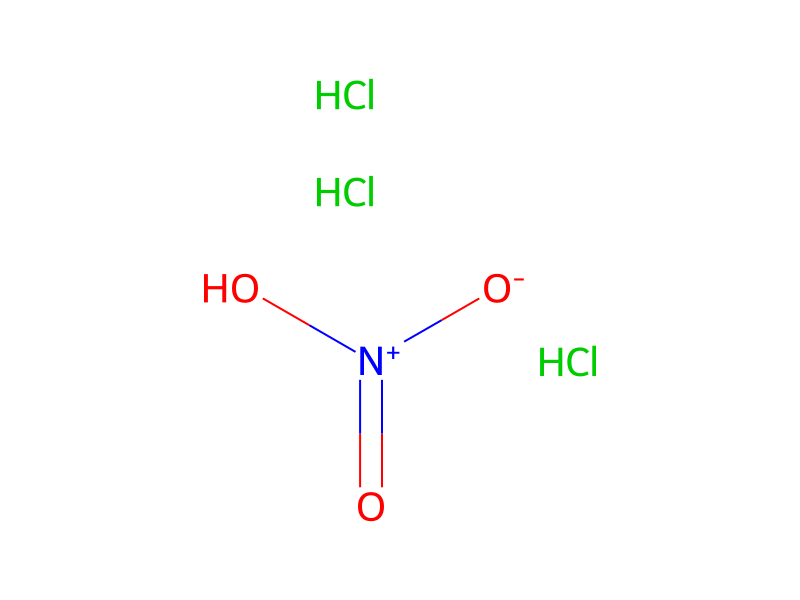
Basic information
- CAS
8007-56-5- Standard SMILES
Cl.Cl.Cl.O=[N+]([O-])O- InChIKey
NICDRCVJGXLKSF-UHFFFAOYSA-N- Molecular formula
- Cl3H4NO3
- Average molar mass
- 172.39 g/mol
- Monoisotopic mass
- 170.92567603
Overview
Aqua regia appears as a yellow liquid with a pungent odor prepared by mixing nitric acid and hydrochloric acid, usually in a ratio of one part of nitric acid to three or four parts of hydrochloric acid. Fumes are irritating to the eyes and mucous membranes. Corrosive to metals and to tissue.
Names & identifiers
- Preferred name
- Aqua regia
- IUPAC
- nitric acid;trihydrochloride
- English name
- Nitrohydrochloric acid
- Molecular formula
- ClHNO2
- Molecular weight
- 82.46644
Names & synonyms
AQUA REGIANitrohydrochloric acidnitromuriatic acidX3TT5X989E8007-56-5MET-ETCHCHLOROAZOTIC ACIDCHLORONITROUS ACIDDTXSID50893666RefChem:558453DTXCID501323698UNII-X3TT5X989E
Show more names
KnigswasserAqua regia (Nitrohydrochloric acid)Aqua regia (75% hydrochloric + 25% nitric acid)
UN1798WANGSHUIAQUA REGISNITROMURIATICUM ACIDUMNITRO-HYDROCHLORIC ACIDSCHEMBL29351365NICDRCVJGXLKSF-UHFFFAOYSA-NNITROHYDROCHLORIC ACID [MI]
Database identifiers
- CAS
8007-56-5- PubChem CID
- 90477010
- DTXSID
DTXSID50893666- UNII
- X3TT5X989E
- EC Number
- 690-364-2
Properties
Computed structural properties
- Topological polar surface area
- 66.1 Ų
- Hydrogen bond donors
- 4
- Hydrogen bond acceptors
- 3
- Rotatable bonds
- 0
- Heavy atoms
- 7
- Formal charge
- 0
- Complexity
- 24.8
Experimental & physicochemical properties
Chemical Classes
Toxic Gases & Vapors -> Acids, Inorganic
Corrosives
Physical Description
Aqua regia appears as a yellow liquid with a pungent odor prepared by mixing nitric acid and hydrochloric acid, usually in a ratio of one part of nitric acid to three or four parts of hydrochloric acid. Fumes are irritating to the eyes and mucous membranes. Corrosive to metals and to tissue.
Yellow fuming liquid with a suffocating odor; [Merck Index] Red, yellow, or gold fuming liquid; [University of Oxford MSDS]
Physicochemical properties
- Stability
- Pressure will develop in sealed bottles. Incompatible with (and may react violently with) a wide variety of materials, including metals, oxidising agents, reducing agents, combustible materials.
- CAS DataBase Reference
- 8007 · 8007-56-5
- FDA UNII
- 3 TT5X989E · X3TT5X989E
- EPA Substance Registry System
- Aqua regia (8007-56-5)
- RIDADR
- 1798 · UN 1798
- HazardClass
- 8 · 8
Safety & regulation
Safety information is for reference only and does not replace the supplier’s Safety Data Sheet (SDS), applicable regulations, or professional assessment.
GHS classification
GHS Classification
This chemical does not meet GHS hazard criteria for 100% (3 of 3) of all reports.
Not Classified
Aggregated GHS information provided per 3 reports by companies from 1 notifications to the ECHA C&L Inventory.
Hazard information
Regulatory InformationThe New Jersey Worker and Community Right to Know Act requires public and private employers to provide information about hazardous substances at their workplaces. (N.J.S.A. 34:5A-1 et. seq.)
DOT LabelCorrosive
Fire Hazards
Excerpt from ERG Guide 157 [Substances - Toxic and/or Corrosive (Non-Combustible / Water-Sensitive)]:
· Non-combustible, substance itself does not burn but may decompose upon heating to produce corrosive and/or toxic fumes.
· Non-combustible, substance itself does not burn but may decompose upon heating to produce corrosive and/or toxic fumes.
Health Hazards
Excerpt from ERG Guide 157 [Substances - Toxic and/or Corrosive (Non-Combustible / Water-Sensitive)]:
· TOXIC and/or CORROSIVE; inhalation, ingestion or contact (skin, eyes) with vapors, dusts or substance may cause severe injury, burns or death.
· TOXIC and/or CORROSIVE; inhalation, ingestion or contact (skin, eyes) with vapors, dusts or substance may cause severe injury, burns or death.
Hazards Summary
Contains nitrosyl chloride and free chlorine; Corrosive; [Merck Index] A strong oxidizing agent with known catalytic activity; Reacts with air; Causes burns; [CAMEO] Causes burns and severe respiratory tract irritation; Highly toxic by ingestion and inhalation; [University of Oxford MSDS] See Nitric acid and Hydrogen chloride.
Chemistry & industry
Uses & manufacturing
UsesMixture of hydrochloric & nitric acids. [ChemIDplus]
Applications
UsesMetallurgy, testing metals, dissolving metals.
General DescriptionA yellow liquid with a pungent odor prepared by mixing nitric acid and hydrochloric acid, usually in a ratio of one part of nitric acid to three or four parts of hydrochloric acid. Fumes are irritating to the eyes and mucous membranes. Corrosive to metals and to tissue. Density 14.7 lb /gal.
Upstream & downstream products
Downstream products
Additional notes
DefinitionA mixture of concentrated nitric acid and three to four parts of hydrochloric acid. It dissolves all metals including gold, hence the name. The mixture contains chlorine and NOCl (nitrosyl chloride).
Related reactions
0 records
No related reactions yet