
uspto-grants-1993_12 · 10.6084/m9.figshare.5104873.v1 · US05269979
查看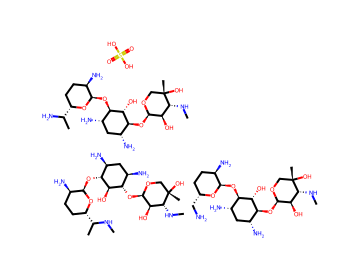
(2R,3R,4R,5R)-2-[(1S,2S,3R,4S,6R)-4,6-diamino-3-[(2R,3R,6S)-3-amino-6-(1-aminoethyl)oxan-2-yl]oxy-2-hydroxycyclohexyl]oxy-5-methyl-4-(methylamino)oxane-3,5-diol;(2R,3R,4R,5R)-2-[(1S,2S,3R,4S,6R)-4,6-diamino-3-[(2R,3R,6S)-3-amino-6-(aminomethyl)oxan-2-yl]oxy-2-hydroxycyclohexyl]oxy-5-methyl-4-(methylamino)oxane-3,5-diol;(2R,3R,4R,5R)-2-[(1S,2S,3R,4S,6R)-4,6-diamino-3-[(2R,3R,6S)-3-amino-6-[1-(methylamino)ethyl]oxan-2-yl]oxy-2-hydroxycyclohexyl]oxy-5-methyl-4-(methylamino)oxane-3,5-diol;sulfuric acid
IDENTITY
COMPUTED
PROPERTIES
Soluble (NTP, 1992)
424 to 459 °F (NTP, 1992)
Sulfate salt of an antibiotic complex produced by fermentation. Three closely related components that are chemically amino-saccharides. White to buff-colored powder. pH (4% solution) 3.5 to 5.5. Odorless. (NTP, 1992)
GHS
Danger
H317 (98.5%): May cause an allergic skin reaction [Warning Sensitization, Skin];H334 (69.2%): May cause allergy or asthma symptoms or breathing difficulties if inhaled [Danger Sensitization, respiratory];H335 (28.4%): May cause respiratory irritation [Warning Specific target organ toxicity, single exposure; Respiratory tract irritation];H361 (11.2%): Suspected of damaging fertility or the unborn child [Warning Reproductive toxicity]
P203, P233, P260, P261, P271, P272, P280, P284, P302+P352, P304+P340, P318, P319, P321, P333+P317, P342+P316, P362+P364, P403, P403+P233, P405, and P501 (click each P-code to see the statement)
Aggregated GHS information provided per 412 reports by companies from 27 notifications to the ECHA C&L Inventory. Each notification may be associated with multiple companies.;Information may vary between notifications depending on impurities, additives, and other factors. The percentage value in parenthesis indicates the notified classification ratio from companies that provide hazard codes. Only hazard codes with percentage values above 10% are shown. For more detailed information, please visit ECHA C&L website.
HAZARDS
Gentamycin sulphate: Does not have an individual approval but may be used under an appropriate group standard
IMAP assessments - Gentamicin, sulfate (salt): Environment tier I assessment;IMAP assessments - Gentamicin, sulfate (salt): Human health tier I assessment
Flash point data for this chemical are not available; however, it is probably combustible. (NTP, 1992)
SYMPTOMS: Symptoms of exposure to this compound include vestibular damage, ototoxicity, hypersensitivity reactions, anemia, purpura, convulsions, increased serum aminotransferase values, increased serum-bilirubin concentrations, alopecia, blood disorders, electrolyte disturbances, nephrotoxicity, neuromuscular blockade, neurotoxicity and psychosis. Other symptoms include vertigo, tinnitus, hearing loss, allergic reactions and fever. Numbness, skin tingling, muscle twitching and roaring in the ears has also been reported. Topical application has resulted in redness and itching of the skin. This compound is poorly absorbed from the gastrointestinal tract, but is rapidly absorbed after intramuscular injection.;ACUTE/CHRONIC HAZARDS: When heated to decomposition this compound emits very toxic fumes of SOx. (NTP, 1992)
Salts, Acidic;Acetals, Ketals, Hemiacetals, and Hemiketals
GENTAMYCIN SULFATE is very stable in solution, even in moderately acidic to strongly basic aqueous media. (NTP, 1992)
Water soluble. Hygroscopic.
Skin Sens. 1 (98.5%);Resp. Sens. 1 (69.2%);STOT SE 3 (28.4%);Repr. 2 (11.2%)
SAFETY
Fires involving this material can be controlled with a dry chemical, carbon dioxide or Halon extinguisher. (NTP, 1992)
EYES: First check the victim for contact lenses and remove if present. Flush victim's eyes with water or normal saline solution for 20 to 30 minutes while simultaneously calling a hospital or poison control center. Do not put any ointments, oils, or medication in the victim's eyes without specific instructions from a physician. IMMEDIATELY transport the victim after flushing eyes to a hospital even if no symptoms (such as redness or irritation) develop.;SKIN: IMMEDIATELY flood affected skin with water while removing and isolating all contaminated clothing. Gently wash all affected skin areas thoroughly with soap and water. If symptoms such as redness or irritation develop, IMMEDIATELY call a physician and be prepared to transport the victim to a hospital for treatment.;INHALATION: IMMEDIATELY leave the contaminated area; take deep breaths of fresh air. If symptoms (such as wheezing, coughing, shortness of breath, or burning in the mouth, throat, or chest) develop, call a physician and be prepared to transport the victim to a hospital. Provide proper respiratory protection to rescuers entering an unknown atmosphere. Whenever possible, Self-Contained Breathing Apparatus (SCBA) should be used; if not available, use a level of protection greater than or equal to that advised under Protective Clothing.;INGESTION: DO NOT INDUCE VOMITING. If the victim is conscious and not convulsing, give 1 or 2 glasses of water to dilute the chemical and IMMEDIATELY call a hospital or poison control center. Be prepared to transport the victim to a hospital if advised by a physician. If the victim is convulsing or unconscious, do not give anything by mouth, ensure that the victim's airway is open and lay the victim on his/her side with the head lower than the body. DO NOT INDUCE VOMITING. IMMEDIATELY transport the victim to a hospital. (NTP, 1992)
SMALL SPILLS AND LEAKAGE: If you spill this chemical, you should dampen the solid spill material with water, then transfer the dampened material to a suitable container. Use absorbent paper dampened with water to pick up any remaining material. Seal your contaminated clothing and the absorbent paper in a vapor-tight plastic bag for eventual disposal. Wash all contaminated surfaces with a soap and water solution. Do not reenter the contaminated area until the Safety Officer (or other responsible person) has verified that the area has been properly cleaned.;STORAGE PRECAUTIONS: You should store this chemical under refrigerated temperatures, and protect it from moisture. (NTP, 1992)
RECOMMENDED RESPIRATOR: Where the neat test chemical is weighed and diluted, wear a NIOSH-approved half face respirator equipped with an organic vapor/acid gas cartridge (specific for organic vapors, HCl, acid gas and SO2) with a dust/mist filter. (NTP, 1992)
REGULATORY
Gentamycin sulphate: Does not have an individual approval but may be used under an appropriate group standard
PHARMACOLOGY
GENTAMICIN SULFATE
Aminoglycoside Antibacterial [EPC]; Aminoglycosides [CS]
GENTAMICIN SULFATE OPTH SOLUTION
Aminoglycoside Antibacterial [EPC]; Aminoglycosides [CS]
Compounds which inhibit the synthesis of proteins. They are usually ANTI-BACTERIAL AGENTS or toxins. Mechanism of the action of inhibition includes the interruption of peptide-chain elongation, the blocking the A site of ribosomes, the misreading of the genetic code or the prevention of the attachment of oligosaccharide side chains to glycoproteins.
Substances that inhibit the growth or reproduction of BACTERIA.
USES
Animal Drugs -> FDA Approved Animal Drug Products (Green Book) -> Active Ingredients
ALIASES
REACTIONS
uspto-grants-1993_12 · 10.6084/m9.figshare.5104873.v1 · US05269979
查看
uspto-grants-1983_08 · 10.6084/m9.figshare.5104873.v1 · US04401765
查看
uspto-grants-1992_07 · 10.6084/m9.figshare.5104873.v1 · US05133965
查看
uspto-grants-2008_03 · 10.6084/m9.figshare.5104873.v1 · US07345024B2
查看
uspto-grants-2008_03 · 10.6084/m9.figshare.5104873.v1 · US07345024B2
查看
uspto-grants-2016_08 · 10.6084/m9.figshare.5104873.v1 · US09427406B2
查看