StartseiteMCPWorkbenchSkills
StartseiteWorkbenchBenachrichtigungenMein Bereich
llms.txt · MCP-AnleitungDatenschutz · Nutzungsbedingungen · Supportv1.8.0
  1. Startseite
  2. /Verbindung

Thiocarbonylchlorid

Thiophosgene

HCID 10040
Neue NotizNeue ReaktionAnfrage stellen
Druckvorschau

Daten werden ergänzt – lade die Seite später neu, um den aktuellen Stand zu sehen

GrundinformationenNamen und BezeichnerEigenschaftenSicherheit und RegulatorischesChemie und IndustrieZugehörige ReaktionenNotizen zur Verbindung
TeilstruktursucheÄhnliche Strukturen suchen

Grundinformationen

CAS
463-71-8
Standard-SMILES
S=C(Cl)Cl
InChIKey
ZWZVWGITAAIFPS-UHFFFAOYSA-N
Summenformel
CCl2S
Durchschnittliche Molmasse
114,98 g/mol
Monoisotopische Masse
113,9097766

Namen und Bezeichner

Bevorzugter Name
Thiophosgene
IUPAC
thiocarbonyl dichloride
Lokaler Name
Thiocarbonylchlorid
Englischer Name
Thiophosgene
Summenformel
CCl2S
Molmasse
114.98

Namen und Synonyme

THIOPHOSGENE463-71-8Thiocarbonyl dichlorideCarbonothioic dichlorideThiocarbonyl chlorideCarbon chlorosulfideDichlorothiocarbonylThiocarbonic dichlorideThiofosgenPhosgene, thio-ThiokarbonylchloridCarbonyl chloride, thio-
Weitere Namen anzeigen
CSCl2Carbonothioyl dichlorideThiophosgthio-phosgen
Carbonic dichloride, thio-067FQP576PDTXSID2060046CHEBI:29366RefChem:189622DTXCID3040485thiocarbonyl dichloride;thiophosgene207-341-6

Datenbank-Bezeichner

CAS
463-71-8
PubChem CID
10040
DTXSID
DTXSID2060046
ChEBI
CHEBI:29366
UNII
067FQP576P
EC Number
207-341-6
Nikkaji
J5.882C

Eigenschaften

Berechnete StruktureigenschaftenWird ergänzt

XLogP
2,4
Polarare Oberfläche (TPSA)
32,1 Ų
H-Brücken-Donoren
0
H-Brücken-Akzeptoren
1
Frei drehbare Bindungen
0
Schwere Atome
4
Formalladung
0
Komplexität
29

Experimentelle und physikochemische Eigenschaften

Odor · 2 Einträge

Sharp choking odor

Malodorous

Density · 2 Einträge

1.513 at 68 °F (USCG, 1999) - Denser than water; will sink

1.508 @ 15 °C

Color/Form · 2 Einträge

Reddish liquid

Reddish-yellow liquid

SolubilityInsoluble in water, soluble in ethanol and ethyl ether
Corrosivity · 2 Einträge

Corrodes metals in presence of moisture

Corrosive lachrymator and moisture sensitive compound.

Boiling Point · 3 Einträge

163 °F at 760 mmHg (USCG, 1999)

163 °F

73 °C

Decomposition · 2 Einträge

Decomposes above 200 °C to carbon disulfide (very flammable) and carbon tetrachloride.

When heated to decomposition it emits very toxic fumes of /chlorides/ Cl- and /sulfur oxides/ SOx.

Sicherheit und Regulatorisches

Sicherheitsangaben dienen nur zur Orientierung und ersetzen weder das Sicherheitsdatenblatt (SDB) des Lieferanten noch geltende Vorschriften oder eine fachliche Bewertung.

GHS-Klassifizierung

GHS Classification · 6 Einträge

Danger

H302: Harmful if swallowed [Warning Acute toxicity, oral];H315: Causes skin irritation [Warning Skin corrosion/irritation];H319: Causes serious eye irritation [Warning Serious eye damage/eye irritation];H331: Toxic if inhaled [Danger Acute toxicity, inhalation];H335: May cause respiratory irritation [Warning Specific target organ toxicity, single exposure; Respiratory tract irritation]

P261, P264, P264+P265, P270, P271, P280, P301+P317, P302+P352, P304+P340, P305+P351+P338, P316, P319, P321, P330, P332+P317, P337+P317, P362+P364, P403+P233, P405, and P501 (click each P-code to see the statement)

Danger

Gefahrenhinweise

Hazards IdentificationToxic/poison by inhalation (TIH/PIH)
Regulatory Information · 4 Einträge

Chemical: Carbonothioic dichloride

Status: No longer Valid Update: 23-05-2018 https://echa.europa.eu/registration-dossier/-/registered-dossier/25354

Thiophosgene: HSNO Approval: HSR003934 Approved with controls

The New Jersey Worker and Community Right to Know Act requires public and private employers to provide information about hazardous substances at their workplaces. (N.J.S.A. 34:5A-1 et. seq.)

DOT LabelPoison Inhalation Hazard
Fire Hazards · 2 Einträge

Special Hazards of Combustion Products: Toxic phosgene, hydrogen chloride, and sulfur dioxide may be generated in a fire.;Behavior in Fire: Decomposes above 200 °C to carbon bisulfide (very flammable) and carbon tetrachloride. (USCG, 1999)

· Combustible material: may burn but does not ignite readily.;· Substance will react with water (some violently) releasing flammable, toxic or corrosive gases and runoff.;· When heated, vapors may form explosive mixtures with air: indoors, outdoors and sewers explosion hazards.;· Most vapors are heavier than air. They will spread along the ground and collect in low or confined areas (sewers, basements, tanks, etc.).;· Vapors may travel to source of ignition and flash back.;· Corrosives in contact with metals may evolve flammable hydrogen gas.;· Containers may explode when heated or if contaminated with water.

Chemie und Industrie

Verwendung und Herstellung

Uses · 3 Einträge

No production in U.S. but available as a reagent in small ampules; [HSDB]

Organic synthesis

There is no full-scale U.S. commercial production of thiophosgene, but it is available in glass ampuls from laboratory reagent suppliers.

U.S. ProductionThere is no full-scale U.S. commercial production of thiophosgene, but it is available in glass ampuls from laboratory reagent suppliers.
Methods of ManufacturingThiophosgene forms from the reaction of carbon tetrachloride with hydrogen sulfide, sulfur, or various sulfides at elevated temperatures.
Formulations/PreparationsGrades or purity: Commercial
Use ClassificationEnvironmental transformation -> Pesticide transformation products (metabolite, successor)
General Manufacturing InformationCarbonothioic dichloride: ACTIVE

Anwendungen

VerwendenThiophosgene is a photo degradation product of the agricultural fungicide Folpet (F402000).

Vor- und nachgelagerte Produkte

Vorgelagerte Rohstoffe

KaliumiodidSchwefeldioxidTrichlormethylsulfenyl-chlorid1,1,2,2-Tetrachlorethan

Nachgelagerte Produkte

Zugehörige Reaktionen

1.077

Reaktionsaufzeichnung erstellen
Reaktionsgleichung von HRID 1476
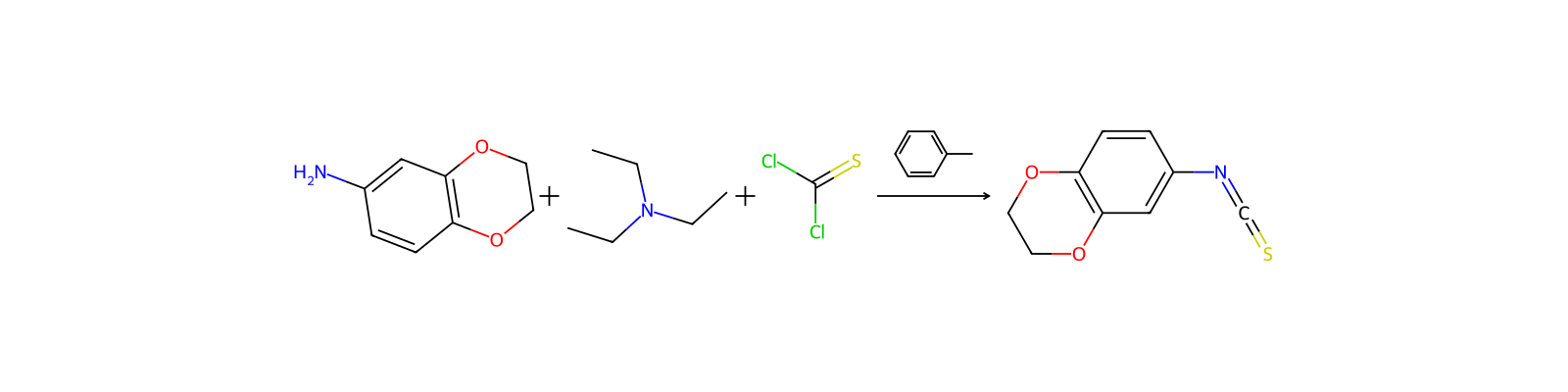
HRID 1476als Eduktuspto-grants-1998_03
Reaktionsgleichung von HRID 5787
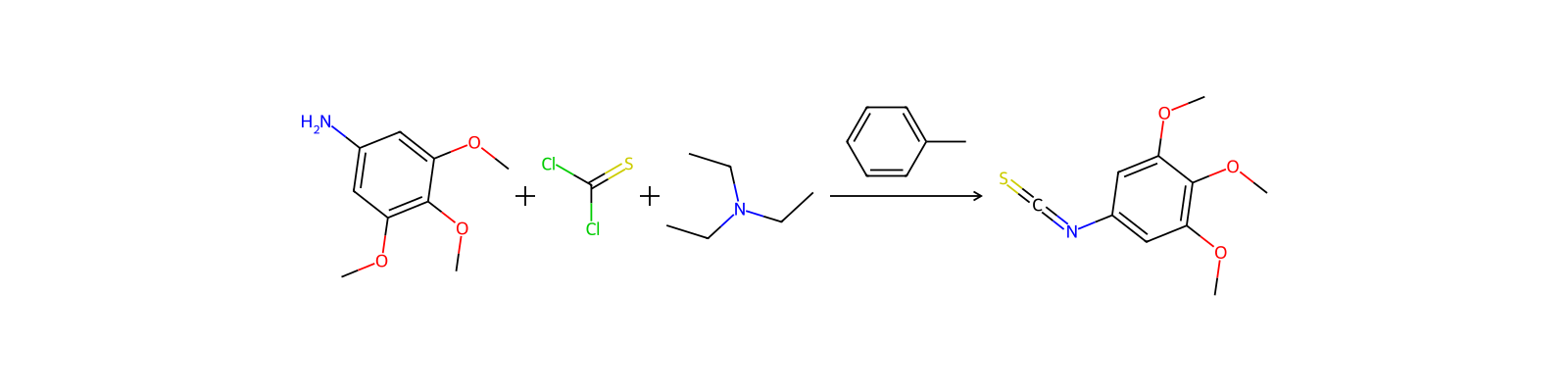
HRID 5787als Eduktuspto-grants-1993_09
Reaktionsgleichung von HRID 5791
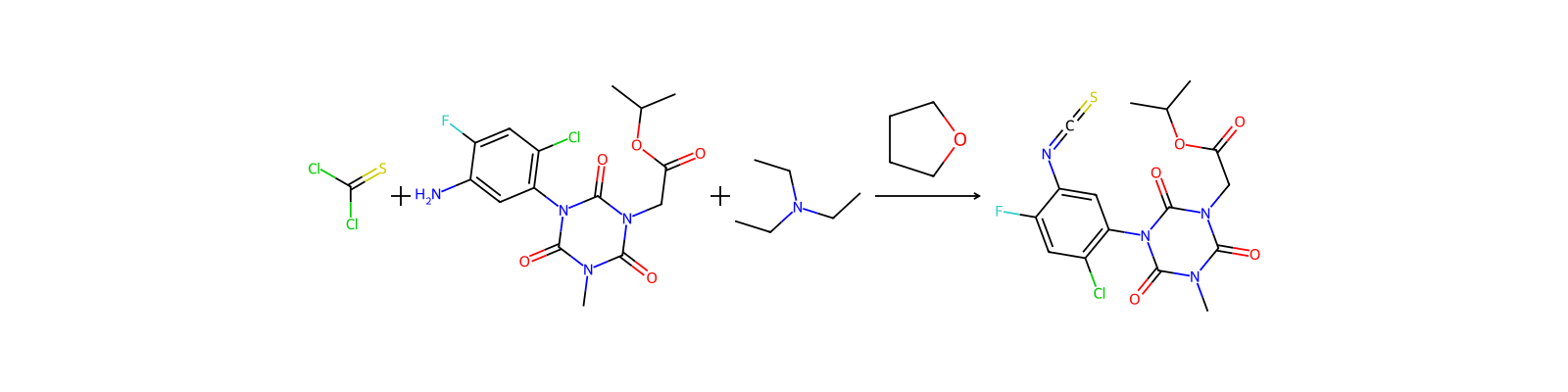
HRID 5791als Eduktuspto-grants-1993_09
Reaktionsgleichung von HRID 5848
HRID 5848als Eduktuspto-grants-1993_09
Reaktionsgleichung von HRID 5856
HRID 5856als Eduktuspto-grants-1993_09
Reaktionsgleichung von HRID 10946
HRID 10946als Eduktuspto-grants-2006_08
Reaktionsgleichung von HRID 13530
HRID 13530als Eduktuspto-grants-2010_06
Reaktionsgleichung von HRID 14692
HRID 14692als Eduktuspto-grants-2010_06
Seite 1 von 135

Notizen zur Verbindung

Wird geladen…

Auf dieser SeiteGrundinformationenNamen und BezeichnerEigenschaftenSicherheit und RegulatorischesChemie und IndustrieZugehörige ReaktionenNotizen zur Verbindung
Weitere Aktionen
Neue NotizNeue ReaktionAnfrage stellen
Vapor Pressure
116.0 [mmHg]
Surface Tension25 dynes/cm= 0.025 N/m @ 20 °C
Refractive IndexIndex of refraction: 1.5442 @ 20 °C/D
Heat of Combustion-3,400 BTU/lb= -1,900 cal/g= -80x10+5 J/kg
Heat of Vaporization128 BTU/lb= 71 cal/g= 3.0x10+5 J/kg

Physikochemische Eigenschaften

Schmelzpunkt
25 °C · <25 °C
Siedepunkt
73 °C · 73 °C
Dichte
1.508 · 1.508
Dampfdichte
4 · 4 (vs air)
Brechungsindex
20 · n20/D 1.548(lit.)
Flammpunkt
62 °C · 62 °C
storage temp.
2 · 2-8°C
Löslichkeit
Chloroform
Aggregatzustand
Liquid
Farbe
A reddish liquid
Wasserlöslichkeit
slow decomposition in cold, fast in hot water
BRN
1633495 · 1633495
Stabilität
2 · Stable. but reacts violently with water to produce toxic fumes. Incompatible with water, alcohols. Refrigerate at 2-8 C.
CAS Datenbank
463 · 463-71-8(CAS DataBase Reference)
NIST chemische Informationen
Carbonothioic dichloride(463-71-8)
EPA chemische Informationen
Thiophosgene (463-71-8)
Health Hazards · 2 Einträge

Inhalation causes irritation of respiratory system and delayed pulmonary edema. Vapor irritates eyes. Liquid burns skin and eyes. Ingestion causes irritation of mouth and stomach. (USCG, 1999)

· TOXIC and/or CORROSIVE; inhalation, ingestion or contact (skin, eyes) with vapors, dusts or substance may cause severe injury, burns or death.;· Contact with molten substance may cause severe burns to skin and eyes.;· Reaction with water or moist air may release toxic, corrosive or flammable gases.;· Reaction with water may generate much heat that will increase the concentration of fumes in the air.;· Fire will produce irritating, corrosive and/or toxic gases.;· Runoff from fire control or dilution water may be corrosive and/or toxic and cause environmental contamination.

Hazards Summary · 2 Einträge

Thiophosgene hydrolyzes (more slowly than phosgene) into CO2, H2S, and HCl. A corrosive lachrymator; [HSDB] Can cause severe burns and delayed pulmonary edema; [CAMEO]

The major hazards encountered in the use and handling of thiophosgene stem from its toxicologic properties. Toxic by all routes (ie, inhalation, ingestion, and dermal contact), exposure to this sharp-smelling, reddish liquid may occur from its use in organic synthesis. Effects from exposure may include contact burns to the skin and eyes, respiratory irritation, pulmonary edema, and death. In activities and situations where over-exposure may occur, wear a self-contained breathing apparatus, and protective clothing specifically recommended by the shipper or producer. If contact should occur, immediately flush affected skin or eyes with running water for at least 15 minutes, and remove contaminated clothing and shoes at the site. While thiophosgene does not ignite easily, it may burn with the production of poisonous gases (eg, phosgene). In addition, thiophosgene decomposes above 200 °C to carbon disulfide (very flammable) and carbon tetrachloride. Containers may explode violently in the heat of a fire. Fires involving thiophosgene may be extinguished with dry chemical, CO2, Halon, water spray, fog, or standard foam. Fight the fire from as far a distance as possible. Thiophosgene may be shipped via air (cargo only), rail (cargo only), road, and water, in containers bearing the label, "Poison". Small spills of thiophosgene may be taken up with sand or other noncombustible absorbent and placed into containers for later disposal. Large spills should be diked far ahead of the spill area to prevent thiophosgene from entering water sources and sewers. Spilled material may be neutralized with crushed limestone, soda ash, or lime. Before implementing land disposal of waste thiophosgene, consult with environmental regulatory agencies for guidance.

DOT ID and Guide2474 156
Reactive GroupHalogenated Organic Compounds;Sulfides, Inorganic
Reactivity Profile · 1 Eintrag

THIOPHOSGENE is incompatible with acids, diazo and azo compounds, halocarbons, isocyanates, aldehydes, alkali metals, nitrides, hydrides, and other strong reducing agents. Reactions with these materials generate heat and in many cases hydrogen gas. Liberates hydrogen sulfide upon reaction with acids.

DOT Emergency Guidelines · 5 Einträge

If ... THERE IS NO FIRE, go directly to the Table of Initial Isolation and Protective Action Distances /(see table below)/ ... to obtain initial isolation and protective action distances. IF THERE IS A FIRE, or IF A FIRE IS INVOLVED, go directly to the appropriate guide /(see guide(s) below)/ and use the evacuation information shown under PUBLIC SAFETY.;Table: Table of Isolation and Protective Action Distances for Thiophosgene [Table#2293]

/GUIDE 157: SUBSTANCES - TOXIC AND/OR CORROSIVE (NON-COMBUSTIBLE/WATER -SENSITIVE)/ Health: TOXIC; inhalation, ingestion or contact (skin, eyes) with vapors, dusts or substance may cause severe injury, burns, or death. Reaction with water or moist air will release toxic, corrosive or flammable gases. Reaction with water may generate much heat which will increase the concentration of fumes in the air. Fire will produce irritating, corrosive and/or toxic gases. Runoff from fire control or dilution water may be corrosive and/or toxic and cause pollution.

/GUIDE 157: SUBSTANCES - TOXIC AND/OR CORROSIVE (NON-COMBUSTIBLE/WATER -SENSITIVE)/ Fire or Explosion: Non-combustible, substance itself does not burn but may decompose upon heating to produce corrosive and/or toxic fumes. Vapors may accumulate in confined areas (basement, tanks, hopper/tank cars etc.). Substance will react with water (some violently), releasing corrosive and/or toxic gases. Contact with metals may evolve flammable hydrogen gas. Containers may explode when heated or contaminated with water.

/GUIDE 157: SUBSTANCES - TOXIC AND/OR CORROSIVE (NON-COMBUSTIBLE/WATER -SENSITIVE)/ Public Safety: CALL Emergency Response Telephone Number ... . As an immediate precautionary measure, isolate spill or leak area in all directions for at least 50 meters (150 feet) for liquids and at least 25 meters (75 feet) for solids. Keep unauthorized personnel away. Stay upwind. Keep out of low areas. Ventilate enclosed areas.

For more DOT Emergency Guidelines (Complete) data for THIOPHOSGENE (9 total), please visit the HSDB record page.

DOT Hazard Classification · 6 Einträge

Thiophosgene

UN2474

Div 6.1 Poisonous materials (49 eCFR § 173.132)

PG I: the degree of danger presented by the material is great;For more information about the packing group assignment, please visit 49 eCFR § 173

Symbol +: Fixes the proper shipping name, hazard class and packing group for that entry

Air and Water ReactionsReacts with water to evolve hydrogen chloride, carbon disulfide, and carbon dioxide. Reaction is slow unless the water is hot.

Sicherheit und Schutzausrüstung

Fire Fighting · 1 Eintrag

Excerpt from ERG Guide 156 [Substances - Toxic and/or Corrosive (Combustible / Water-Sensitive)]:;Note: Most foams will react with the material and release corrosive/toxic gases. CAUTION: For Acetyl bromide (UN1716), use CO2 or dry chemical only.;SMALL FIRE: CO2, dry chemical, dry sand, alcohol-resistant foam.;LARGE FIRE: Water spray, fog or alcohol-resistant foam. FOR CHLOROSILANES, DO NOT USE WATER; use alcohol-resistant foam. If it can be done safely, move undamaged containers away from the area around the fire. Avoid aiming straight or solid streams directly onto the product.;FIRE INVOLVING TANKS, RAIL TANK CARS OR HIGHWAY TANKS: Fight fire from maximum distance or use unmanned master stream devices or monitor nozzles. Do not get water inside containers. Cool containers with flooding quantities of water until well after fire is out. Withdraw immediately in case of rising sound from venting safety devices or discoloration of tank. ALWAYS stay away from tanks in direct contact with flames. (ERG, 2024)

Accidental Release Measures · 2 Einträge

· CALL 911. Then call emergency response telephone number on shipping paper. If shipping paper not available or no answer, refer to appropriate telephone number listed on the inside back cover.;· Keep unauthorized personnel away.;· Stay upwind, uphill and/or upstream.;· Ventilate closed spaces before entering, but only if properly trained and equipped.

· ELIMINATE all ignition sources (no smoking, flares, sparks or flames) from immediate area.;· All equipment used when handling the product must be grounded.;· Do not touch damaged containers or spilled material unless wearing appropriate protective clothing.;· Stop leak if you can do it without risk.;· A vapor-suppressing foam may be used to reduce vapors.;· FOR CHLOROSILANES, use alcohol-resistant foam to reduce vapors.;· DO NOT GET WATER on spilled substance or inside containers.;· Use water spray to reduce vapors or divert vapor cloud drift. Avoid allowing water runoff to contact spilled material.;· Prevent entry into waterways, sewers, basements or confined areas.;Small Spill;· Cover with DRY earth, DRY sand or other non-combustible material followed with plastic sheet to minimize spreading or contact with rain.;· Use clean, non-sparking tools to collect material and place it into loosely covered plastic containers for later disposal.

First Aid · 2 Einträge

Get medical attention at once after any exposure to this compound.;INHALATION: remove victim from exposure; support respiration; watch for pulmonary edema.;EYES: irrigate with large quantities of water for 15 min.;SKIN: flush with water.;INGESTION: do NOT induce vomiting; give large amount of water. (USCG, 1999)

General First Aid:;· Call 911 or emergency medical service.;· Ensure that medical personnel are aware of the material(s) involved, take precautions to protect themselves and avoid contamination.;· Move victim to fresh air if it can be done safely.;· Administer oxygen if breathing is difficult.;· If victim is not breathing:;-- DO NOT perform mouth-to-mouth resuscitation; the victim may have ingested or inhaled the substance.;-- If equipped and pulse detected, wash face and mouth, then give artificial respiration using a proper respiratory medical device (bag-valve mask, pocket mask equipped with a one-way valve or other device).;-- If no pulse detected or no respiratory medical device available, provide continuous compressions. Conduct a pulse check every two minutes or monitor for any signs of spontaneous respirations.;· Remove and isolate contaminated clothing and shoes.;· For minor skin contact, avoid spreading material on unaffected skin.;· In case of contact with substance, remove immediately by flushing skin or eyes with running water for at least 20 minutes.;· For severe burns, immediate medical attention is required.;· Effects of exposure (inhalation, ingestion, or skin contact) to substance may be delayed.;· Keep victim calm and warm.;· Keep victim under observation.;· For further assistance, contact your local Poison Control Center.;· Note: Basic Life Support (BLS) and Advanced Life Support (ALS) should be done by trained professionals.;Specific First Aid:;· For corrosives, in case of contact, immediately flush skin or eyes with running water for at least 30 minutes. Additional flushing may be required.

Exposure Control and Personal Protection · 2 Einträge

· Wear positive pressure self-contained breathing apparatus (SCBA).;· Wear chemical protective clothing that is specifically recommended by the manufacturer when there is NO RISK OF FIRE.;· Structural firefighters' protective clothing provides thermal protection but only limited chemical protection.

TIH (Toxic Inhalation Hazard) - Term used to describe gases and volatile liquids that are toxic when inhaled. Some are TIH materials themselves, e.g., chlorine, and some release TIH gases when spilled in water, e.g., chlorosilanes. [ERG 2016].

Fire Fighting Procedures · 1 Eintrag

If material involved in fire Extinguish fire using agent suitable for type of surrounding fire. (Material itself does not burn or burns with difficulty.) Use foam, dry chemical, or carbon dioxide. Cool all affected containers with flooding quantities of water. Do not use water on material itself. If large quantities of combustibles are involved, use water in flooding quantities as spray and fog. Use water spray to knock down vapors.

Nonfire Spill Response · 1 Eintrag

Excerpt from ERG Guide 156 [Substances - Toxic and/or Corrosive (Combustible / Water-Sensitive)]:;ELIMINATE all ignition sources (no smoking, flares, sparks or flames) from immediate area. All equipment used when handling the product must be grounded. Do not touch damaged containers or spilled material unless wearing appropriate protective clothing. Stop leak if you can do it without risk. A vapor-suppressing foam may be used to reduce vapors. FOR CHLOROSILANES, use alcohol-resistant foam to reduce vapors. DO NOT GET WATER on spilled substance or inside containers. Use water spray to reduce vapors or divert vapor cloud drift. Avoid allowing water runoff to contact spilled material. Prevent entry into waterways, sewers, basements or confined areas.;SMALL SPILL: Cover with DRY earth, DRY sand or other non-combustible material followed with plastic sheet to minimize spreading or contact with rain. Use clean, non-sparking tools to collect material and place it into loosely covered plastic containers for later disposal. (ERG, 2024)

Disposal Methods · 1 Eintrag

SRP: At the time of review, criteria for land treatment or burial (sanitary landfill) disposal practices are subject to significant revision. Prior to implementing land disposal of waste residue (including waste sludge), consult with environmental regulatory agencies for guidance on acceptable disposal practices.

Preventive Measures · 4 Einträge

Personnel protection Avoid breathing vapors. Keep upwind. ... Avoid bodily contact with the material. Do not handle broken packages unless wearing appropriate personal protective equipment. Wash away any material which may have contacted the body with copious amounts of water or soap and water.

SRP: Contaminated protective clothing should be segregated in such a manner so that there is no direct personal contact by personnel who handle, dispose, or clean the clothing. Quality assurance to ascertain the completeness of the cleaning procedures should be implemented before the decontaminated protective clothing is returned for reuse by the workers. Contaminated clothing should not be taken home at end of shift, but should remain at employee's place of work for cleaning.

If material not involved in fire: Keep material out of water sources and sewers. Build dikes to contain flow as necessary. Use water spray to knock down vapors. Do not use water on material itself. Neutralize spilled material with crushed limestone, soda ash, or lime.

SRP: The scientific literature for the use of contact lenses in industry is conflicting. The benefit or detrimental effects of wearing contact lenses depend not only upon the substance, but also on factors including the form of the substance, characteristics and duration of the exposure, the uses of other eye protection equipment, and the hygiene of the lenses. However, there may be individual substances whose irritating or corrosive properties are such that the wearing of contact lenses would be harmful to the eye. In those specific cases, contact lenses should not be worn. In any event, the usual eye protection equipment should be worn even when contact lenses are in place.

Isolation and Evacuation · 4 Einträge

Excerpt from ERG Guide 156 [Substances - Toxic and/or Corrosive (Combustible / Water-Sensitive)]:;IMMEDIATE PRECAUTIONARY MEASURE: Isolate spill or leak area in all directions for at least 50 meters (150 feet) for liquids and at least 25 meters (75 feet) for solids.;SPILL: See ERG Table 1 - Initial Isolation and Protective Action Distances on the UN/NA 2474 datasheet.;FIRE: If tank, rail tank car or highway tank is involved in a fire, ISOLATE for 800 meters (1/2 mile) in all directions; also, consider initial evacuation for 800 meters (1/2 mile) in all directions. (ERG, 2024)

Immediate precautionary measure;· Isolate spill or leak area in all directions for at least 50 meters (150 feet) for liquids and at least 25 meters (75 feet) for solids.;Spill;· For highlighted materials: see Table 1 - Initial Isolation and Protective Action Distances.;· For non-highlighted materials: increase the immediate precautionary measure distance, in the downwind direction, as necessary.;Fire;· If tank, rail tank car or highway tank is involved in a fire, ISOLATE for 800 meters (1/2 mile) in all directions; also, consider initial evacuation for 800 meters (1/2 mile) in all directions.

Small spill:;- ISOLATE in all directions: 60 m (200 ft);Large spill:;- ISOLATE in all directions: 200 m (600 ft)

Small spill:;- PROTECT people from downwind during DAY time: 0.6 km (0.4 mi);- PROTECT people from downwind during NIGHT time: 1.8 km (1.1 mi);Large spill:;- PROTECT people from downwind during DAY time: 2.3 km (1.4 mi);- PROTECT people from downwind during NIGHT time: 4.2 km (2.6 mi)

Personal Protective Equipment (PPE) · 2 Einträge

Self-contained breathing apparatus or organic canister mask; goggles or face shield; rubber gloves (USCG, 1999)

/Wear a/ self contained breathing apparatus or organic canister mask; goggles or face shield; rubber gloves.

Emergency Response Planning Guidelines · 1 Eintrag

· Note: Most foams will react with the material and release corrosive/toxic gases.;CAUTION: For Acetyl bromide (UN1716), use CO2 or dry chemical only.;Small Fire;· CO2, dry chemical, dry sand, alcohol-resistant foam.;Large Fire;· Water spray, fog or alcohol-resistant foam.;· FOR CHLOROSILANES, DO NOT USE WATER; use alcohol-resistant foam.;· If it can be done safely, move undamaged containers away from the area around the fire.;· Avoid aiming straight or solid streams directly onto the product.;Fire Involving Tanks, Rail Tank Cars or Highway Tanks;· Fight fire from maximum distance or use unmanned master stream devices or monitor nozzles.;· Do not get water inside containers.;· Cool containers with flooding quantities of water until well after fire is out.;· Withdraw immediately in case of rising sound from venting safety devices or discoloration of tank.;· ALWAYS stay away from tanks in direct contact with flames.

Acute Exposure Guideline Levels (AEGLs)The compound is currently at the Holding Status AEGLs which have been reviewed by the NAC/AEGL Committee and are on hold due to insufficient data to develop AEGL values.

Toxikologische Informationen

Adverse EffectsDermatotoxin - Skin burns.;Lacrimator (Lachrymator) - A substance that irritates the eyes and induces the flow of tears.;Toxic Pneumonitis - Inflammation of the lungs induced by inhalation of metal fumes or toxic gases and vapors.
Human Toxicity ExcerptsContact with skin can cause severe burns.
Non-Human Toxicity ExcerptsThiophosgene was mutagenic when tested using histidine auxotroph Salmonella typhimurium.
Antidote and Emergency Treatment · 2 Einträge

Basic treatment: Establish a patent airway. Suction if necessary. Watch for signs of respiratory insufficiency and assist ventilations if necessary. Administer oxygen by nonrebreather mask at 10 to 15 L/min. Monitor for pulmonary edema and treat if necessary ... . Anticipate seizures and treat if necessary ... . For eye contamination, flush eyes immediately with water. Irrigate each eye continuously with normal saline during transport ... . Do not use emetics. For ingestion, rinse mouth and administer 5 m1/kg up to 200 ml of water for dilution if the patient can swallow, has a strong gag reflex, and does not drool ... . Cover skin burns with dry sterile dressings after decontamination ... . /Phosgene and related compounds/

Advanced treatment: Consider orotracheal or nasotracheal intubation for airway control in the patient who is unconscious, has severe pulmonary edema, or is in respiratory arrest. Positive-pressure ventilation techniques with a bag-valve-mask device may be beneficial. Monitor cardiac rhythm and treat arrhythmias if necessary ... . Start an IV with D5W /SRP: "To keep open", minimal flow rate/. Use lactated Ringer's if signs of hypovolemia are present. Watch for signs of fluid overload. Consider drug therapy for pulmonary edema ... . Treat seizures with diazepam (Valium) ... . Use proparacaine hydrochloride to assist eye irrigation ... . /Phosgene and related compounds/

Non-Human Toxicity Values · 2 Einträge

LD50 Mouse iv 100 mg/kg

LD50 Rat oral 929 mg/kg

Regulatorische Informationen

Regulatory Information · 4 Einträge

Chemical: Carbonothioic dichloride

Status: No longer Valid Update: 23-05-2018 https://echa.europa.eu/registration-dossier/-/registered-dossier/25354

Thiophosgene: HSNO Approval: HSR003934 Approved with controls

The New Jersey Worker and Community Right to Know Act requires public and private employers to provide information about hazardous substances at their workplaces. (N.J.S.A. 34:5A-1 et. seq.)

Sicherheitsdaten

F
19-21
wgk
1
tsca
TSCA listed
ridadr
UN 2474
hs_code
28530090
RTECS-Nr.
XN2450000
risk_code
22-23-36/37/38
hazard_code
T
safety_code
7-9-36/37-45-7/9
hazard_class
6.1
packing_group
I
Giftige Stoffe Daten
463-71-8(Hazardous Substances Data)
Di-2-pyridyl thionocarbonate
2-(6-Hydroxy-3-oxo-(3H)-xanthen-9-yl)-5-isothiocyanatobenzoesure
o-Ethoxyphenylisothiocyanat
3,4-Methylenedioxyphenyl isothiocyanate
3-Isothiocyanato-1,5-dimethyl-1H-pyrazole
3-Chloro-2-methylphenyl isothiocyanate
3,5-Dimethylphenyl isothiocyanate
2-(1,3-Dimethyl-1H-pyrazol-5-yl)ethenethione
2,3-Dihydro-1,4-benzodioxin-6-yl isothiocyanate
5-Bromo-6-isothiocyanate quinoxaline
1,4-Diisothiocyanatobenzol
Amoscanate
2-Isothiocyanato-4,6-dimethoxypyrimidine
4-Carboxyphenyl isothiocyanate
4-(1H-Pyrazol-1-yl)phenyl isothiocyanate
3,5-Dimethoxyphenyl isothiocyanate
1,3-diisopropyl-2-isothiocyanato-5-phenoxybenzene
5-Isothiocyanato-1,3-dimethyl-1H-pyrazole
3-Chlor-6-isothiocyanatotoluol
2-Chloro-4-methylphenyl isothiocyanate