StartseiteMCPWorkbenchSkills
StartseiteWorkbenchBenachrichtigungenMein Bereich
llms.txt · MCP-AnleitungDatenschutz · Nutzungsbedingungen · Supportv1.8.3
  1. Startseite
  2. /Verbindung

N-Hydroxybenzamid

Benzohydroxamic acid

HCID 10313
Neue Reaktion
Drucken
GrundinformationenÜberblickNamen und BezeichnerEigenschaftenSicherheit und RegulatorischesChemie und IndustrieZugehörige ReaktionenNotizen zur Verbindung
TeilstruktursucheÄhnliche Strukturen suchen

Grundinformationen

CAS
32685-16-8
Standard-SMILES
O=C(NO)c1ccccc1
InChIKey
VDEUYMSGMPQMIK-UHFFFAOYSA-N
Summenformel
C7H7NO2
Durchschnittliche Molmasse
137,14 g/mol
Monoisotopische Masse
137,04767847

Überblick

Rhombic crystals or light beige solid. (NTP, 1992)

Namen und Bezeichner

Bevorzugter Name
Benzohydroxamic acid
IUPAC
N-hydroxybenzamide
Lokaler Name
N-Hydroxybenzamid
Englischer Name
Benzohydroxamic acid
Summenformel
C7H7NO2
Molmasse
137.14

Namen und Synonyme

N-HydroxybenzamideBENZOHYDROXAMIC ACID495-18-1Benzhydroxamic acidBenzamide, N-hydroxy-Phenylhydroxamic acidBenzoylhydroxamic acidHydroxylamine, N-benzoyl-DTXSID7025421K8YW73872DNSC-147248DTXCID305421
Weitere Namen anzeigen
BHAMNSC 3136NSC 147248n-hydroxy-benzamidBenzohydroxamsαureBENZOHYROXAMICACID
RefChem:163535207-797-6BenzohydroxamateN-Hydroxy-benzamideBenzohyroxamatebenzenecarbohydroxamic acidN-Benzoylhydroxylamine122231-61-2

Datenbank-Bezeichner

CAS
32685-16-8、495-18-1
PubChem CID
10313
DTXSID
DTXSID7025421
ChEMBL
CHEMBL16300
UNII
K8YW73872D
EC Number
207-797-6
Nikkaji
J1.560A

Eigenschaften

Berechnete Struktureigenschaften

XLogP
0,3
Polarare Oberfläche (TPSA)
49,3 Ų
H-Brücken-Donoren
2
H-Brücken-Akzeptoren
2
Frei drehbare Bindungen
1
Schwere Atome
10
Formalladung
0
Komplexität
119

Experimentelle und physikochemische Eigenschaften

DrugsPharmaceuticals -> Listed in ZINC15
SpringerMaterials PropertiesChemical shift
LogP0.26
Solubility5 to 10 mg/mL at 74.7 °F (NTP, 1992)
Boiling PointExplodes (NTP, 1992)
Melting Point259 to 266 °F (NTP, 1992)
Physical DescriptionRhombic crystals or light beige solid. (NTP, 1992)

Physikochemische Eigenschaften

Schmelzpunkt
126 · 126-130 °C(lit.)
Siedepunkt
251.96 °C · 251.96°C (rough estimate)
Dichte
1.2528 · 1.2528 (rough estimate)

Sicherheit und Regulatorisches

Sicherheitsangaben dienen nur zur Orientierung und ersetzen weder das Sicherheitsdatenblatt (SDB) des Lieferanten noch geltende Vorschriften oder eine fachliche Bewertung.

GHS-Klassifizierung

GHS Classification · 4 Einträge

Warning

H315 (100%): Causes skin irritation [Warning Skin corrosion/irritation]

P203, P261, P264, P264+P265, P271, P280, P302+P352, P304+P340, P305+P351+P338, P318, P319, P321, P332+P317, P337+P317, P362+P364, P403+P233, P405, and P501 (click each P-code to see the statement)

Aggregated GHS information provided per 33 reports by companies from 3 notifications to the ECHA C&L Inventory. Each notification may be associated with multiple companies.

Gefahrenhinweise

Regulatory Information · 3 Einträge

Chemical: Benzamide, N-hydroxy-

REACH registered substance: N-hydroxybenzamide (EC: 207-797-6)

Benzamide, N-hydroxy-: Does not have an individual approval but may be used under an appropriate group standard

Fire HazardsFlash point data for this chemical are not available; however, it is probably combustible. (NTP, 1992)
Health HazardsACUTE/CHRONIC HAZARDS: When heated to decomposition this compound emits toxic fumes of nitrogen oxides. (NTP, 1992)
Reactive GroupAlcohols and Polyols
Reactivity Profile · 1 Eintrag

N-HYDROXYBENZAMIDE is an amide. Amides/imides react with azo and diazo compounds to generate toxic gases. Flammable gases are formed by the reaction of organic amides/imides with strong reducing agents. Amides are very weak bases (weaker than water). Imides are less basic yet and in fact react with strong bases to form salts. That is, they can react as acids. Mixing amides with dehydrating agents such as P2O5 or SOCl2 generates the corresponding nitrile. The combustion of these compounds generates mixed oxides of nitrogen (NOx).

Chemie und Industrie

Verwendung und Herstellung

General Manufacturing InformationBenzamide, N-hydroxy-: ACTIVE
Anwendungen · 1 Eintrag

VerwendenBenzhydroxamic acid is used as precursor in the synthesis of novel mono-anionic and di-anionic hydroxamato complexes by reacting with BiPh3 and Bi(O(t)Bu)3, which has anti-bacterial activity against helicobacter pylori. It is used in the photometric determination of trace amounts of vanadium in alloy steels by making mixed-ligand vanadium chelates with ammonium thiocyanate. It is also involved in the palladium catalyzed synthesis of benzisoxazolones.

Darstellung · 1 Eintrag

synthetischeTo a rapidly stirred suspension of 19.6 gm (0.35 mole) of powdered anhydrous potassium hydroxide in 120 ml of pyridine, maintained at 0-5°C, is a added a solution of 13.9 gm (0.2 mole) of hydroxylamine hy­drochloride in 100 ml of pyridine. While maintaining the reaction temperature at 0-5°C, 15 gm (0.1 mole) of ethyl benzoate is added. Vigorous stirring is continued at room tempera­ture for 6 hr. Then the solids are filtered off. The solids are washed with cold water to remove inorganic coproducts. The remainder, recrystallized from aqueous ethanol, represents a 94% yield of potassium benzohy­droxamate. This salt is triturated with cold 0.01 TV hydrochloric acid. From this mixture, by the usual procedures, 12.5 gm (91% overall) of benzohydrox­amic acid is isolated, m.p. 131°C (from aqueous alcohol).

Vor- und nachgelagerte Produkte

Vorgelagerte Rohstoffe

NatriumchloridEthylacetatHydrogenchloridMethanol

Zugehörige Reaktionen

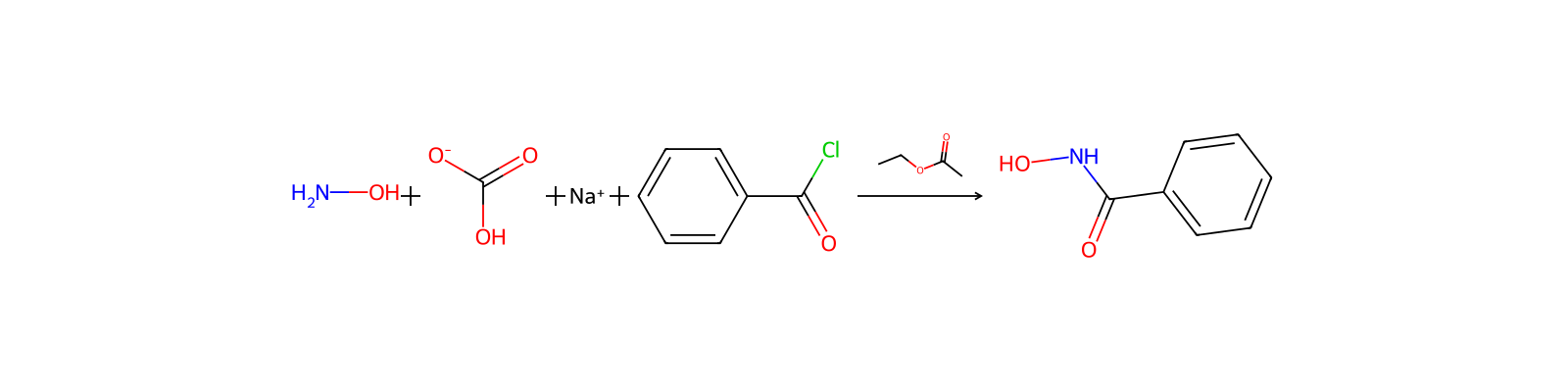
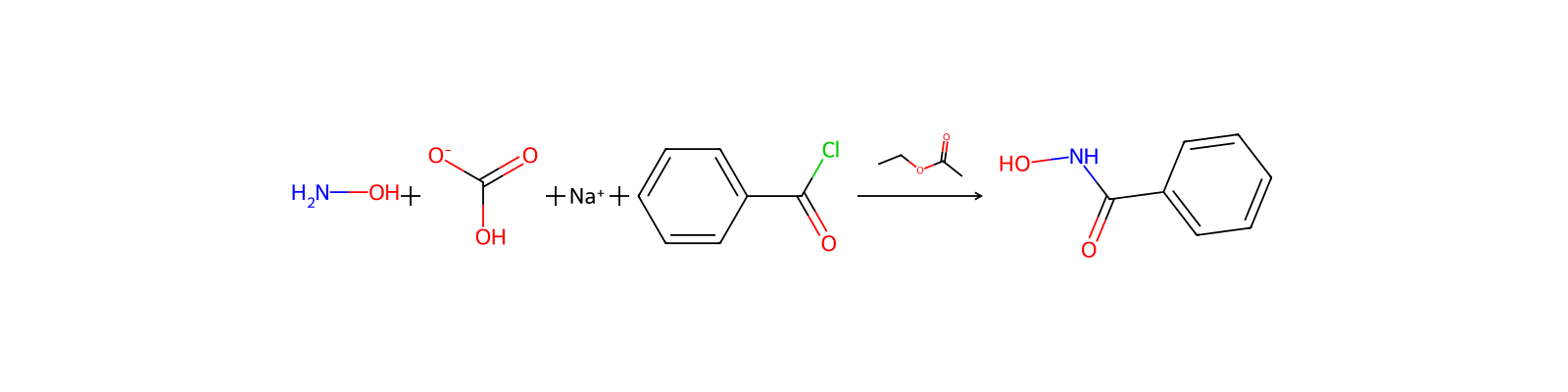
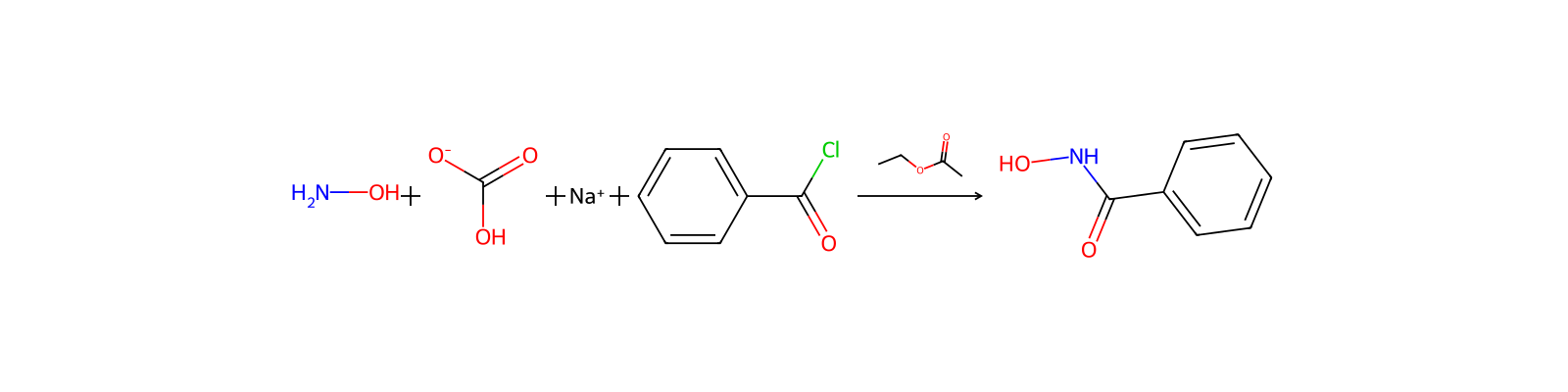
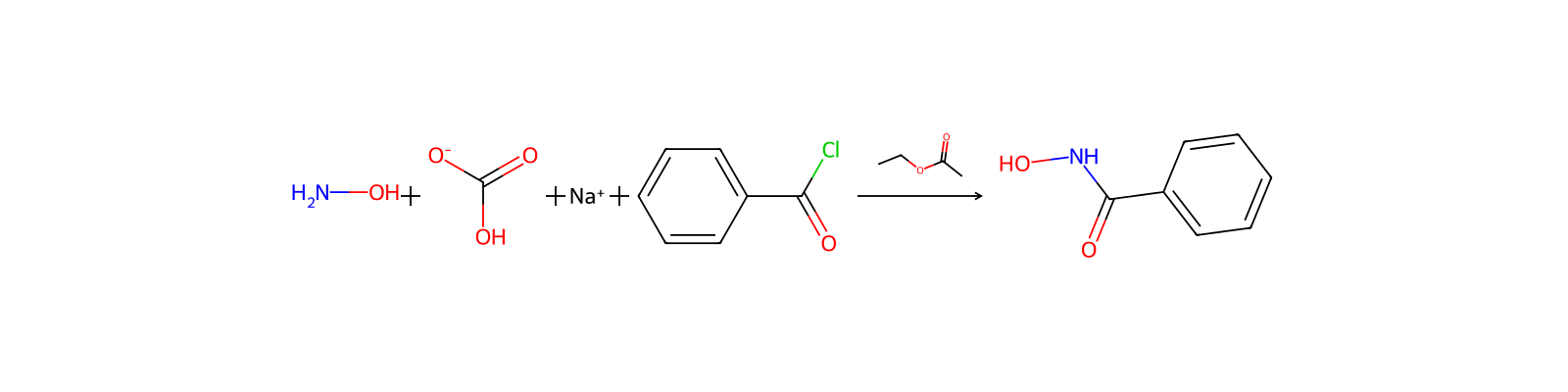
15
Reaktionsaufzeichnung erstellen
Reaktionsgleichung von HRID 108023
HRID 108023als Produkt
Reaktionsgleichung von HRID 336118
HRID 336118als Edukt
Reaktionsgleichung von HRID 351363
HRID 351363als Edukt
Reaktionsgleichung von HRID 358976
HRID 358976als Edukt
Reaktionsgleichung von HRID 369476
HRID 369476als Produkt
Reaktionsgleichung von HRID 369477
HRID 369477als Produkt
Reaktionsgleichung von HRID 369478
HRID 369478als Produkt
Reaktionsgleichung von HRID 369479
HRID 369479als Produkt
ZurückSeite 1 von 2

Notizen zur Verbindung

Auf dieser SeiteGrundinformationenÜberblickNamen und BezeichnerEigenschaftenSicherheit und RegulatorischesChemie und IndustrieZugehörige ReaktionenNotizen zur Verbindung
Brechungsindex
1.503 · 1.5030 (estimate)
storage temp.
2 · 2-8°C
Löslichkeit
Soluble in alcohol. Slightly soluble in ether. Insoluble in benzene.
pka
1 · pK1: 8.89(0) (20°C)
Aggregatzustand
Solid
Farbe
Rhombic tablets
Wasserlöslichkeit
22 g/L · 22 g/L (6 ºC)
BRN
1907585 · 1907585
Stabilität
Moisture and Temperature Sensitive
InChI
1S/C7H7NO2/c9-7(8-10)6-4-2-1-3-5-6/h1-5,10H,(H,8,9)
InChIKey
VDEUYMSGMPQMIK-UHFFFAOYSA-N
SMILES
ONC(=O)c1ccccc1
CAS Datenbank
495 · 495-18-1(CAS DataBase Reference)
NIST chemische Informationen
Benzamide, n-hydroxy-(495-18-1)
EPA chemische Informationen
Benzohydroxamic acid (495-18-1)
Air and Water ReactionsSlightly soluble in water.
Hazard Classes and CategoriesSkin Irrit. 2 (100%)

Sicherheit und Schutzausrüstung

Fire FightingFires involving this material can be controlled with a dry chemical, carbon dioxide or Halon extinguisher. (NTP, 1992)
First Aid · 1 Eintrag

EYES: First check the victim for contact lenses and remove if present. Flush victim's eyes with water or normal saline solution for 20 to 30 minutes while simultaneously calling a hospital or poison control center. Do not put any ointments, oils, or medication in the victim's eyes without specific instructions from a physician. IMMEDIATELY transport the victim after flushing eyes to a hospital even if no symptoms (such as redness or irritation) develop.

Nonfire Spill Response · 1 Eintrag

SMALL SPILLS AND LEAKAGE: If you spill this chemical, you should dampen the solid spill material with water, then transfer the dampened material to a suitable container. Use absorbent paper dampened with water to pick up any remaining material. Seal your contaminated clothing and the absorbent paper in a vapor-tight plastic bag for eventual disposal. Wash all contaminated surfaces with a soap and water solution. Do not reenter the contaminated area until the Safety Officer (or other responsible person) has verified that the area has been properly cleaned.

Personal Protective Equipment (PPE) · 1 Eintrag

RECOMMENDED RESPIRATOR: Where the neat test chemical is weighed and diluted, wear a NIOSH-approved half face respirator equipped with an organic vapor/acid gas cartridge (specific for organic vapors, HCl, acid gas and SO2) with a dust/mist filter. (NTP, 1992)

Sicherheitsdaten

wgk
3
tsca
TSCA listed
hs_code
2928000090
RTECS-Nr.
DF9650000
risk_code
68-40-20/21/22
Toxizität
LD orl-rat: >500 mg/kg NCNSA6 5,26,53
hazard_code
Xn
safety_code
45-36/37-36-22
Speicherklasse
11 - Combustible Solids
Natriumhydroxid
Hydroxylammoniumchlorid
Hydroxylammoniumsulfat
Methylbenzoat
Ethylbenzoat

Nachgelagerte Produkte

2-MorpholinoanilineN-(but-3-enyloxy)benzaMide