StartseiteMCPWorkbenchSkills
StartseiteWorkbenchBenachrichtigungenMein Bereich
llms.txt · MCP-AnleitungDatenschutz · Nutzungsbedingungen · Supportv1.8.0
  1. Startseite
  2. /Verbindung

1,3-Epoxypropan

Oxetane

HCID 10423
Neue NotizNeue ReaktionAnfrage stellen
Druckvorschau
GrundinformationenÜberblickNamen und BezeichnerEigenschaftenSicherheit und RegulatorischesChemie und IndustrieZugehörige ReaktionenNotizen zur Verbindung
TeilstruktursucheÄhnliche Strukturen suchen

Grundinformationen

CAS
503-30-0
Standard-SMILES
C1COC1
InChIKey
AHHWIHXENZJRFG-UHFFFAOYSA-N
Summenformel
C3H6O
Durchschnittliche Molmasse
58,08 g/mol
Monoisotopische Masse
58,04186481

Überblick

1,3-propylene oxide is a clear, colorless liquid with an agreeable aromatic odor. (NTP, 1992)

Namen und Bezeichner

Bevorzugter Name
Oxetane
IUPAC
oxetane
Lokaler Name
1,3-Epoxypropan
Englischer Name
Trimethylene oxide
Summenformel
C3H6O
Molmasse
58.08

Namen und Synonyme

OxetaneTrimethylene oxide503-30-01,3-Propylene oxideOxacyclobutane1,3-EPOXYPROPANECyclooxabutaneTrimethylenoxidOxetan1,3-Trimethylene oxidePropane, 1,3-epoxy-alpha,gamma-Propane oxide
Weitere Namen anzeigen
OXECTANE1,3-EPOXYPROPAN
DTXSID8025969I279Q16FU6NSC-30086DTXCID705969CHEBI:30965RefChem:168900207-964-3Trimethylenoxid [German]

Datenbank-Bezeichner

CAS
503-30-0
PubChem CID
10423
DTXSID
DTXSID8025969
ChEMBL
CHEMBL1538076
ChEBI
CHEBI:30965
UNII
I279Q16FU6
EC Number
207-964-3
Nikkaji
J6.210C

Eigenschaften

Berechnete Struktureigenschaften

XLogP
-0,1
Polarare Oberfläche (TPSA)
9,2 Ų
H-Brücken-Donoren
0
H-Brücken-Akzeptoren
1
Frei drehbare Bindungen
0
Schwere Atome
4
Formalladung
0
Komplexität
17,2

Experimentelle und physikochemische Eigenschaften

Chemical ClassesOther Classes -> Other Organic Compounds
SpringerMaterials PropertiesSchoenflies notation
LogP · 2 Einträge

log Kow= -0.14

-0.14

OdorAgreeable aromatic odor
Density · 2 Einträge

0.893 at 77 °F (NTP, 1992) - Less dense than water; will float

0.8930 @ 25 °C/4 °C

Color/FormOil
Solubility · 3 Einträge

10 to 50 mg/mL at 68 °F (NTP, 1992)

SOL IN ALL PROPORTIONS OF WATER, ALCOHOL; SOL IN ETHER; VERY SOL IN ACETONE, ORGANIC SOLVENTS

In water, miscible.

Flash Point · 2 Einträge

-19 °F (NTP, 1992)

-28 °C

Boiling Point · 2 Einträge

122 °F at 760 mmHg (NTP, 1992)

48 °C @ 750 mm Hg

Sicherheit und Regulatorisches

Sicherheitsangaben dienen nur zur Orientierung und ersetzen weder das Sicherheitsdatenblatt (SDB) des Lieferanten noch geltende Vorschriften oder eine fachliche Bewertung.

GHS-Klassifizierung

GHS Classification · 6 Einträge

Danger

H225: Highly Flammable liquid and vapor [Danger Flammable liquids]

P210, P233, P240, P241, P242, P243, P261, P264, P270, P271, P280, P301+P317, P302+P352, P303+P361+P353, P304+P340, P317, P321, P330, P362+P364, P370+P378, P403+P235, and P501 (click each P-code to see the statement)

Danger

H225 (100%): Highly Flammable liquid and vapor [Danger Flammable liquids]

P210, P233, P240, P241, P242, P243, P261, P264, P270, P271, P280, P301+P317, P302+P352, P303+P361+P353, P304+P340, P317, P321, P330, P362+P364, P370+P378, P403+P235, and P501 (click each P-code to see the statement)

Gefahrenhinweise

Regulatory Information1,3-Trimethylene oxide: HSNO Approval: HSR004981 Approved with controls
DOT LabelFlammable Liquid
Fire HazardsThis chemical is flammable. (NTP, 1992)
Health HazardsSYMPTOMS: Exposure to this compound may cause irritation.
Hazards SummaryA tumorigen and a mutagen; [RTECS] May cause irritation; Harmful by inhalation, ingestion, and skin absorption; [CAMEO] An irritant; [MSDSonline]
Reactive GroupEpoxides
Reactivity AlertsHighly Flammable
Reactivity Profile · 1 Eintrag

1,3-PROPYLENE OXIDE reacts with Grignard reagents and organolithium compounds. It is also incompatible with oxidizing agents and strong acids. (NTP, 1992). An explosion occurred when propylene oxide was added to epoxy resin. Polymerization was catalyzed by amine accelerator in the resin [Bretherick 1995]. Propylene oxide and sodium hydroxide base-catalyzed the polymerization of the former, causing ignition and explosion of a drum of the crude product. [Combust Sci. Technol., 1983].

Chemie und Industrie

Verwendung und Herstellung

Uses · 4 Einträge

Used as a chemical intermediate for epoxy resins and 3-substituted propanols; [HSDB]

CHEM INT, EG, FOR EPOXY RESINS & 3-SUBSTITUTED PROPANOLS

Photoreactions leading to carefully selected oxetanes are impressive tools in the construction of complex molecules ... such as drugs, crop protection agents, and fragrants. /Oxetanes/

/Chemical intermediate/

Methods of Manufacturing · 2 Einträge

Prepd by dropwise addition of 3-chloropropyl acetate to hot potassium hydroxide soln: Noller, Org Syn 29, 92 (1949); modified procedure: Searles, J Am Chem Soc, 73, 124 (1951).

REACTION OF 3-BROMOPROPANOL WITH POTASSIUM HYDROXIDE

General Manufacturing InformationOxetane: ACTIVE

Anwendungen

VerwendenTrimethylene oxide useful for the synthesis of 3-substituted propanols by reaction with Grignards or organolithiums in the presence of CuBr.

Vor- und nachgelagerte Produkte

Vorgelagerte Rohstoffe

Tributylzinnbromid2H-Oxete3-Chlorpropan-1-olEthyl 1-acetylcyclobutane-1-carboxylate1,3-DibrompropanDimethyl 1,1-cyclobutanedicarboxylateDiethyl-1,1-cyclobutandicarboxylat

Zugehörige Reaktionen

48
Reaktionsaufzeichnung erstellen
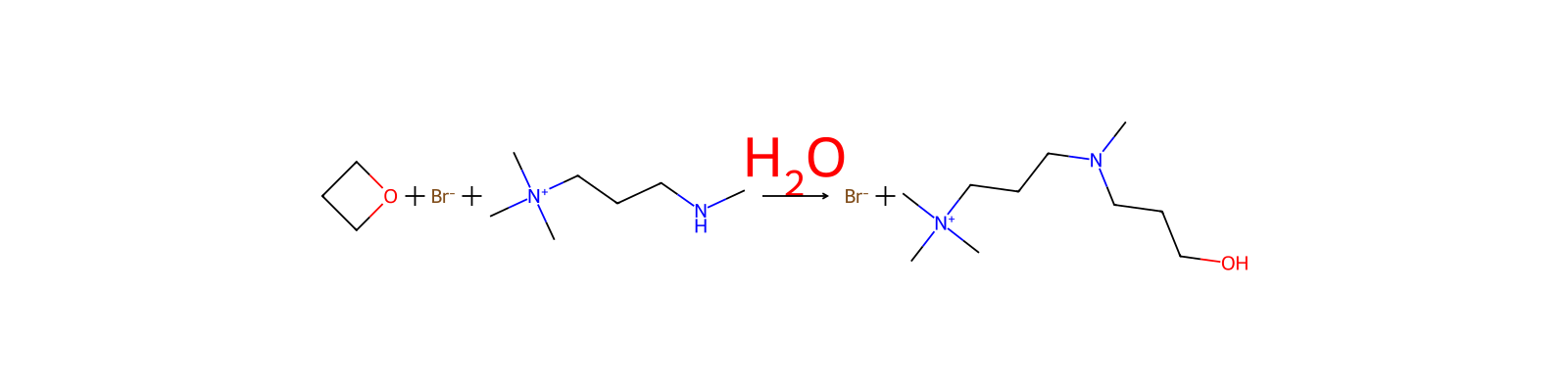
Reaktionsgleichung von HRID 5213
HRID 5213als Eduktuspto-grants-1993_09
Reaktionsgleichung von HRID 5216
HRID 5216als Eduktuspto-grants-1993_09
Reaktionsgleichung von HRID 135345
HRID 135345als EduktTraining data from https://doi.org/10.1039/C8SC04228D (9/10)
Reaktionsgleichung von HRID 143356
HRID 143356als EduktTraining data from https://doi.org/10.1039/C8SC04228D (9/10)
Reaktionsgleichung von HRID 263167
HRID 263167als Eduktuspto-grants-1979_05
Reaktionsgleichung von HRID 263176
HRID 263176als Eduktuspto-grants-1979_05
Reaktionsgleichung von HRID 287428
HRID 287428als EduktTraining data from https://doi.org/10.1039/C8SC04228D (8/10)
Reaktionsgleichung von HRID 287859
HRID 287859als EduktTraining data from https://doi.org/10.1039/C8SC04228D (8/10)
Seite 1 von 6

Notizen zur Verbindung

Wird geladen…

Auf dieser SeiteGrundinformationenÜberblickNamen und BezeichnerEigenschaftenSicherheit und RegulatorischesChemie und IndustrieZugehörige ReaktionenNotizen zur Verbindung
Weitere Aktionen
Neue NotizNeue ReaktionAnfrage stellen
DecompositionWhen heated to decomposition it emits acrid smoke and irritating fumes.
Vapor Pressure · 2 Einträge

324.0 [mmHg]

324 mm Hg @ 25 °C

Refractive IndexIndex of refraction: 1.3895 @ 25 °C/D

Physikochemische Eigenschaften

Schmelzpunkt
97 °C · −97 °C (−143 °F; 176 K)
Siedepunkt
49 to · 49 to 50 °C (120 to 122 °F; 322 to 323 K)
Dichte
0.893 g/cm3 · 0.8930 g/cm3
Dampfdruck
5.09 psi · 5.09 psi ( 20 °C)
Brechungsindex
1.3895 at · 1.3895 at 25 °C
Flammpunkt
28.3 °C; · −28.3 °C; −19.0 °F; 244.8 K (NTP, 1992)
storage temp.
2 · 2-8°C
Löslichkeit
1000 g/l · 1000g/l
Aggregatzustand
clear liquid
Farbe
Colorless to Almost colorless
Geruch (Odor)
agreeable odor
Explosionsgrenze
2.4 % · 2.4%(V)
Wasserlöslichkeit
Soluble in water.
Merck
14 · 14,9715
BRN
102382 · 102382
Henry's Law Constant
4 · 4.0×10-1 mol/(m3Pa) at 25℃, Duchowicz et al. (2020)
InChI
1S/C3H6O/c1-2-4-3-1/h1-3H2
InChIKey
AHHWIHXENZJRFG-UHFFFAOYSA-N
SMILES
C1COC1
CAS Datenbank
503 · 503-30-0(CAS DataBase Reference)
EPA chemische Informationen
Oxetane (503-30-0)
Air and Water ReactionsHighly flammable. Water soluble.
Hazard Classes and Categories · 3 Einträge

Flam. Liq. 2 (100%)

Flammable liquid - category 2

Flam. Liq. 2

Hazardous Reactivities and IncompatibilitiesStrained ring oxygen heterocycles such as epoxides and exetanes react with the oxide in dichloromethane at sub-ambient temperatures to form high yields of the powerfully explosive glycol dinitrate esters.

Sicherheit und Schutzausrüstung

Fire FightingFires involving this material should be controlled with a dry chemical carbon dioxide or Halon extinguisher. (NTP, 1992)
First Aid · 1 Eintrag

EYES: First check the victim for contact lenses and remove if present. Flush victim's eyes with water or normal saline solution for 20 to 30 minutes while simultaneously calling a hospital or poison control center. Do not put any ointments, oils, or medication in the victim's eyes without specific instructions from a physician. IMMEDIATELY transport the victim after flushing eyes to a hospital even if no symptoms (such as redness or irritation) develop.

Nonfire Spill Response · 1 Eintrag

SMALL SPILLS AND LEAKAGE: If you spill this chemical, FIRST REMOVE ALL SOURCES OF IGNITION. Then, use absorbent paper to pick up all liquid spill material. Seal the absorbent paper, as well as any of your clothing which may be contaminated, in a vapor-tight plastic bag for eventual disposal. Wash any surfaces you may have contaminated with a soap and water solution. Do not reenter the contaminated area until the Safety Officer (or other responsible person) has verified that the area has been properly cleaned.

Disposal Methods · 1 Eintrag

SRP: At the time of review, criteria for land treatment or burial (sanitary landfill) disposal practices are subject to significant revision. Prior to implementing land disposal of waste residue (including waste sludge), consult with environmental regulatory agencies for guidance on acceptable disposal practices.

Isolation and EvacuationExcerpt from ERG Guide 127 [Flammable Liquids (Water-Miscible); polymerization hazard]:
Personal Protective Equipment (PPE) · 1 Eintrag

RECOMMENDED RESPIRATOR: When working with this chemical, wear a NIOSH-approved full face chemical cartridge respirator equipped with the appropriate organic vapor cartridges. If that is not available, a half face respirator similarly equipped plus airtight goggles can be substituted. However, please note that half face respirators provide a substantially lower level of protection than do full face respirators. (NTP, 1992)

Toxikologische Informationen

Environmental Fate · 3 Einträge

TERRESTRIAL FATE: Based on a classification scheme(1), an estimated Koc value of 20(SRC), determined from a measured log Kow of -0.14(2) and a regression-derived equation(3), indicates that 1,3-epoxypropane is expected to have very high mobility in soil(SRC). Volatilization of 1,3-epoxypropane from moist soil surfaces may be an important fate process(SRC) given an estimated Henry's Law constant of 2.5X10⁻⁵ atm-cu m/mole(SRC), calculated from its vapor pressure of 324 mm Hg(4) and water solubility of 1,000,000 mg/l(5). The potential for volatilization of 1,3-epoxypropane from dry soil surfaces may exist(SRC) based upon its vapor pressure(4).

AQUATIC FATE: Based on a classification scheme(1), an estimated Koc value of 20(SRC), determined from a measured log Kow of -0.14(2) and a regression-derived equation(3), indicates that 1,3-epoxypropane is not expected to adsorb to suspended solids and sediment(SRC). Volatilization of 1,3-epoxypropane from water surfaces is expected to be an important fate process(SRC) given an estimated Henry's Law constant of 2.5X10⁻⁵ atm-cu m/mole(SRC), calculated from its vapor pressure of 324 mm Hg(4) and water solubility of 1,000,000 mg/l(5). Using this Henry's Law constant and an estimation method(3), volatilization half-lives for a model river and model lake are 29 and 269 hours, respectively(SRC). According to a classification scheme(6), an estimated BCF of 0.5(SRC), calculated from a log Kow of -0.14(2) and a regression-derived equation(7), suggests the potential for bioconcentration in aquatic organisms is low.

ATMOSPHERIC FATE: According to a model of gas/particle partitioning of semivolatile organic compounds in the atmosphere(1), 1,3-epoxypropane, which has a vapor pressure of 3.24X10+002 mm Hg at 25 °C(2), is expected to exist solely in the vapor-phase. Vapor-phase 1,3-epoxypropane is degraded in the atmosphere by reaction with photochemically-produced hydroxyl radicals(SRC); the half-life for this reaction in air is estimated to be 1.6 days(SRC), calculated from its rate constant of 1.03X10⁻¹¹ cu cm/molecule-sec at 25 °C(3).

Soil Adsorption/Mobility · 1 Eintrag

The Koc of 1,3-epoxypropane is estimated as 20(SRC), using a log Kow of -0.14(1) and a regression-derived equation(2). According to a classification scheme(3), this estimated Koc value suggests that 1,3-epoxypropane is expected to have very high mobility in soil.

Artificial Pollution Sources1,3-Epoxypropane's production and use as a chemical intermediate(1) may result in its release to the environment through various waste streams(SRC).
Environmental Bioconcentration · 1 Eintrag

An estimated BCF of 0.5 was calculated for 1,3-epoxypropane(SRC), using a log Kow of -0.14(1) and a regression-derived equation(2). According to a classification scheme(3), this BCF suggests the potential for bioconcentration in aquatic organisms is low(SRC).

Volatilization from Water/Soil · 1 Eintrag

The Henry's Law constant for 1,3-epoxypropane is estimated as 2.5X10⁻⁵ atm-cu m/mole(SRC) based upon its vapor pressure, 324 mm Hg(1), and water solubility, 1,000,000 mg/l(2). This Henry's Law constant indicates that 1,3-epoxypropane is expected to volatilize from water surfaces(3). Based on this Henry's Law constant, the volatilization half-life from a model river (1 m deep, flowing 1 m/sec, wind velocity of 3 m/sec)(3) is estimated as 29 hours(SRC). The volatilization half-life from a model lake (1 m deep, flowing 0.05 m/sec, wind velocity of 0.5 m/sec)(3) is estimated as 269 hours(SRC). 1,3-Epoxypropane's estimated Henry's Law constant indicates that volatilization from moist soil surfaces may occur(SRC). The potential for volatilization of 1,3-epoxypropane from dry soil surfaces may exist(SRC) based upon its vapor pressure(1).

Non-Human Toxicity ExcerptsBD STRAIN RATS GIVEN SC 40 MG/KG/WEEK, FOR DURATION OF 550 DAYS 6/14 DEVELOPED LOCAL SARCOMAS. DOSAGE OF 80 MG/KG/WEEK DURATION OF 550 DAYS 5/6 DEVELOPED LOCAL SARCOMAS AND 1/6 VAGINAL CARCINOMA. /FROM TABLE/
Environmental Abiotic Degradation · 1 Eintrag

The rate constant for the vapor-phase reaction of 1,3-epoxypropane with photochemically-produced hydroxyl radicals is 1.3X10⁻¹¹ cu cm/molecule-sec at 25 °C(1). This corresponds to an atmospheric half-life of about 1.6 days at an atmospheric concentration of 5X10+5 hydroxyl radicals per cu cm(1). 1,3-Epoxypropane may undergo hydrolysis in the environment because it contains hydrolyzable functional groups(2) but is not expected to directly photolyze due to a lack of absorption in the environmental UV spectrum (>290 nm)(2).

Probable Routes of Human ExposureOccupational exposure to 1,3-epoxypropane may occur through inhalation and dermal contact with this compound at workplaces where 1,3-epoxypropane is produced or used. (SRC)
Environmental Fate/Exposure Summary · 1 Eintrag

1,3-Epoxypropane's production and use as a chemical intermediate may result in its release to the environment through various waste streams. If released to air, a vapor pressure of 324 mm Hg at 25 °C indicates 1,3-epoxypropane will exist solely as a vapor in the ambient atmosphere. Vapor-phase 1,3-epoxypropane will be degraded in the atmosphere by reaction with photochemically-produced hydroxyl radicals; the half-life for this reaction in air is estimated to be 1.6 days. If released to soil, 1,3-epoxypropane is expected to have very high mobility based upon an estimated Koc of 20. Volatilization from moist soil surfaces may be an important fate process based upon an estimated Henry's Law constant of 2.5X10⁻⁵ atm-cu m/mole. 1,3-Epoxypropane may volatilize from dry soil surfaces based upon its vapor pressure. If released into water, 1,3-epoxypropane is not expected to adsorb to suspended solids and sediment based upon its estimated Koc. Volatilization from water surfaces may be an important fate process based upon this compound's estimated Henry's Law constant. Estimated volatilization half-lives for a model river and model lake are 29 and 269 hours, respectively. An estimated BCF of 0.5 suggests the potential for bioconcentration in aquatic organisms is low. Hydrolysis may be an important environmental fate process since this compound contains hydrolyzable functional groups, however information regarding the kinetics of this reaction are not available. Occupational exposure to 1,3-epoxypropane may occur through inhalation and dermal contact with this compound at workplaces where 1,3-epoxypropane is produced or used. (SRC)

Non-Human Toxicity ValuesLD50 Rat subcutaneous 500 mg/kg

Sicherheitsdaten

F
3-10-23
wgk
1
tsca
TSCA listed
ridadr
UN 1993 3/PG 2
hs_code
29329990
RTECS-Nr.
RQ6825000
risk_code
11-20/21/22
Toxizität
mmo-sat 3333 mg/plate EMMUEG 11(Suppl 12),1,88
hazard_code
F,Xn
safety_code
9-16-26-29
hazard_class
3
packing_group
II
Speicherklasse
3 - Flammable liquids
Giftige Stoffe Daten
503-30-0(Hazardous Substances Data)
Hazard Classifications
Acute Tox. 4 DermalAcute Tox. 4 InhalationAcute Tox. 4 OralFlam. Liq. 2
3-Ethoxypropan-1-ol
(3-Chloropropoxy)trimethylsilane
Propan-1,3-diol

Nachgelagerte Produkte

poly [3, 3-di(chloromethyl) oxaheterocyclobutane] plastics thermoelectric filmPentanoic acid, 5-hydroxy-, 1,1-dimethylethyl ester3,3-Dimethyloxetane1-Iodo-3-[(tert-butyldiMethylsilyl)oxy]propanesec-Butyl methyl ether

Ergänzende Hinweise

DefinitionChEBI: A saturated organic heteromonocyclic parent that is a four-membered ring comprising of three carbon atoms and an oxygen atom.