
Pyruvate
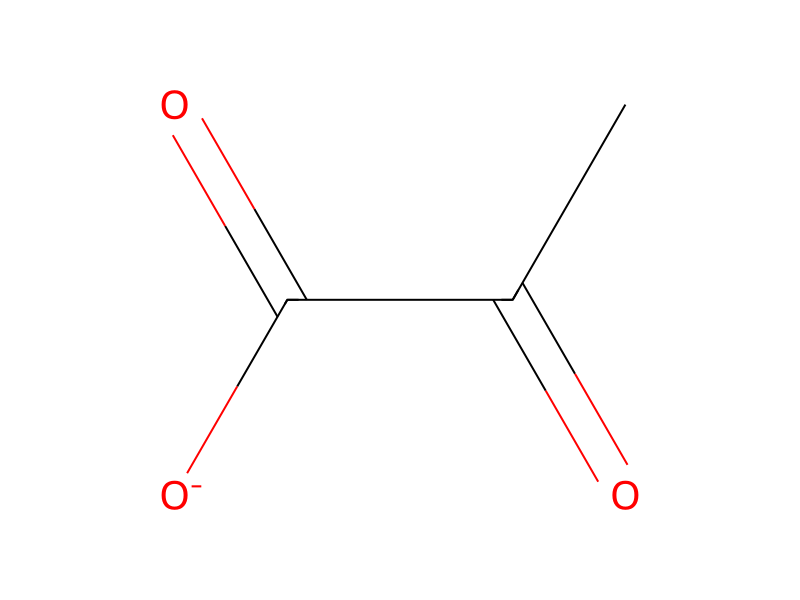
Grundinformationen
- CAS
57-60-3- Standard-SMILES
CC(=O)C(=O)[O-]- InChIKey
LCTONWCANYUPML-UHFFFAOYSA-M- Summenformel
- C3H3O3-
- Durchschnittliche Molmasse
- 87,05 g/mol
- Monoisotopische Masse
- 87,00821895
Überblick
Pyruvate is a 2-oxo monocarboxylic acid anion that is the conjugate base of pyruvic acid, arising from deprotonation of the carboxy group. It has a role as a cofactor and a fundamental metabolite. It is functionally related to a propionate. It is a conjugate base of a pyruvic acid.
Namen und Bezeichner
- Bevorzugter Name
- Pyruvate
- IUPAC
- 2-oxopropanoate
Namen und Synonyme
pyruvate2-Oxopropanoate57-60-3HO43T60JMGPropanoic acid, 2-oxo-, ion(1-)CHEBI:15361DTXSID50205604RefChem:871148DTXCID40128095MethylglyoxylatePyruvate ion2-oxopropanoic acid, ion(1-)
Weitere Namen anzeigen
2-oxo-Propanoic acidCHEMBL1818862hzlUNII-HO43T60JMGPYRUVIC ACID, ION(1-)LCTONWCANYUPML-UHFFFAOYSA-MBDBM50159792PD162526
Datenbank-Bezeichner
- CAS
57-60-3- PubChem CID
- 107735
- DTXSID
DTXSID50205604- ChEMBL
CHEMBL1162144- ChEBI
CHEBI:15361- UNII
- HO43T60JMG
- EC Number
- 106-312-4
- Nikkaji
- J469.720K
Eigenschaften
Berechnete Struktureigenschaften
- XLogP
- -0,6
- Polarare Oberfläche (TPSA)
- 57,2 Ų
- H-Brücken-Donoren
- 0
- H-Brücken-Akzeptoren
- 3
- Frei drehbare Bindungen
- 0
- Schwere Atome
- 6
- Formalladung
- -1
- Komplexität
- 78,5
Experimentelle und physikochemische Eigenschaften
Dietary IngredientsPyruvate
Sicherheit und Regulatorisches
Sicherheitsangaben dienen nur zur Orientierung und ersetzen weder das Sicherheitsdatenblatt (SDB) des Lieferanten noch geltende Vorschriften oder eine fachliche Bewertung.
GHS-Klassifizierung
GHS Classification
Danger
H314 (100%): Causes severe skin burns and eye damage [Danger Skin corrosion/irritation]
P260, P264, P280, P301+P330+P331, P302+P361+P354, P304+P340, P305+P354+P338, P316, P321, P363, P405, and P501 (click each P-code to see the statement)
The GHS information provided by 1 company from 1 notification to the ECHA C&L Inventory.
Gefahrenhinweise
Hazard Classes and CategoriesSkin Corr. 1B (100%)
Toxikologische Informationen
Exposure RoutesPyruvate is absorbed from the gastrointestinal tract from whence it is transported to the liver via the portal circulation.
Toxicity Summary
Pyruvate serves as a biological fuel by being converted to acetyl coenzyme A, which enters the tricarboxylic acid or Krebs cycle where it is metabolized to produce ATP aerobically. Energy can also be obtained anaerobically from pyruvate via its conversion to lactate. Pyruvate injections or perfusions increase contractile function of hearts when metabolizing glucose or fatty acids. This inotropic effect is striking in hearts stunned by ischemia/reperfusion. The inotropic effect of pyruvate requires intracoronary infusion. Among possible mechanisms for this effect are increased generation of ATP and an increase in ATP phosphorylation potential. Another is activation of pyruvate dehydrogenase, promoting its own oxidation by inhibiting pyruvate dehydrogenase kinase. Pyruvate dehydrogenase is inactivated in ischemia myocardium. Yet another is reduction of cytosolic inorganic phosphate concentration. Pyruvate, as an antioxidant, is known to scavenge such reactive oxygen species as hydrogen peroxide and lipid peroxides. Indirectly, supraphysiological levels of pyruvate may increase cellular reduced glutathione.
Chemie und Industrie
Pharmakologische Informationen
Metabolism/MetabolitesIn the liver, pyruvate is metabolized via several pathways.
Verwendung und Herstellung
UsesFor nutritional supplementation, also for treating dietary shortage or imbalance
Zugehörige Reaktionen
91





Notizen zur Verbindung
Wird geladen…