
N-Glycylglycin
Glycylglycine
Daten werden ergänzt – lade die Seite später neu, um den aktuellen Stand zu sehen
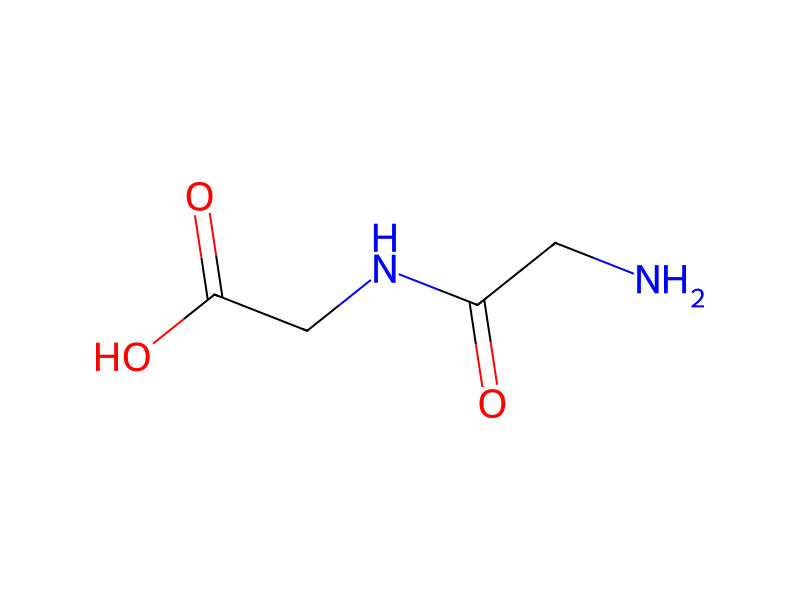
Grundinformationen
- CAS
556-50-3- Standard-SMILES
NCC(=O)NCC(=O)O- InChIKey
YMAWOPBAYDPSLA-UHFFFAOYSA-N- Summenformel
- C4H8N2O3
- Durchschnittliche Molmasse
- 132,12 g/mol
- Monoisotopische Masse
- 132,05349212
Überblick
Glycylglycine is a dipeptide formed from glycine residues. It has a role as a human metabolite. It is functionally related to a glycine. It is a tautomer of a glycylglycine zwitterion.
Namen und Bezeichner
- Bevorzugter Name
- Glycylglycine
- IUPAC
- 2-[(2-aminoacetyl)amino]acetic acid
- Lokaler Name
- N-Glycylglycin
- Englischer Name
- Glycylglycine
- Summenformel
- C4H8N2O3
- Molmasse
- 132.12
Namen und Synonyme
Glycylglycine556-50-3DiglycineN-GLYCYLGLYCINEGlycine dipeptideGlycine, glycyl-Glycyl-glycine2-[(2-aminoacetyl)amino]acetic acidGly22-(Aminoacetamido)acetic acidGlycyl Glycine10525P22U0
Weitere Namen anzeigen
GLY-GLYH-GLY-GLY-OHGLY-GLY-OH2-(2-aMinoacetaMido)acetic acidGlycylglyciny-GL
NSC-49346CHEBI:17201DTXSID908621942-((2-aminoacetyl)amino)acetic acidN GlycylglycineRefChem:663940Hydrochloride, GlycylglycineMonohydrochloride, Glycylglycine
Datenbank-Bezeichner
- CAS
556-50-3- PubChem CID
- 11163
- DTXSID
DTXSID90862194- ChEMBL
CHEMBL292467- ChEBI
CHEBI:17201- UNII
- 10525P22U0
- EC Number
- 209-127-8
- Nikkaji
- J2.659J
Eigenschaften
Berechnete StruktureigenschaftenWird ergänzt
- XLogP
- -2,9
- Polarare Oberfläche (TPSA)
- 92,4 Ų
- H-Brücken-Donoren
- 3
- H-Brücken-Akzeptoren
- 4
- Frei drehbare Bindungen
- 3
- Schwere Atome
- 9
- Formalladung
- 0
- Komplexität
- 123
Experimentelle und physikochemische Eigenschaften
Chemical ClassesBiological Agents -> Amino Acids and Derivatives
CosmeticsSkin conditioning; Hair conditioning
LogP-2.92
Solubility166 mg/mL at 21 °C
Melting Point215 °C
Vapor Pressure0.00000005 [mmHg]
Physical Description
Solid; [Merck Index] White powder; [Sigma-Aldrich MSDS]
Solid
Physikochemische Eigenschaften
- Schmelzpunkt
- 220 · 220-240 °C (dec.)
- Siedepunkt
- 267.18 °C · 267.18°C (rough estimate)
- Dichte
- 1.5851 · 1.5851 (rough estimate)
Sicherheit und Regulatorisches
Sicherheitsangaben dienen nur zur Orientierung und ersetzen weder das Sicherheitsdatenblatt (SDB) des Lieferanten noch geltende Vorschriften oder eine fachliche Bewertung.
GHS-Klassifizierung
GHS Classification
This chemical does not meet GHS hazard criteria for 32.4% (22 of 68) of reports.
Warning
H319 (67.6%): Causes serious eye irritation [Warning Serious eye damage/eye irritation]
P264+P265, P280, P305+P351+P338, and P337+P317 (click each P-code to see the statement)
Aggregated GHS information provided per 68 reports by companies from 4 notifications to the ECHA C&L Inventory.
Gefahrenhinweise
Regulatory Information
Chemical: Glycine, N-glycyl-
Status: Active Update: 16-03-2021 https://echa.europa.eu/registration-dossier/-/registered-dossier/32332
Glycine, glycyl-: Does not have an individual approval but may be used under an appropriate group standard
Other Safety InformationEvaluation - Chemicals that are unlikely to require further regulation to manage risks to environment
Hazards SummaryAn irritant that may cause severe eye irritation; [Sigma-Aldrich MSDS]
Hazard Classes and CategoriesEye Irrit. 2A (67.6%)
Sicherheitsdaten
- F
- 10
- wgk
- 3
- tsca
- TSCA listed
- hs_code
- 29241900
- risk_code
- 36
- hazard_code
- Xi
- safety_code
- 24/25-26
Chemie und Industrie
Verwendung und Herstellung
UsesUsed to make peptides; [Merck Index]
Use ClassificationCosmetics -> Skin conditioning; Hair conditioning
General Manufacturing InformationGlycine, glycyl-: ACTIVE
Anwendungen
VerwendenGlycylglycine is as a buffering reagent and also used in biochemical research. It is the simplest of all dipeptides and is used as a starting template for preparation of more complex peptides. It is also employed as a practical buffer with a buffering range of 7.5 - 8.9 (at 25°C). Valuable agent for experiments investigating peptide transport and absorption.
Vor- und nachgelagerte Produkte
Vorgelagerte Rohstoffe
Zugehörige Reaktionen
17


Notizen zur Verbindung
Wird geladen…