
Magnesiumdistearat
Magnesium Stearate
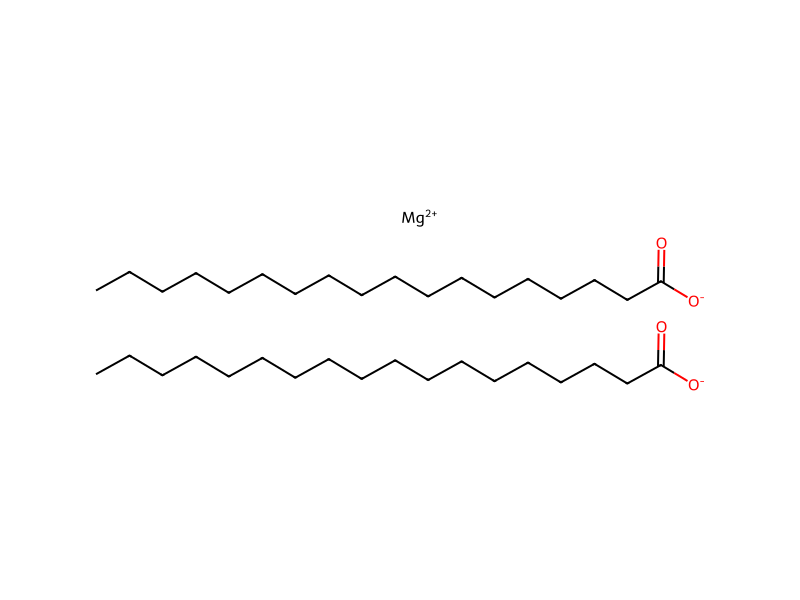
Grundinformationen
- CAS
557-04-0- Standard-SMILES
CCCCCCCCCCCCCCCCCC(=O)[O-].CCCCCCCCCCCCCCCCCC(=O)[O-].[Mg+2]- InChIKey
HQKMJHAJHXVSDF-UHFFFAOYSA-L- Summenformel
- C36H70MgO4
- Durchschnittliche Molmasse
- 591,2 g/mol
- Monoisotopische Masse
- 590,5124524
Überblick
Magnesium distearate is an organic magnesium salt and a magnesium salt.
Namen und Bezeichner
- Bevorzugter Name
- Magnesium Stearate
- IUPAC
- magnesium bis(octadecanoate)
- Lokaler Name
- Magnesiumdistearat
- Englischer Name
- Magnesium stearate
- Summenformel
- C36H70MgO4
- Molmasse
- 591.24
Namen und Synonyme
MAGNESIUM STEARATE557-04-0Magnesium distearateMagnesium octadecanoateDibasic magnesium stearateSynpro 90Octadecanoic acid, magnesium saltStearic acid, magnesium saltPetrac MG 20NFMagnesium stearate gMagnesii stearasSynpro Magnesium Stearate 90
Weitere Namen anzeigen
stearatedemagnesiumMagnesium Stearate BpMAGNESIUM STEARATE N.F.Magnesium Stearate Veg. NFC4d-ADolomolAnti-C4d-Apetracmg20nfnesium stearate
NP 1500SM 1000Octadecanoic acid, magnesium salt (2:1)CHEBI:925470097M6I30DTXSID2027208DAYCLINGRefChem:5973
Datenbank-Bezeichner
- CAS
557-04-0- PubChem CID
Eigenschaften
Berechnete Struktureigenschaften
- Polarare Oberfläche (TPSA)
- 80,3 Ų
- H-Brücken-Donoren
- 0
- H-Brücken-Akzeptoren
- 4
- Frei drehbare Bindungen
- 30
- Schwere Atome
- 41
- Formalladung
- 0
- Komplexität
- 196
Experimentelle und physikochemische Eigenschaften
Chemical Classes
Other Classes -> Stearates
Other Classes -> Stearates
Cosmetics
Cosmetic ingredients (Magnesium Stearate) -> CIR (Cosmetic Ingredient Review)
Moisturising; Cosmetic colorant; Anticaking; Bulking
Odor
Odorless
Faint, characteristic odor
TasteTasteless
Food AdditivesANTICAKING AGENT OR FREE-FLOW AGENT, DRYING AGENT, FORMULATION AID, HUMECTANT -> FDA Substance added to food
Density
1.028
1.02 g/cm³
Color/Form
LUMPS
Fine, bulky, white powder
Soft, white, light powder
Solubility
IN 100 CC WATER: 0.003 G @ 15 °C; 0.004 G @ 25 °C; 0.008 G @ 50 °C
IN 100 CC SOLVENT @ 25 °C: 0.020 G IN ALCOHOL; 0.003 G IN ETHER
Solubility in water: none
Sicherheit und Regulatorisches
Sicherheitsangaben dienen nur zur Orientierung und ersetzen weder das Sicherheitsdatenblatt (SDB) des Lieferanten noch geltende Vorschriften oder eine fachliche Bewertung.
GHS-Klassifizierung
GHS Classification
This chemical does not meet GHS hazard criteria for 54.9% (280 of 510) of all reports.
Warning
H315 (22.4%): Causes skin irritation [Warning Skin corrosion/irritation]
P261, P264, P264+P265, P271, P273, P280, P302+P352, P304+P340, P305+P351+P338, P319, P321, P332+P317, P337+P317, P362+P364, P403+P233, P405, and P501 (click each P-code to see the statement)
Aggregated GHS information provided per 510 reports by companies from 20 notifications to the ECHA C&L Inventory. Each notification may be associated with multiple companies.
Warning
Gefahrenhinweise
Regulatory Information
Chemical: Octadecanoic acid, magnesium salt
Octadecanoic acid, magnesium salt (2:1) is listed on the EPA's Chemical Data Reporting (CDR) system. Manufacturers and importers of Octadecanoic acid, magnesium salt (2:1) are required to report information about their production and use of this chemical to the EPA under the Toxic Substances Control Act (TSCA). (40 eCFR Part 711)
Octadecanoic acid, magnesium salt: Does not have an individual approval but may be used under an appropriate group standard
Other Safety InformationIMAP assessments - Octadecanoic acid, magnesium salt: Human health tier I assessment
Fire HazardsCombustible. Gives off irritating or toxic fumes (or gases) in a fire. Finely dispersed particles form explosive mixtures in air.
Hazards Summary
This TLV Documentation applies only to stearic acid and magnesium, sodium, and zinc stearates. It excludes stearates of other metals. TLV Basis is lower respiratory tract irritation. No acute systemic effects of stearic acid have been reported after ingestion. . . . Sprague-Dawley rats fed stearic acid in their diet at 3000 ppm for 209 days showed 'severe pulmonary infection consisting of tracheobronchitis, lobular pneumonia, lipoid histiocytic response, and abscess formation.' [ACGIH] See Stearic acid.
Chemie und Industrie
Verwendung und Herstellung
Uses
CIR ingredient: Magnesium Stearate
Used in cosmetics, pharmaceuticals, food additives, waterproofing agents, plastic stabilizers, emulsifiers, and rubber lubricants and dusting agents; Stearic acid occurs naturally in human and animal fats and oils and in some vegetable oils, including cocoa oil. Stearic acid can be prepared from animal fat (triglyceride) by treating with water at high temperature, leading to hydrolysis of triglycerides, or by hydrogenation of unsaturated vegetable oils such as cottonseed oil. [ACGIH]
Used in baby dusting powders; as lubricant for plastics; as emulsifying agent in cosmetics; as drier in paints and varnishes; as flatting agent; as anticaking agent in foods and fire extinguishers; and as lubricant in making pharmaceutical tablets; [HSDB]
Painting (Pigments, Binders, and Biocides) [Category: Paint]
IN BABY DUSTING POWDERS
Dusting powder, lubricant for plastics, emulsifying agent in cosmetics, drier in paints and varnishes and flatting agent.
Impuritiescontains small amounts of the oleate and 7% magnesium oxide. /technical grade/
U.S. Production
2023: 2,500,000 - <4,000,000 lb
(1972) 2.16X10+9 GRAMS
(1975) 1.79X10+9 GRAMS
(1984) 1.08X10+10 g
Consumer UsesFlame retardant
Industry UsesFlame retardant
Methods of ManufacturingREACTION OF SODIUM STEARATE WITH MAGNESIUM SULFATE
Formulations/Preparations
MAGNESIUM STEARATE /IS/ COMPD OF MAGNESIUM WITH MIXTURE OF SOLID ORG ACIDS OBTAINED FROM FATS, & CONSISTS CHIEFLY OF VARIABLE PROPORTIONS OF MAGNESIUM STEARATE & MAGNESIUM PALMITATE. IT CONTAINS EQUIVALENT OF 6.8-8.0% OF MAGNESIUM OXIDE (40.30).
GRADES: TECHNICAL, USP FCC.
A TYPICAL DRY COMPRESSED ANTIPERSPIRANT STICK/CONTAINS/0.25 wt% MAGNESIUM STEARATE
Zugehörige Reaktionen
19




Notizen zur Verbindung
Wird geladen…