
Zinkcyanid
Zinc cyanide (Zn(CN)2)
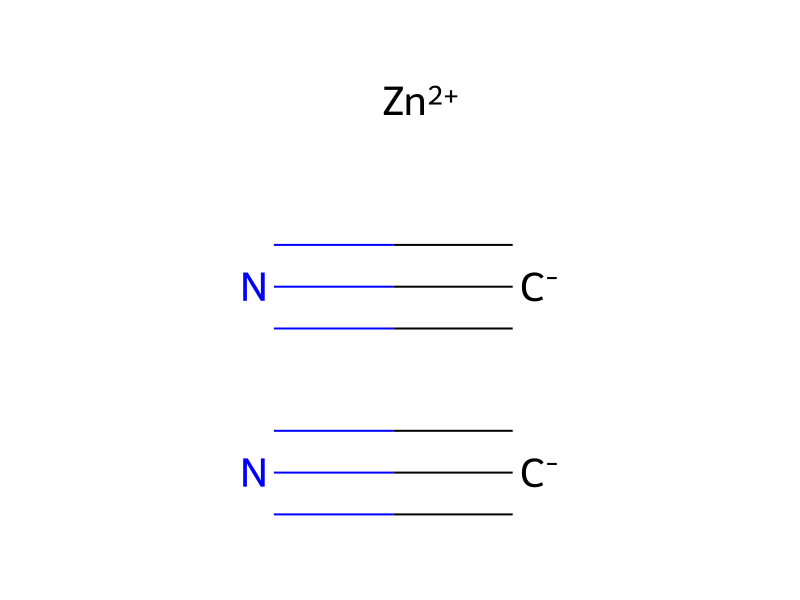
Grundinformationen
- CAS
557-21-1- Standard-SMILES
[C-]#N.[C-]#N.[Zn+2]- InChIKey
GTLDTDOJJJZVBW-UHFFFAOYSA-N- Summenformel
- C2N2Zn
- Durchschnittliche Molmasse
- 117,4 g/mol
- Monoisotopische Masse
- 115,93529
Überblick
Zinc cyanide is a chemical compound of zinc and cyanide. It is used in organic synthesis. Zinc is a metallic element with the atomic number 30. It is found in nature most often as the mineral sphalerite. Though excess zinc in harmful, in smaller amounts it is an essential element for life, as it is a cofactor for over 300 enzymes and is found in just as many transcription factors. (L48, L49, L65)
Namen und Bezeichner
- Bevorzugter Name
- Zinc cyanide (Zn(CN)2)
- IUPAC
- zinc dicyanide
- Lokaler Name
- Zinkcyanid
- Englischer Name
- ZINC CYANIDE
- Summenformel
- C2N2Zn
- Molmasse
- 117.43
Namen und Synonyme
zinc;dicyanideZinc cyanide (Zn(CN)2)dicyanozincZinc cyanide Zn(CN)2Cyanure de zinc [French]RCRA waste no. P121RCRA waste number P121dicyano zincCyanure de zincHSDB 1051EINECS 209-162-9UN1713
Weitere Namen anzeigen
Zn(Cn)2ZinkcyanidZINC CYANIDEcyanuredezinczincdicyanideZinc cyanide, purercrawastenumberp121zinccyanide(zn(cn)2)
Zinc cyanide, 98%BRN 4124366AI3-28752SCHEMBL360531UNII-04392RL5SRVJHHEOJUJAQMPF-UHFFFAOYSA-NZinc cyanide [UN1713] [Poison]BP-21167
Datenbank-Bezeichner
- CAS
557-21-1- PubChem CID
- 11186
- Nikkaji
- J44.262C
Eigenschaften
Berechnete Struktureigenschaften
- Polarare Oberfläche (TPSA)
- 47,6 Ų
- H-Brücken-Donoren
- 0
- H-Brücken-Akzeptoren
- 4
- Frei drehbare Bindungen
- 0
- Schwere Atome
- 5
- Formalladung
- 0
- Komplexität
- 31,6
Physikochemische Eigenschaften
- Schmelzpunkt
- 800 °C · 800 °C
- Dichte
- 1 · 1,85 g/cm3
- Dampfdruck
- 0 Pa · 0Pa at 25℃
- Löslichkeit
- Aqueous Base (Sparingly)
- Aggregatzustand
- Powder
- Farbe
- White to off-white
- Wasserlöslichkeit
- Soluble in alkalies, potassium cyanide and ammonia. Insoluble in water and most solvents.
- Merck
- 14 · 14,10135
- BRN
- 4124366 · 4124366
- Stabilität
- Moisture Sensitive
- InChI
- 1S/2CN.Zn/c2*1-2;
- InChIKey
- VJHHEOJUJAQMPF-UHFFFAOYSA-N
- SMILES
- N#C[Zn]C#N
- LogP
- -2.31 at · -2.31 at 25℃
- CAS Datenbank
- 557 · 557-21-1(CAS DataBase Reference)
- EPA chemische Informationen
- Zinc cyanide (557-21-1)
Sicherheit und Regulatorisches
Sicherheitsangaben dienen nur zur Orientierung und ersetzen weder das Sicherheitsdatenblatt (SDB) des Lieferanten noch geltende Vorschriften oder eine fachliche Bewertung.
Gefahrenhinweise
CSL Reaction Information
CSL00046
N,N-DIMETHYLFORMAMIDE + 2-CHLORO-5-FLUOROPYRIMIDINE + ZINC CYANIDE
Violent thermal exotherm at >100oC
Harmful,Toxic
Heteroaryl chloride
Cyanation
Sicherheit und Schutzausrüstung
Minimum Risk LevelIntermediate Oral: 0.3 mg/kg/day (L134)
Chronic Oral: 0.3 mg/kg/day (L134)
Toxikologische Informationen
Treatment
Zinc poisoning is treated symptomatically, often by administering fluids such as water or milk, or with gastric lavage. Antidotes to cyanide poisoning include hydroxocobalamin and sodium nitrite, which release the cyanide from the cytochrome system, and rhodanase, which is an enzyme occurring naturally in mammals that combines serum cyanide with thiosulfate, producing comparatively harmless thiocyanate. Oxygen therapy can also be administered. (L49, L97)
Health Effects
Chronic exposure to zinc causes anemia, atazia, lethargy, and decreases the level of good cholesterol in the body. It is also believed to cause pancreatic and reproductive damage. Exposure to high levels of cyanide for a short time harms the brain and heart and can even cause coma, seizures, apnea, cardiac arrest and death. Chronic inhalation of cyanide causes breathing difficulties, chest pain, vomiting, blood changes, headaches, and enlargement of the thyroid gland. Skin contact with cyanide salts can irritate and produce sores. (L49, L96, L97)
Exposure RoutesInhalation (L96) ; oral (L96) ; dermal (L96)
Chemie und Industrie
Pharmakologische Informationen
Metabolism/Metabolites
Zinc can enter the body through the lungs, skin, and gastrointestinal tract. Intestinal absorption of zinc is controlled by zinc carrier protein CRIP. Zinc also binds to metallothioneins, which help prevent absorption of excess zinc. Zinc is widely distributed and found in all tissues and tissues fluids, concentrating in the liver, gastrointestinal tract, kidney, skin, lung, brain, heart, and pancreas. In the bloodstream zinc is found bound to carbonic anhydrase in erythrocytes, as well as bound to albumin, _2-macroglobulin, and amino acids in the the plasma. Albumin and amino acid bound zinc can diffuse across tissue membranes. Zinc is excreted in the urine and faeces. Organic nitriles are converted into cyanide ions through the action of cytochrome P450 enzymes in the liver. Cyanide is rapidly absorbed and distributed throughout the body. Cyanide is mainly metabolized into thiocyanate by either rhodanese or 3-mercaptopyruvate sulfur transferase. Cyanide metabolites are excreted in the urine. (L49, L96)
Verwendung und Herstellung
UsesZinc cyanide is used in organic synthesis. (L65)
Anwendungen
VerwendenZinc cyanide is used in electroplating; as an insecticide; and for separating ammonia from producer gas.
Vor- und nachgelagerte Produkte
Vorgelagerte Rohstoffe
Nachgelagerte Produkte
Zugehörige Reaktionen
1.898


Notizen zur Verbindung
Wird geladen…