StartseiteMCPWorkbenchSkills
StartseiteWorkbenchBenachrichtigungenMein Bereich
llms.txt · MCP-AnleitungDatenschutz · Nutzungsbedingungen · Supportv1.8.0
  1. Startseite
  2. /Verbindung

Diisopropylbenzol

Bis(1-methylethyl)benzene
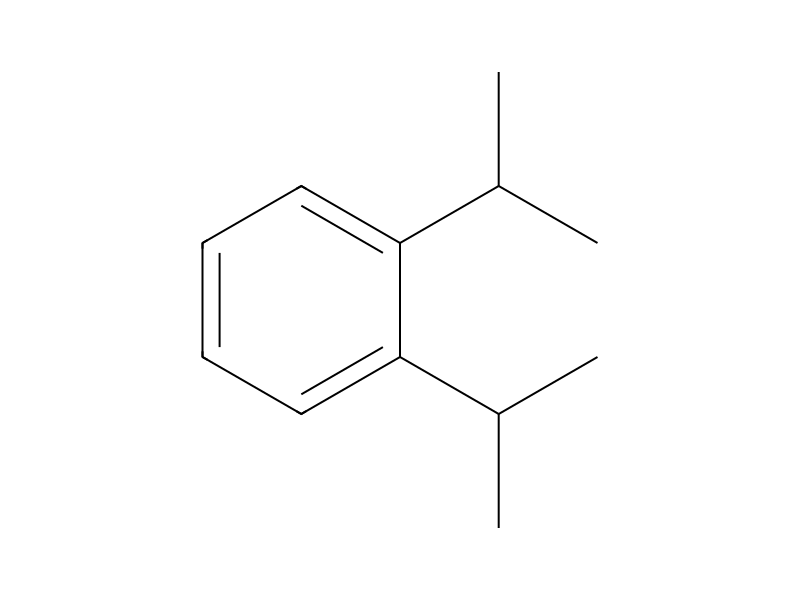
HCID 11345
Neue NotizNeue ReaktionAnfrage stellen
Druckvorschau
GrundinformationenNamen und BezeichnerEigenschaftenSicherheit und RegulatorischesChemie und IndustrieZugehörige ReaktionenNotizen zur Verbindung
TeilstruktursucheÄhnliche Strukturen suchen

Grundinformationen

CAS
25321-09-9
Standard-SMILES
CC(C)c1ccccc1C(C)C
InChIKey
OKIRBHVFJGXOIS-UHFFFAOYSA-N
Summenformel
C12H18
Durchschnittliche Molmasse
162,27 g/mol
Monoisotopische Masse
162,14085057

Namen und Bezeichner

Bevorzugter Name
Bis(1-methylethyl)benzene
IUPAC
1,2-di(propan-2-yl)benzene
Lokaler Name
Diisopropylbenzol
Englischer Name
Diisopropylbenzene
Summenformel
C12H18
Molmasse
162.27

Namen und Synonyme

25321-09-9DIISOPROPYLBENZENEBenzene, diisopropyl-Benzene, bis(1-methylethyl)-Bis(1-methylethyl)benzeneDTXSID0027858RefChem:917230K2RZG204KIDTXCID001769091246-835-61,2-DIISOPROPYLBENZENE577-55-9
Weitere Namen anzeigen
DIPBDiisopropylbenzoldiisopropyl-benzenBis(isopropyl)benzeneORTHO-DIISOPROPYLBENZENEbis(1-methylethyl)-benzenbis(1-methylethyl)-BenzeneBENZENE,BIS(1-METHYLETHYL)-
o-DiisopropylbenzeneBenzene, 1,2-bis(1-methylethyl)-1,2-di(propan-2-yl)benzene1,2-Bis(1-methylethyl)benzeneBenzene, o-diisopropyl-1,2-bis(propan-2-yl)benzeneMFCD00054263DSSTox_CID_7858

Datenbank-Bezeichner

CAS
25321-09-9、577-55-9
PubChem CID
11345
DTXSID
DTXSID30860336
ChEMBL
CHEMBL3188905
UNII
6E5460R9HG
EC Number
209-412-7、246-835-6
Nikkaji
J54.882K

Eigenschaften

Berechnete Struktureigenschaften

XLogP
4,2
Polarare Oberfläche (TPSA)
0 Ų
H-Brücken-Donoren
0
H-Brücken-Akzeptoren
0
Frei drehbare Bindungen
2
Schwere Atome
12
Formalladung
0
Komplexität
108

Experimentelle und physikochemische Eigenschaften

Solvents · 2 Einträge

Solvents -> Aromatic Solvents

Solvents -> Aromatic Solvents

SpringerMaterials PropertiesBoiling point
LogP5.2
Density · 5 Einträge

0.9 (water=1)

0.8701 at 20 °C/4 °C

0.9 g/cm³

Relative density of the vapour/air-mixture at 20 °C (air = 1): 1

0.9 No Temp

Color/FormClear, colorless liquid
Solubility · 2 Einträge

Sol in all proportions of alcohol, ether, acetone and benzene.

Solubility in water at 25 °C: poor

Flash Point · 3 Einträge

77 °C

170 °F (Open cup)

77 °C o.c.

Boiling Point · 5 Einträge

205 °C

204 °C at 760 mm Hg

Boiling point: 115.4 °C @ 50 mm Hg

203-205 °C

205 °C @760 [mm Hg]

Sicherheit und Regulatorisches

Sicherheitsangaben dienen nur zur Orientierung und ersetzen weder das Sicherheitsdatenblatt (SDB) des Lieferanten noch geltende Vorschriften oder eine fachliche Bewertung.

GHS-Klassifizierung

GHS Classification · 6 Einträge

Danger

H304 (44.5%): May be fatal if swallowed and enters airways [Danger Aspiration hazard]

P260, P264, P273, P280, P301+P316, P302+P352, P319, P321, P331, P332+P317, P362+P364, P405, and P501 (click each P-code to see the statement)

Aggregated GHS information provided per 236 reports by companies from 8 notifications to the ECHA C&L Inventory. Each notification may be associated with multiple companies.

H413 (100%): May cause long lasting harmful effects to aquatic life [Hazardous to the aquatic environment, long-term hazard]

P273, and P501 (click each P-code to see the statement)

Gefahrenhinweise

Regulatory Information · 2 Einträge

Chemical: Benzene, bis(1-methylethyl)-

Benzene, 1,2-bis(1-methylethyl)- is listed on the EPA's Chemical Data Reporting (CDR) system. Manufacturers and importers of Benzene, 1,2-bis(1-methylethyl)- are required to report information about their production and use of this chemical to the EPA under the Toxic Substances Control Act (TSCA). (40 eCFR Part 711)

Fire HazardsCombustible. Above 77 °C explosive vapour/air mixtures may be formed.
Fire PotentialModerate, when exposed to heat or flame.
Hazards Summary · 2 Einträge

Inhalation of high concentrations can cause CNS depression; [ICSC] An eye, mucous membrane, and upper respiratory tract irritant; May cause CNS depression; Defats the skin; [CAMEO] May cause mild to moderate irritation, based on animal studies; [CHEMINFO]

A skin, eye, and respiratory tract irritant; May be harmful after ingestion, inhalation, or skin contact; Anesthetic effect at high doses; [MSDSonline]

Chemie und Industrie

Verwendung und Herstellung

Uses · 3 Einträge

Occurs in isomeric forms ortho, meta, and para; Blended into gasoline, diesel, and other hydrocarbon fuels; [HSDB] Used to make diisopropylbenzeneperoxide; [eChemPortal: SIDSUNEP]

Petroleum Production and Refining [Category: Industry]

Distillate fractions containing diisopropylbenzene can be blended into gasoline, diesel and other hydrocarbon fuels.

U.S. Production2023: <50,000 lb
Consumer UsesIntermediate
Industry UsesIntermediate
Methods of Manufacturing · 3 Einträge

By-product of cumene production /Diisopropylbenzenes/

By alkylation /of benzene/ using a silica - alumina catalyst. ... Isomers can be separated by fractionation.

By-product of cumene production /Diisopropylbenzenes/

Formulations/PreparationsDiisopropylbenzene ... occurs in three isomeric forms, namely as the ortho, the meta, and the para derivatives, all being flammable liquids.
General Manufacturing Information · 4 Einträge

Petroleum Refineries

Benzene, 1,2-bis(1-methylethyl)-: ACTIVE

Benzene, bis(1-methylethyl)-: ACTIVE

Diisopropylbenzene ... occurs in three isomeric forms, namely as the ortho, the meta, and the para derivatives, all being flammable liquids.

Vor- und nachgelagerte Produkte

Nachgelagerte Produkte

(1-Methylethyl)benzol1-(4-Isopropylphenyl)-1-methylethylhydroperoxid

Zugehörige Reaktionen

31
Reaktionsaufzeichnung erstellen
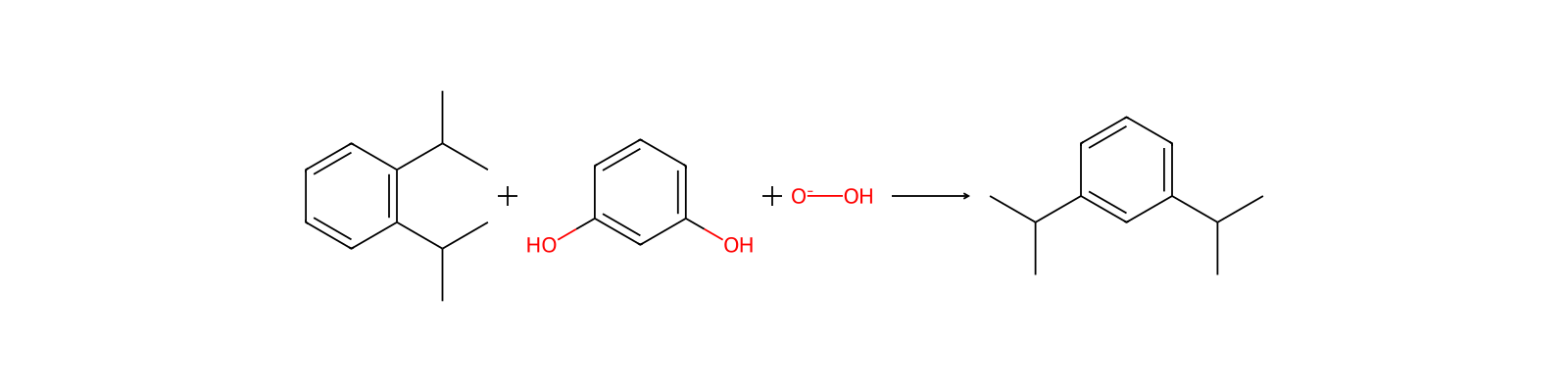
Reaktionsgleichung von HRID 149732
HRID 149732als EduktTraining data from https://doi.org/10.1039/C8SC04228D (9/10)
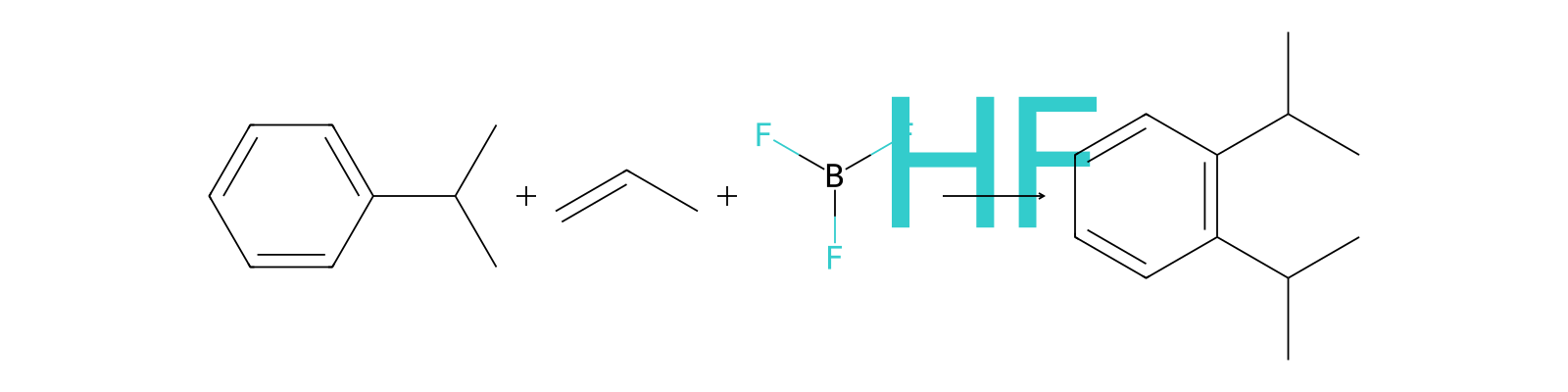
Reaktionsgleichung von HRID 196957
HRID 196957als EduktTraining data from https://doi.org/10.1039/C8SC04228D (6/10)
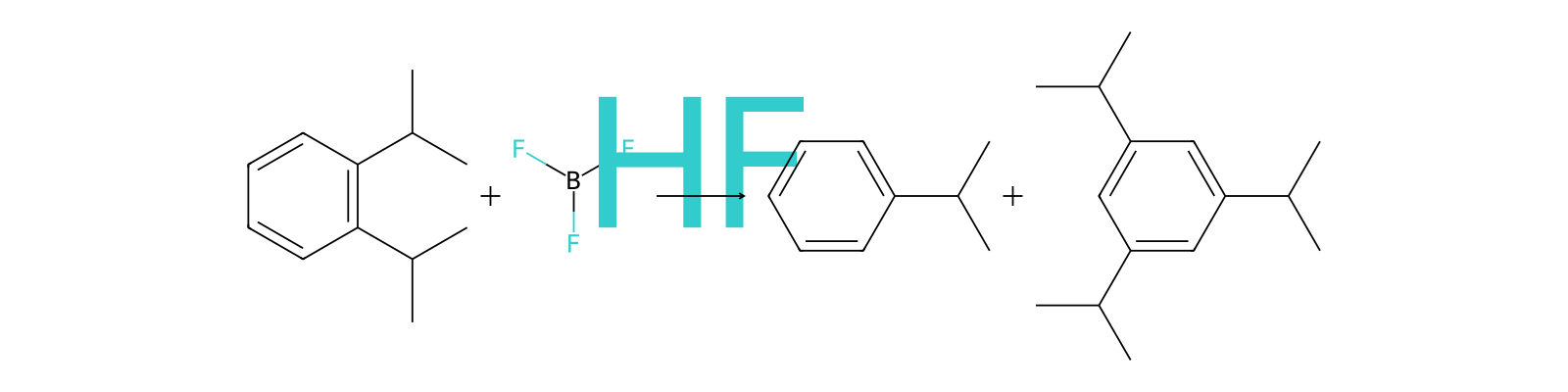
Reaktionsgleichung von HRID 231538
HRID 231538als Eduktuspto-grants-1989_07
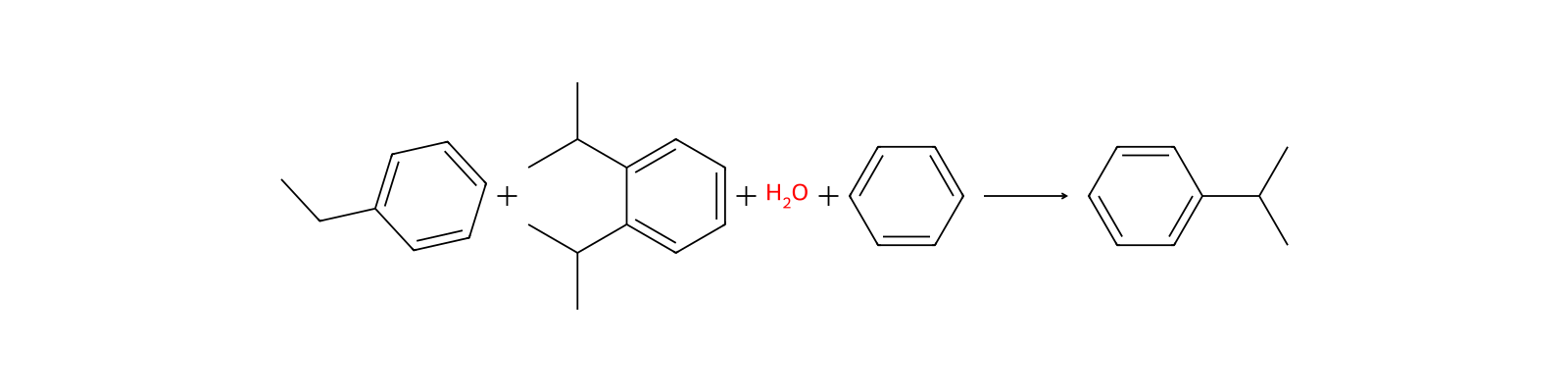
Reaktionsgleichung von HRID 231667
HRID 231667als Eduktuspto-grants-1989_07
Reaktionsgleichung von HRID 464493
HRID 464493als Eduktuspto-grants-1985_10
Reaktionsgleichung von HRID 464494
HRID 464494als Produktuspto-grants-1985_10
Reaktionsgleichung von HRID 464495
HRID 464495als Produktuspto-grants-1985_10
Reaktionsgleichung von HRID 464496
HRID 464496als Eduktuspto-grants-1985_10
Seite 1 von 4

Notizen zur Verbindung

Wird geladen…

Auf dieser SeiteGrundinformationenNamen und BezeichnerEigenschaftenSicherheit und RegulatorischesChemie und IndustrieZugehörige ReaktionenNotizen zur Verbindung
Weitere Aktionen
Neue NotizNeue ReaktionAnfrage stellen
DecompositionWhen heated to decomposition it emits acrid smoke and irritating fumes.
Melting Point-57 °C
Vapor Density · 2 Einträge

5.6 (Air= 1)

Relative vapor density (air = 1): 5.6

Vapor Pressure0.25 to 0.39 mm Hg at 25 °C

Physikochemische Eigenschaften

Schmelzpunkt
-25.43 °C · -25.43°C (estimate)
Siedepunkt
77 · 77-82 °C (10 mmHg)
Dichte
0.86 · 0.86
Brechungsindex
1.488 · 1.488-1.491
Flammpunkt
77 °C · 77 °C
storage temp.
Sealed in dry,Room Temperature
Aggregatzustand
clear liquid
Farbe
Colorless to Almost colorless
Henry's Law Constant
4.8 · 4.8×10-4 mol/(m3Pa) at 25℃, HSDB (2015)
InChI
InChI=1S/C12H18/c1-9(2)11-7-5-6-8-12(11)10(3)4/h5-10H,1-4H3
InChIKey
OKIRBHVFJGXOIS-UHFFFAOYSA-N
SMILES
C1(C(C)C)=CC=CC=C1C(C)C
CAS Datenbank
25321 · 25321-09-9(CAS DataBase Reference)
EPA chemische Informationen
Diisopropylbenzene (25321-09-9)
UN Classification
UN Hazard Class: 9; UN Pack Group: III
DOT Emergency Guidelines · 5 Einträge

/GUIDE 130: FLAMMABLE LIQUIDS (NON-POLAR/WATER-IMMISCIBLE/NOXIOUS)/ Fire or Explosion: HIGHLY FLAMMABLE: Will be easily ignited by heat, sparks or flames. Vapors may form explosive mixtures with air. Vapors may travel to source of ignition and flash back. Most vapors are heavier than air. They will spread along ground and collect in low or confined areas (sewers, basements, tanks). Vapor explosion hazard indoors, outdoors or in sewers. Those substances designated with a "P" may polymerize explosively when heated or involved in a fire. Runoff to sewer may create fire or explosion hazard. Containers may explode when heated. Many liquids are lighter than water. /Isopropylbenzene/

/GUIDE 130: FLAMMABLE LIQUIDS (NON-POLAR/WATER-IMMISCIBLE/NOXIOUS)/ Health: May cause toxic effects if inhaled or absorbed through skin. Inhalation or contact with material may irritate or burn skin and eyes. Fire will produce irritating, corrosive and/or toxic gases. Vapors may cause dizziness or suffocation. Runoff from fire control or dilution water may cause pollution. /Isopropylbenzene/

/GUIDE 130: FLAMMABLE LIQUIDS (NON-POLAR/WATER-IMMISCIBLE/NOXIOUS)/ Public Safety: CALL Emergency Response Telephone Number ... . As an immediate precautionary measure, isolate spill or leak area for at least 50 meters (150 feet) in all directions. Keep unauthorized personnel away. Stay upwind. Keep out of low areas. Ventilate closed spaces before entering. /Isopropylbenzene/

/GUIDE 130: FLAMMABLE LIQUIDS (NON-POLAR/WATER-IMMISCIBLE/NOXIOUS)/ Protective Clothing: Wear positive pressure self-contained breathing apparatus (SCBA). Structural firefighters' protective clothing will only provide limited protection. /Isopropylbenzene/

For more DOT Emergency Guidelines (Complete) data for 1,2-DIISOPROPYLBENZENE (8 total), please visit the HSDB record page.

Hazard Classes and Categories · 3 Einträge

Aquatic Chronic 4 (100%)

Asp. Tox. 1 (44.5%)

Flammable liquids - Category 4

Hazardous Reactivities and Incompatibilities... Can react with oxidizing materials.

Sicherheit und Schutzausrüstung

Fire FightingUse powder, carbon dioxide. In case of fire: keep drums, etc., cool by spraying with water.
First Aid Measures · 4 Einträge

Fresh air, rest.

Rinse and then wash skin with water and soap.

Rinse with plenty of water (remove contact lenses if easily possible).

Rinse mouth. Rest.

Safe StorageProvision to contain effluent from fire extinguishing. Keep in a well-ventilated room. Store in an area without drain or sewer access.
Fire Fighting ProceduresFoam, carbon dioxide, dry chemical, water spray or mist.
Spillage Disposal · 1 Eintrag

Remove all ignition sources. Do NOT let this chemical enter the environment. Ventilation. Collect leaking liquid in covered containers. Absorb remaining liquid in sand or inert absorbent. Then store and dispose of according to local regulations.

Eye PreventionWear safety spectacles.
Fire PreventionNO open flames. Above 77 °C use a closed system and ventilation.
Inhalation RiskNo indication can be given about the rate at which a harmful concentration of this substance in the air is reached.
Skin PreventionProtective gloves.
Exposure PreventionPREVENT GENERATION OF MISTS!
Ingestion PreventionDo not eat, drink, or smoke during work.
Inhalation PreventionUse ventilation.

Toxikologische Informationen

Environmental Fate · 3 Einträge

TERRESTRIAL FATE: Based upon an estimated Koc value of 4000(1), diisopropylbenzene is expected to be relatively immobile in soil(SRC). Insufficient data are available to predict the rates or importance of soil degradation processes(SRC).

AQUATIC FATE: Volatilization and adsorption to sediment may be important transport processes in water for diisopropylbenzene. Volatilization half-lives of 3.8 and 45 hours can be estimated for a model river (1 meter deep) and model pond (2 meters deep), respectively, when the effects of adsorption are not present(1-2); in the presence of adsorption (Koc of 4000), the volatilization half-life from the pond increases to 27 days(2). Based upon an estimated Koc of 4000(3), diisopropylbenzene may partition from the water column to sediment and suspended material. Insufficient data are available to predict the importance of biodegradation(SRC).

ATMOSPHERIC FATE: Based upon vapor pressures of 0.25 to 0.39 mm Hg at 25 °C(1), the diisopropylbenzene isomers are expected to exist almost entirely in the vapor-phase in the ambient atmosphere(2). Diisopropylbenzene will degrade in an average ambient atmosphere by reaction with photochemically produced hydroxyl radicals (estimated half-life of 30 hours)(3,SRC).

Adverse Effects · 2 Einträge

Neurotoxin - Acute solvent syndrome

Neurotoxin - Acute solvent syndrome

Signs and SymptomsHeadache. Drowsiness.
Effluent Concentrations · 1 Eintrag

m- and p-Diisopropylbenzene were qualitatively detected in water samples collected from advanced waste treatment facilities in Pomona, CA (Jun 17, 1975) and Lake Tahoe, CA (Oct 24, 1974)(1). Diisopropylbenzene was detected in the wastewater effluent from a chemical manufacturing facility in LA (concn, site or date not reported)(2).

ICSC Environmental DataThe substance is very toxic to aquatic organisms. It is strongly advised not to let the chemical enter into the environment.
Soil Adsorption/Mobility · 1 Eintrag

Using a structure estimation method based on molecular connectivity indexes, the Koc for diisopropylbenzene can be estimated to be about 4000(1). This estimated Koc indicates that diisopropylbenzene will be relatively immobile in soil(2,SRC).

Natural Pollution SourcesDiisopropylbenzene is reported to occur in coal(1).
Artificial Pollution Sources · 1 Eintrag

Diisopropylbenzene occurs in large amounts in the high-boiling fractions of cumene production facilities(1) and can therefore be released in waste streams and fugitive emissions associated with cumene production. Distillate fractions containing diisopropylbenzene can be blended into gasoline, diesel and other hydrocarbon fuels(2); therefore, evaporation or incomplete combustion of these fuels can release diisopropylbenzene into the atmosphere. Diisopropylbenzene and its individual isomers are used in solvents and as feedstock for making other chemicals(1-3) which can result in their release to the environment through evaporation and manufacturing waste streams(SRC).

Environmental BioconcentrationThe log BCF (bioconcentration factor) of the o- and m-isomers of diisopropylbenzene was experimentally measured to be 2.11-2.14(1) in goldfish. This suggests that some bioconcentration may occur in aquatic organisms(SRC).
Volatilization from Water/Soil · 1 Eintrag

The Henry's Law constant for diisopropylbenzene can be estimated(SRC) to be 0.0204 atm-cu m/mole using a structure estimation method(1). This value of Henry's Law constant indicates rapid volatilization from water(2). Based on this Henry's Law constant, the volatilization half-life from a model river (1 m deep flowing 1 m/sec with a wind velocity of 3 m/sec) can be estimated(SRC) to be about 3.8 hours(2). The volatilization half-life from a model environmental pond can be estimated to be about 45 hours if the effect of adsorption to sediment is ignored(3); if the effect of adsorption to sediment is predicted from an estimated Koc of 4000(4), the estimated volatilization half-life from the pond increases to about 27 days(3,SRC).

Non-Human Toxicity Excerpts · 4 Einträge

Rated 1 on rabbit eyes. /On a scale of 1 to 10 with 10 being the most severe./

Diisopropylbenzene occurs in three isomeric forms, namely as the ortho, the meta, and the para derivatives ... . Orally, they are of very low toxicity. Of 10 rats dosed with 5.0 ml/kg, no deaths for the meta, and one death for the ortho and the para isomers occurred. ... Rats and rabbits exposed to 0.2 to 1.0 mg/l (30 to 150 ppm) for 90 minutes daily for 5 weeks developed vascular hyperemia, hemorrhaging in most major organs, and fatty and protein dystrophy in the liver, kidney, and heart, and hyperplasia of the bone marrow.

Diisopropylbenzene rated 1 on rabbit eyes /on a scale of 1 to 10 with 10 being the most severe/. /Diisopropylbenzene/

Diisopropylbenzene occurs in three isomeric forms, namely as the ortho, the meta, and the para derivatives ... . Orally, they are of very low toxicity. Of 10 rats dosed with 5.0 ml/kg, no deaths for the meta, and one death for the ortho and the para isomers occurred. ... Rats and rabbits exposed to 0.2 to 1.0 mg/l (30 to 150 ppm) for 90 minutes daily for 5 weeks developed vascular hyperemia, hemorrhaging in most major organs, and fatty and protein dystrophy in the liver, kidney, and heart, and hyperplasia of the bone marrow. meta-Diisopropylbenzene caused decreased fertility in the rat and mouse at 1 to 3 mg/l for 30 days.

Environmental Abiotic Degradation · 1 Eintrag

The rate constant for the vapor-phase reaction of diisopropylbenzene with photochemically produced hydroxyl radicals has been estimated to be about 1.3X10⁻¹¹ cu cm/molecule-sec at 25 °C which corresponds to an atmospheric half-life of about 30 hrs at an atmospheric concn of 5X10+5 hydroxyl radicals per cu cm(1). Benzenes are generally resistant to aqueous environmental hydrolysis(2), therefore, diisopropylbenzene is not expected to hydrolyze in the environment(SRC).

Sicherheitsdaten

tsca
TSCA listed
ridadr
3082
hs_code
29029000
RTECS-Nr.
CZ6330000
risk_code
10-37-51/53-65
hazard_code
Xn,N
safety_code
24/25-62-61-37-24
hazard_class
9
packing_group
III
Giftige Stoffe Daten
25321-09-9(Hazardous Substances Data)
Aceton
1,3-Dihydroxybenzol
Diisopropylbenzolhydroperoxid