
Di-tert-butyl (chloromethyl) phosphate
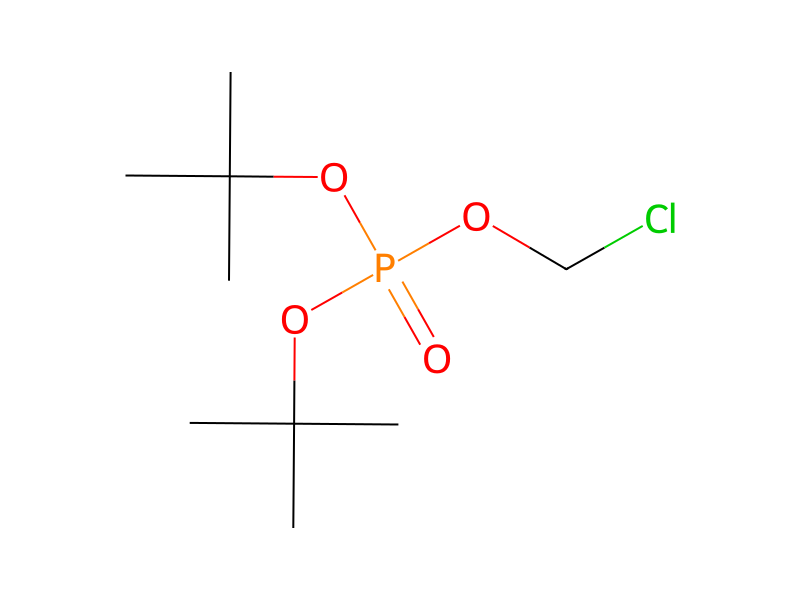
Grundinformationen
- CAS
229625-50-7- Standard-SMILES
CC(C)(C)OP(=O)(OCCl)OC(C)(C)C- InChIKey
LNJAJHJFSKUCIR-UHFFFAOYSA-N- Summenformel
- C9H20ClO4P
- Durchschnittliche Molmasse
- 258,68 g/mol
- Monoisotopische Masse
- 258,07877343
Namen und Bezeichner
- Bevorzugter Name
- Di-tert-butyl (chloromethyl) phosphate
- IUPAC
- ditert-butyl chloromethyl phosphate
- Englischer Name
- Di-tert-butyl Chloromethyl Phosphate
- Summenformel
- C9H20ClO4P
- Molmasse
- 258.68
Namen und Synonyme
di-tert-butyl (chloromethyl) phosphateRefChem:586098695-516-1Di-tert-butyl Chloromethyl Phosphate229625-50-7ditert-butyl chloromethyl phosphatePhosphoric acid, chloromethyl bis(1,1-dimethylethyl) esterMFCD12165895C9H20ClO4Pchloromethyl di-tert-butyl phosphateDi-tert-butyl ChloromethylPhosphate (stabilized with K2CO3)PHOSPHORIC ACI DI-T-BUTYL EXTER CHLOROMETHYL ESTER
Weitere Namen anzeigen
Phosphoric acid di-tert-butyl chloromethyl esterFostemsavir-SMFoscarbidopa Impurity 20ditetrabutyl chloromethyl phosphatePHOSPHORIC ACID DERIVATIVE229625-50-7Di-tert-butyl chloromethyl phosphate 95%Di tertiary butyl chloromethyl phosphite
43LLC5MM9BSCHEMBL194036di-t-butyl chloromethylphosphatedi-t-butyl chloromethyl phosphatedi-tert-butylchloromethylphosphateDTXSID20470842LNJAJHJFSKUCIR-UHFFFAOYSA-Ndi tert-butyl chloromethyl phosphate
Datenbank-Bezeichner
- CAS
229625-50-7- PubChem CID
- 11701630
- DTXSID
DTXSID20470842- UNII
- 43LLC5MM9B
- EC Number
- 695-516-1
- Nikkaji
- J1.721.732A
Eigenschaften
Berechnete Struktureigenschaften
- XLogP
- 2,2
- Polarare Oberfläche (TPSA)
- 44,8 Ų
- H-Brücken-Donoren
- 0
- H-Brücken-Akzeptoren
- 4
- Frei drehbare Bindungen
- 6
- Schwere Atome
- 15
- Formalladung
- 0
- Komplexität
- 221
Physikochemische Eigenschaften
- Siedepunkt
- 272.9 · 272.9±23.0 °C(Predicted)
- Dichte
- 1.115 · 1.115±0.06 g/cm3(Predicted)
- storage temp.
- 2 · Inert atmosphere,2-8°C
- Löslichkeit
- Benzene (Slightly), Methanol (Slightly)
- Aggregatzustand
- clear liquid
- Farbe
- Colorless to Light yellow
- Stabilität
- Moisture Sensitive
- InChI
- InChI=1S/C9H20ClO4P/c1-8(2,3)13-15(11,12-7-10)14-9(4,5)6/h7H2,1-6H3
- InChIKey
- LNJAJHJFSKUCIR-UHFFFAOYSA-N
- SMILES
- P(OC(C)(C)C)(OC(C)(C)C)(OCCl)=O
- CAS Datenbank
- 229625 · 229625-50-7
Sicherheit und Regulatorisches
GHS-Klassifizierung
GHS Classification
Warning
H302 (97.8%): Harmful if swallowed [Warning Acute toxicity, oral]
P264, P270, P301+P317, P330, and P501 (click each P-code to see the statement)
Aggregated GHS information provided per 46 reports by companies from 4 notifications to the ECHA C&L Inventory.
Gefahrenhinweise
Hazard Classes and CategoriesAcute Tox. 4 (97.8%)
Sicherheitsdaten
- hs_code
- 29199000
- risk_code
- 20/21/22
- hazard_code
- Xn
- safety_code
- 36/37
Chemie und Industrie
Anwendungen
BeschreibungDi-tert-butyl Chloromethyl Phosphate has become one of the most common reagents to prepare phosphon-oxymethyl pro-drugs, generally by direct alkylation of hydroxyl or amino groups. Its synthesis was first reported in 1999 via a reaction of di-tert-butyl tetramethylammonium phosphate with chloroiodomethane. This approach required the use of the corresponding tetramethylammonium phosphate and a vast excess (>11 equiv) of chloroiodomethane to minimize the formation of tetra-tert-butyl methylene bisphosphate[1].
VerwendenUsed as an intermediate for laboratory research.
VerwendenThe prodrug was obtained through an alkylation of Albendazole employing Di-tert-butyl Chloromethyl Phosphate in DMF[2].
Vor- und nachgelagerte Produkte
Vorgelagerte Rohstoffe
Anbieter100 Anbieter
郑州阿尔法化工有限公司+86-18530059196 · [email protected]
武汉英诺医药科技有限公司+86-027-59232304 15387063101 · [email protected]
河北创海生物科技有限公司+86-86-13131129325 · [email protected]
湖北科乐精细化工有限公司027-59101668 19945030958 · [email protected]
Dayang Chem (Hangzhou) Co.,Ltd.+86-0571-88938639 17705817739 · [email protected]
上海凯曼化工科技有限公司021-021-50400622 15618790390 · [email protected]
淮安嘉目生物科技有限公司0517-83187139 18205232085 · [email protected]
毕佳索(上海毕得医药科技股份有限公司)400-6005915 · [email protected]
韶远科技(上海)有限公司021-50795510 4000665055 · [email protected]
北京华威锐科化工有限公司0757-86329057 18934348241 · [email protected]
Hangzhou Sage Chemical Co., Ltd.+86057186818502 13588463833 · [email protected]
安耐吉化学&3A(安徽泽升科技股份有限公司)400-0056266 · [email protected]
南京圣亿来化工有限公司19951936396 · [email protected]
Advanced chemblocks inc650-6922368 650-6922368;650-6922368 · [email protected]
上海相辉医药科技有限公司13761987713 · [email protected]
苏州新瑞生物科技有限公司13401437572 · [email protected]
苏州莱克施德药业有限公司0512-63970158-603 18018108880 · [email protected]
宁波奕睿生物科技有限公司15221000252 · [email protected]
武汉盈邦医药有限公司+86-13296627870; +86-13971566811 · [email protected]
上海昊锐医药生物科技有限公司021-58388037;21-58388037 13472507714 · [email protected]
苏州岚云医药科技有限公司2332782371 · [email protected]
安徽实特医药科技有限公司086-21-50829787 13621628489 · [email protected]
江苏艾康生物医药研发有限公司025-66113011 13913916777 · [email protected]
上海健超生物科技有限公司150-2103-5486 18017383231 · [email protected]
TOKYO CHEMICAL INDUSTRY CO., LTD.03-36680489 · [email protected]
TCI Europe320-37350700 · [email protected]
赛纳斯特化学(欢迎点击联系)021-60343070
南京世洲生物科技有限公司13675144456 · [email protected]
上海贺康生物技术有限公司17721021104 18939837085 · [email protected]
苏州月朗星稀化学有限公司0512-62857507 · [email protected]
Labnetwork lnc.+86-27-50766799 +86-18062016861 · [email protected]
四川美域高生物医药科技有限公司028-86136736 19130631884 · [email protected]
杭州杰恒化工有限公司0571-87396432 · [email protected]
上海寰川实业有限公司021-61478794 · [email protected]
上海嵩爰化工科技有限公司010-1234567 18521000990 · [email protected]
陕西缔都医药化工有限公司029-81024372 17792795018 · [email protected]
Accela ChemBio Inc.+1(858) 699-3322 · [email protected]
苏州克瑞斯特医药科技有限公司0512-62910395 17751098781 · [email protected]
四川美大康华康药业有限公司0838-3216983 18942895460 · [email protected]
上海皓之翔生物科技有限公司(原上海拓青化工有限公司)526763801 13301653310 · [email protected]
杭州励德生物科技有限公司0576-83993127 18869992276 · [email protected]
上海威尔舒氪医药科技有限公司15250615384
广东翁江化学试剂有限公司0751-2815987 13927875076 · [email protected]
安耐吉化学&3A(安徽泽升科技股份有限公司)400-0056266 · [email protected]
上海德轩医药科技有限公司[email protected] · [email protected]
sgtlifesciences pvt ltd+91-8790379245 · [email protected]
武汉多普乐生物医药有限公司+86-02787215551 19945035818 · [email protected]
南京世洲生物科技有限公司025-85563444 18351873721 · [email protected]
成都叮当时代医药科技有限公司028-86040038 · [email protected]
上海天习化工有限公司021-20960837,QQ1332204249 · [email protected]
Zugehörige Reaktionen
64


Notizen zur Verbindung
Wird geladen…