
Grundinformationen
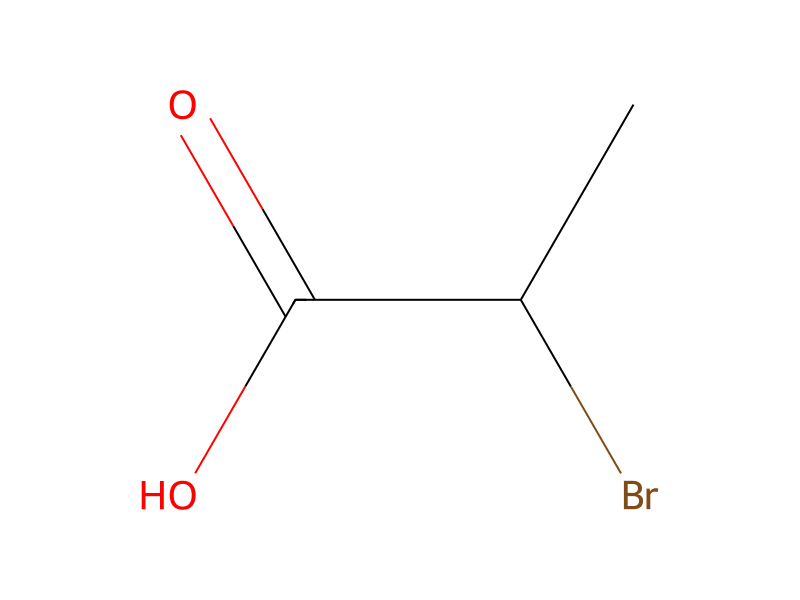
- Standard-SMILES
CC(Br)C(=O)O- InChIKey
MONMFXREYOKQTI-UHFFFAOYSA-N- Summenformel
- C3H5BrO2
- Durchschnittliche Molmasse
- 152,97 g/mol
- Monoisotopische Masse
- 151,9472915
Überblick
RN given refers to cpd without isomeric designation
Namen und Bezeichner
- Bevorzugter Name
- 2-Bromopropionic acid
- IUPAC
- 2-bromopropanoic acid
- Lokaler Name
- 2-Brompropionsure
- Englischer Name
- 2-Bromopropionic acid
- Summenformel
- C3H5BrO2
- Molmasse
- 152.97
Namen und Synonyme
2-BROMOPROPIONIC ACID2-Bromopropanoic acid598-72-1Propanoic acid, 2-bromo-alpha-Bromopropionic acidDTXSID9027233UE0XVY2DT6NSC-172J631IDTXCID207233RefChem:85900209-947-6
Weitere Namen anzeigen
(S)-2-BROMOPROPANOIC ACID2-BROMOPROPANAMIDEA-BROMOPROPIONIC ACID2-broMide3-(3-(4'2-Bromopropion-Bromo-[1,1'DL-2-BromopropionicRARECHEM AL BO 1266
Propionic acid, 2-bromo-.alpha.-Bromopropionic acid(+/-)-2-Bromopropionic acid(+/-)-2-Bromopropanoic acid2-bromo-propionic acidBR1120S-2-Bromopropionic acidDL-2-Bromopropionic acid
Datenbank-Bezeichner
- CAS
598-72-1- PubChem CID
- 11729
- DTXSID
DTXSID9027233- ChEMBL
CHEMBL3182324- UNII
- UE0XVY2DT6
- EC Number
- 209-947-6
- Nikkaji
- J480D、J631I
Eigenschaften
Berechnete Struktureigenschaften
- XLogP
- 0,9
- Polarare Oberfläche (TPSA)
- 37,3 Ų
- H-Brücken-Donoren
- 1
- H-Brücken-Akzeptoren
- 2
- Frei drehbare Bindungen
- 1
- Schwere Atome
- 6
- Formalladung
- 0
- Komplexität
- 61,8
Experimentelle und physikochemische Eigenschaften
Chemical ClassesOther Classes -> Organic Acids
Vapor Pressure0.29 [mmHg]
Physical Description
Liquid
Colorless melt; mp = 25 deg C; [Alfa Aesar MSDS]
Physikochemische Eigenschaften
- Schmelzpunkt
- 25.7 °C · 25.7°C
- Siedepunkt
- 203 °C · 203 °C (lit.)
- Dichte
- 1.7 g/mL · 1.7 g/mL at 25 °C (lit.)
- Brechungsindex
- 20 · n20/D 1.475(lit.)
- Flammpunkt
- 212 °F · 212 °F
- storage temp.
- room temp
- Aggregatzustand
- Liquid After Melting
- pka
- 1 · pK1: 2.971 (25°C)
- Wichte
- 1.7 · 1.7
- Farbe
- Clear colorless to yellow
- Wasserlöslichkeit
- soluble
- BRN
- 605451 · 605451
- Dielectric constant
- 11 · 11.0
- Major Application
- environmental
- InChI
- 1S/C3H5BrO2/c1-2(4)3(5)6/h2H,1H3,(H,5,6)
- InChIKey
- MONMFXREYOKQTI-UHFFFAOYSA-N
- NIST chemische Informationen
- 2 · 2-Bromopropanoic acid(598-72-1)
- EPA chemische Informationen
- 2 · Propanoic acid, 2-bromo- (598-72-1)
Sicherheit und Regulatorisches
GHS-Klassifizierung
GHS Classification
Danger
H301 (69.9%): Toxic if swallowed [Danger Acute toxicity, oral]
P260, P264, P264+P265, P270, P280, P301+P316, P301+P317, P301+P330+P331, P302+P361+P354, P304+P340, P305+P354+P338, P316, P317, P321, P330, P363, P405, and P501 (click each P-code to see the statement)
Aggregated GHS information provided per 163 reports by companies from 8 notifications to the ECHA C&L Inventory. Each notification may be associated with multiple companies.
Gefahrenhinweise
Regulatory Information
Chemical: Propanoic acid, 2-bromo-
Propanoic acid, 2-bromo- is listed on the EPA's Chemical Data Reporting (CDR) system. Manufacturers and importers of Propanoic acid, 2-bromo- are required to report information about their production and use of this chemical to the EPA under the Toxic Substances Control Act (TSCA). (40 eCFR Part 711)
Status: Active Update: 10-08-2020 https://echa.europa.eu/registration-dossier/-/registered-dossier/10591
2-Bromopropionic acid: Does not have an individual approval but may be used under an appropriate group standard
Hazards Summary
Causes other degenerative changes in brain, ataxia, changes in sodium, and muscle weakness in 2- and 3-day intermittent oral studies of rats; [RTECS] Causes burns; Inhalation may cause corrosive injuries to upper respiratory tract and lungs; Harmful by ingestion; [Alfa Aesar MSDS] See 3-Bromopropionic acid.
Hazard Classes and CategoriesAcute Tox. 3 (69.9%)
Toxikologische Informationen
Adverse EffectsDermatotoxin - Skin burns.
Sicherheitsdaten
- wgk
- 3
- tsca
- TSCA listed
- ridadr
- UN 3265 8/PG 2
- hs_code
- 29159080
- RTECS-Nr.
- UA2451715
- risk_code
- 22-34-40-36/37/38-38-11
- hazard_code
- C,Xi,F
- safety_code
- 26-36/37/39-45-36-16-24-9
- hazard_class
- 8
- packing_group
- II
- Speicherklasse
- 3 - Flammable liquids
- Hazard Classifications
- Flam. Liq. 2Skin Irrit. 2
Chemie und Industrie
Verwendung und Herstellung
U.S. Production2023: <50,000 lb
Industry UsesChemical reaction regulator
General Manufacturing Information
All Other Chemical Product and Preparation Manufacturing
Propanoic acid, 2-bromo-: ACTIVE
Anwendungen
VerwendenIt is employed as pharmaceutical and agrochemical intermediate. It is used as an alkylation agent for mercaptans and other sulfur containing compounds.
Darstellung
synthetische2-Bromopropionic acid is obtained by bromination of propionic acid. Add propionic acid and phosphorus trichloride to the reaction kettle, keep the temperature at 80°C, slowly add bromine to the reaction solution dropwise, and heat up to 85°C after the addition of bromine, and raise the temperature to 100°C when the color of bromine disappears completely, it takes about 2~3h, and then the bromine and hydrobromic acid are recovered under reduced pressure, and then the finished product is obtained by distillation under reduced pressure.
Vor- und nachgelagerte Produkte
Vorgelagerte Rohstoffe
Nachgelagerte Produkte
Anbieter50 Anbieter
国药集团化学试剂有限公司86-21-63210123 · [email protected]
梯希爱(上海)化成工业发展有限公司021-67121386 · [email protected]
上海阿拉丁生化科技股份有限公司400-6206333 13167063860 · [email protected]
Shandong chuangyingchemical Co., Ltd.18853181302 · [email protected]
Career Henan Chemica Co+86-0371-86658258 +86-13203830695 · [email protected]
武汉欣扬瑞和化学科技有限公司153-07155313 15307155313 · [email protected]
河北创海生物科技有限公司+86-86-13131129325 · [email protected]
河北展药生物科技有限公司15369953316 +8615369953316 · [email protected]
爱斯特(成都)生物制药股份有限公司+86-28-85122536 85324413 · [email protected]
Baoji Guokang Healthchem co.,ltd+8615604608665 15604608665 · [email protected]
山东前元高分子材料有限公司18678041314 18765609661 · [email protected]
Dayang Chem (Hangzhou) Co.,Ltd.+86-0571-88938639 17705817739 · [email protected]
Hebei Yanxi Chemical Co., Ltd.+86-17531190177 · [email protected]
科瑞迪化学400-821-5857 021-64326257 · [email protected]
上海晶抗生物工程有限公司021-54721350 13524668266 · [email protected]
宁波亿诺化学品有限公司86-574-27787657 · [email protected]
阿法埃莎(中国)化学有限公司400-6106006 · [email protected]
太原市瑞和丰科贸有限公司+86 351 7031519 · [email protected]
安耐吉化学&3A(安徽泽升科技股份有限公司)400-0056266 · [email protected]
武汉卡诺斯科技有限公司027-83238443 15327105076 · [email protected]
上海瀚鸿科技股份有限公司021-54306202 13764082696 · [email protected]
嘉兴市艾森化工有限公司0573-85285100 18627885956 · [email protected]
Pure Chemistry Scientific Inc.001-857-928-2050 or 1-888-588-9418 · [email protected]
山东西亚化学有限公司13355009207 13355009207 · [email protected]
玛雅试剂+86 (573) 82222445 (0)18006601000 452520369 · [email protected]
HONG KONG IPURE BIOLOGY CO.,LIMITED86 18062405514 18062405514 · [email protected]
四川库利南科技有限公司400-1166-196 18981987031 · [email protected]
天津希恩思生化科技有限公司400 638 7771 · [email protected]
Xiamen AmoyChem Co., Ltd+86-86-5926051114 · [email protected]
南京维奥化工有限公司Please Send Email 18652950785 · [email protected]
斯百全化学(上海)有限公司021-021-021-67601398-809-809-809 15221380277 · [email protected]
上海思域化工科技有限公司86-21-34053660 · [email protected]
赛默飞世尔科技(中国)有限公司800-810-5118 · [email protected]
北京伊诺凯科技有限公司400-810-7969 010-59572699 · [email protected]
江苏艾康生物医药研发有限公司025-66113011 13913916777 · [email protected]
TCI AMERICA800-4238616 · [email protected]
TOKYO CHEMICAL INDUSTRY CO., LTD.03-36680489 · [email protected]
TCI Europe320-37350700 · [email protected]
上海贤鼎生物科技有限公司4009209199 · [email protected]
上海倍卓生物科技有限公司021-61119791,13386096464 · [email protected]
日照力德士化工有限公司010-51268198 · [email protected]
美岚实业(上海)有限公司021-58958189 · [email protected]
上海石洋化工有限公司021-56795766 · [email protected]
上海爱蝶实业有限公司021-58957966 18930537195 · [email protected]
成都零六生物科技有限公司400-1166-196 13458535857 · [email protected]
上海麦克林生化科技股份有限公司15221275939 15221275939 · [email protected]
上海嵩爰化工科技有限公司010-1234567 18521000990 · [email protected]
上海有朋化工有限公司021-69005955 13701776567 · [email protected]
上海凯赛化工有限公司021-33516722 13701817765 · [email protected]
上海彤源化工有限公司021-021-69182866 13701855675 · [email protected]
Zugehörige Reaktionen
82


Verknüpfte Notizen
Wird geladen…