
9-Phenylanthracen
9-Phenylanthracene
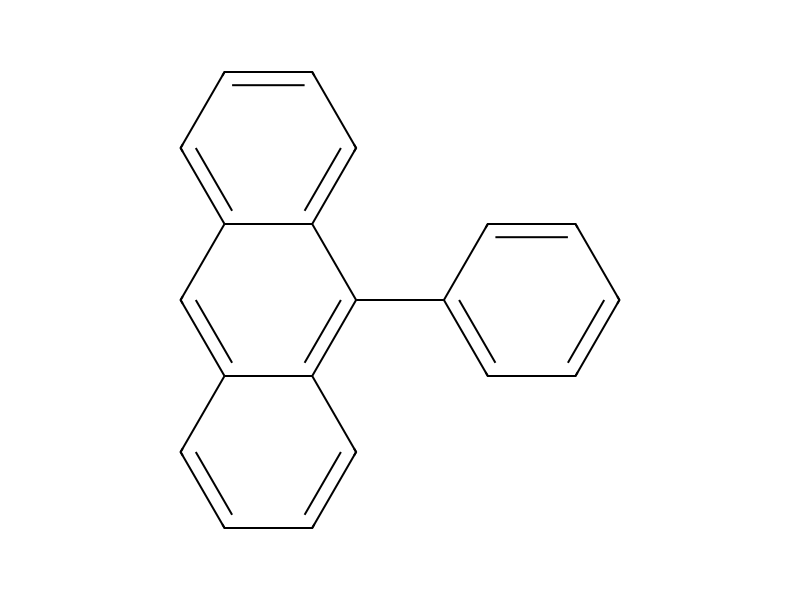
Grundinformationen
- CAS
602-55-1- Standard-SMILES
c1ccc(-c2c3ccccc3cc3ccccc23)cc1- InChIKey
LUBXLGUQZVKOFP-UHFFFAOYSA-N- Summenformel
- C20H14
- Durchschnittliche Molmasse
- 254,3 g/mol
- Monoisotopische Masse
- 254,10955045
Namen und Bezeichner
- Bevorzugter Name
- 9-Phenylanthracene
- IUPAC
- 9-phenylanthracene
- Lokaler Name
- 9-Phenylanthracen
- Englischer Name
- 9-phenylanthracene
- Summenformel
- C20H14
- Molmasse
- 254.33
Namen und Synonyme
9-PHENYLANTHRACENEAnthracene, 9-phenyl-EINECS 210-019-8DC63Z5S1UPNSC 90796NSC-90796DTXSID3075254UNII-DC63Z5S1UPAnthracene, 9phenylRefChem:108184Anthracene, 9-phenyl-(8CI)DTXCID2042771
Weitere Namen anzeigen
9-phenylantracenePhenylanthracene,98%anthracene,9-phenyl-9-Phenylanthracene97%9-Phenylanthracene>9-phenylanthracene-D99-Phenylanthracene,98%9-Phenylanthracene 97%
Anthracene, 9-phenyl-(8CI)(9CI)210-019-8LUBXLGUQZVKOFP-UHFFFAOYSA-N602-55-1MFCD000012529-phenyl-anthraceneNSC907969-Phenylanthracene, 98%
Datenbank-Bezeichner
- CAS
602-55-1- PubChem CID
- 11766
- DTXSID
DTXSID3075254- UNII
- DC63Z5S1UP
- EC Number
- 210-019-8
- Nikkaji
- J79.700F
Eigenschaften
Berechnete Struktureigenschaften
- XLogP
- 6
- Polarare Oberfläche (TPSA)
- 0 Ų
- H-Brücken-Donoren
- 0
- H-Brücken-Akzeptoren
- 0
- Frei drehbare Bindungen
- 1
- Schwere Atome
- 20
- Formalladung
- 0
- Komplexität
- 292
Experimentelle und physikochemische Eigenschaften
PolymersOther Classes -> Polycyclic Aromatic Hydrocarbons
SpringerMaterials PropertiesAngular frequency
LogP6.01
Vapor Pressure0.00000009 [mmHg]
Physical DescriptionSolid; [Aldrich MSDS]
Physikochemische Eigenschaften
- Schmelzpunkt
- 153 · 153-155 °C (lit.)
- Siedepunkt
- 417 °C · 417 °C (lit.)
- Dichte
- 1.118 · 1.1180 (estimate)
- Brechungsindex
- 1.704 · 1.7040 (estimate)
- storage temp.
- Sealed in dry,Room Temperature
- Löslichkeit
- Chloroform (Slightly), Ethyl Acetate (Slightly)
- Aggregatzustand
- Solid
Sicherheit und Regulatorisches
Sicherheitsangaben dienen nur zur Orientierung und ersetzen weder das Sicherheitsdatenblatt (SDB) des Lieferanten noch geltende Vorschriften oder eine fachliche Bewertung.
GHS-Klassifizierung
GHS Classification
Warning
H400 (100%): Very toxic to aquatic life [Warning Hazardous to the aquatic environment, acute hazard]
P273, P391, and P501 (click each P-code to see the statement)
Aggregated GHS information provided per 39 reports by companies from 2 notifications to the ECHA C&L Inventory. Each notification may be associated with multiple companies.
Gefahrenhinweise
Hazards SummaryMay cause irritation; [Aldrich MSDS] See POLYCYCLIC AROMATIC HYDROCARBONS.
Hazard Classes and CategoriesAquatic Acute 1 (100%)
Sicherheitsdaten
- wgk
- 3
- ridadr
- UN 3077 9/PG 3
- hs_code
- 29029090
- risk_code
- 50/53
- hazard_code
- N
- safety_code
- 60-61
- hazard_class
- 9
- Speicherklasse
- 11 - Combustible Solids
- Hazard Classifications
- Aquatic Acute 1Aquatic Chronic 1
Chemie und Industrie
Anwendungen
Verwenden9-Phenylanthracene is used to synthesize organic light-emitting material intermediates.
Darstellung
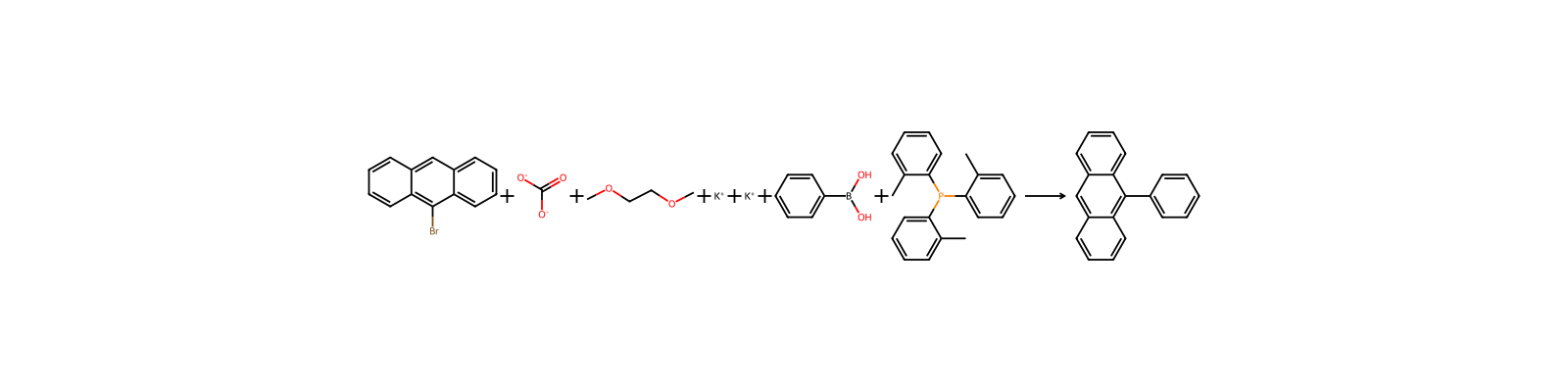
synthetischeThe synthesis of 9-phenylanthracene involved mixing phenylboronic acid (2.13 g, 17.49 mmol), 9-bromoanthracene (3 g, 11.66 mmol), Pd(PPh3)4 (140 mg, 0.12 mmol), K2CO3 (16 mL, 2 M), and ethanol (8 mL) in a 100 mL flask with anhydrous toluene (32 mL). The mixture was refluxed for 48 h under nitrogen. After cooled to room temperature, the reaction mixture was quenched with dilute hydrochloric acid solution and extracted with CH2Cl2. The organic extracts were dried over anhydrous MgSO4 and concentrated by rotary evaporation. The crude product was further purified by silica gel column chromatography (CH2Cl2/petroleum ether (1:4,v/v)) to get a white powder (2.43 g, 81.9 %). 1H NMR (500 MHz, CDCl3) δ 8.53 (s, 1H), 8.08 (d, J = 8.5 Hz, 2H), 7.70 – 7.67 (m, 2H), 7.63 – 7.54 (m, 3H), 7.50 – 7.45 (m, 4H), 7.37 (ddd, J = 8.7, 6.5, 1.2 Hz, 2H). EI-MS (m/z): Calculated for C20H14: 254.33. Found [M+]: 253.02.Synthesis of 9-phenylanthracene
Vor- und nachgelagerte Produkte
Vorgelagerte Rohstoffe
Zugehörige Reaktionen
39.452


Notizen zur Verbindung
Wird geladen…