
Triphenylarsin
Triphenylarsine
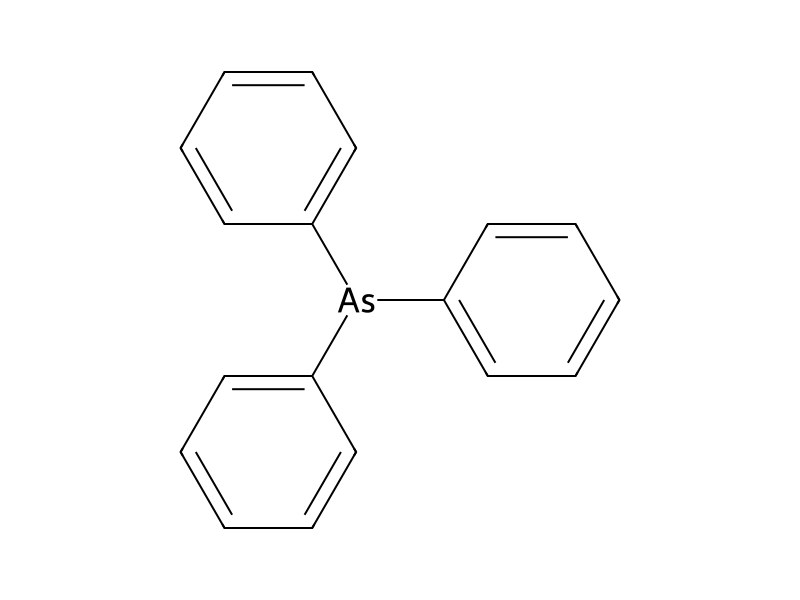
Grundinformationen
- CAS
603-32-7- Standard-SMILES
c1ccc([As](c2ccccc2)c2ccccc2)cc1- InChIKey
BPLUKJNHPBNVQL-UHFFFAOYSA-N- Summenformel
- C18H15As
- Durchschnittliche Molmasse
- 306,2 g/mol
- Monoisotopische Masse
- 306,03897
Überblick
Triphenylarsine is an organoarsenic compound. It is used as a ligand and a reagent in coordination chemistry and organic synthesis. Arsenic is a chemical element that has the symbol As and atomic number 33. It is a poisonous metalloid that has many allotropic forms: yellow (molecular non-metallic) and several black and grey forms (metalloids) are a few that are seen. Three metalloidal forms of arsenic with different crystal structures are found free in nature (the minerals arsenopyrite and the much rarer arsenolamprite and pararsenolamprite), but it is more commonly found as a compound with other elements. (T3, L398)
Namen und Bezeichner
- Bevorzugter Name
- Triphenylarsine
- IUPAC
- triphenylarsane
- Lokaler Name
- Triphenylarsin
- Englischer Name
- Triphenylarsine
- Summenformel
- C18H15As
- Molmasse
- 306.23
Namen und Synonyme
TRIPHENYLARSINE603-32-7TriphenylarsaneArsine, triphenyl-TriphenylarseneTriphenyl arsenicMN8EZ3FL74NSC-478DTXSID4060529RefChem:191898DTXCID6042787210-032-9
Weitere Namen anzeigen
Triphenyl-arsaneNSC 478triphenyl-arsinTriphenylarsine,97%Triphenylarsine,98%
ArsinetriphenylMFCD00002994TriphenylarsenicArsenic triphenylC18H15Astriphenyl arsinetriphenyl-arsineNSC478
Datenbank-Bezeichner
- CAS
603-32-7- PubChem CID
- 11773
- DTXSID
DTXSID4060529- UNII
- MN8EZ3FL74
- EC Number
- 210-032-9
- Nikkaji
- J44.111B
Eigenschaften
Berechnete Struktureigenschaften
- Polarare Oberfläche (TPSA)
- 0 Ų
- H-Brücken-Donoren
- 0
- H-Brücken-Akzeptoren
- 0
- Frei drehbare Bindungen
- 3
- Schwere Atome
- 19
- Formalladung
- 0
- Komplexität
- 202
Experimentelle und physikochemische Eigenschaften
Chemical ClassesMetals -> Arsenic Compounds, Organic
Vapor Pressure0.0000496 [mmHg]
Physical DescriptionWhite powder; [Alfa Aesar MSDS] Fine colorless crystals; [Aldrich MSDS]
Physikochemische Eigenschaften
- Schmelzpunkt
- 58 · 58-61 °C (lit.)
- Siedepunkt
- 360 °C · 360 °C
- Dichte
- 1 · 1,225 g/cm3
- Brechungsindex
- 1.6888 · 1.6888
- Flammpunkt
- 265 °C · 265 °C
- storage temp.
- 30 °C · Store below +30°C.
- Aggregatzustand
- Powder
- Wichte
- 1.2225 · 1.2225
- Farbe
- white
- Wasserlöslichkeit
- Soluble in methanol. Insoluble in water.
- BRN
- 1842037 · 1842037
Sicherheit und Regulatorisches
Sicherheitsangaben dienen nur zur Orientierung und ersetzen weder das Sicherheitsdatenblatt (SDB) des Lieferanten noch geltende Vorschriften oder eine fachliche Bewertung.
GHS-Klassifizierung
GHS Classification
Danger
H301 (100%): Toxic if swallowed [Danger Acute toxicity, oral]
P261, P264, P270, P271, P273, P301+P316, P304+P340, P316, P321, P330, P391, P403+P233, P405, and P501 (click each P-code to see the statement)
Aggregated GHS information provided per 44 reports by companies from 4 notifications to the ECHA C&L Inventory. Each notification may be associated with multiple companies.
Gefahrenhinweise
Regulatory Information
Restricted substance: Triphenylarsine
Triphenylarsine: Does not have an individual approval but may be used under an appropriate group standard
Hazards Summary
An irritant; Toxic by ingestion and inhalation; [Alfa Aesar MSDS] Almost nothing is known regarding health effects of organic arsenic compounds in humans. Studies in animals show that some simple organic arsenic compounds are less toxic than inorganic forms. Ingestion of methyl and dimethyl compounds can cause diarrhea and damage to the kidneys. [ATSDR ToxProfiles] See Dimethylarsenic acid.
Hazard Classes and CategoriesAcute Tox. 3 (100%)
Sicherheit und Schutzausrüstung
Minimum Risk LevelAcute Oral: 0.005 mg/kg/day (L134)
Chronic Oral: 0.0003 mg/kg/day (L134)
Chronic Inhalation: 0.01 mg/m3 (L134)
Permissible Exposure Limit (PEL)0.5 [mg/m3], as As
Toxikologische Informationen
Chemie und Industrie
Pharmakologische Informationen
Metabolism/Metabolites
Arsenic is absorbed mainly by inhalation or ingestion, as to a lesser extent, dermal exposure. It is then distributed throughout the body, where it is reduced into arsenite if necessary, then methylated into monomethylarsenic (MMA) and dimethylarsenic acid (DMA) by arsenite methyltransferase. Arsenic and its metabolites are primarily excreted in the urine. Arsenic is known to induce the metal-binding protein metallothionein, which decreases the toxic effects of arsenic and other metals by binding them and making them biologically inactive, as well as acting as an antioxidant. (L20)
Verwendung und Herstellung
UsesTriphenylarsine is used as a ligand and a reagent in coordination chemistry and organic synthesis. (L398)
General Manufacturing InformationArsine, triphenyl-: ACTIVE
Anwendungen
BeschreibungTriphenylarsin bildet farblose, wasserunlösliche, trikline Tafeln. Es ist leicht löslich in Diethylether und Benzol. Die Substanz ist zu 5 % im sogenannten Arsinöl enthalten, welches im 1. Weltkrieg als chemischer Kampfstoff verwendet wurde.
VerwendenTriphenylarsine is used in certain metal-catalyzed coupling reactions. It is a precursor to tetraphenylarsonium chloride a popular precipitating agent.
Vor- und nachgelagerte Produkte
Nachgelagerte Produkte
Zugehörige Reaktionen
190







Notizen zur Verbindung
Wird geladen…