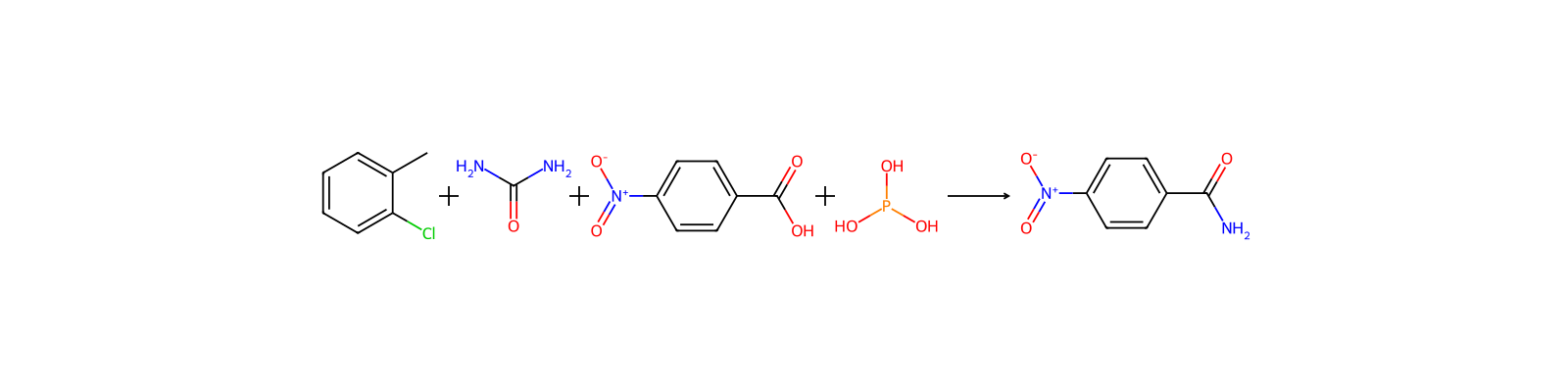
4-Nitrobenzamid
4-Nitrobenzamide
Daten werden ergänzt – lade die Seite später neu, um den aktuellen Stand zu sehen

Grundinformationen
- CAS
619-80-7- Standard-SMILES
NC(=O)c1ccc([N+](=O)[O-])cc1- InChIKey
ZESWUEBPRPGMTP-UHFFFAOYSA-N- Summenformel
- C7H6N2O3
- Durchschnittliche Molmasse
- 166,13 g/mol
- Monoisotopische Masse
- 166,03784205
Überblick
P-nitrobenzamide is a white powder. (NTP, 1992)
Namen und Bezeichner
- Bevorzugter Name
- 4-Nitrobenzamide
- IUPAC
- 4-nitrobenzamide
- Lokaler Name
- 4-Nitrobenzamid
- Englischer Name
- p-Nitrobenzamide
- Summenformel
- C7H6N2O3
- Molmasse
- 166.13
Namen und Synonyme
4-NITROBENZAMIDEp-NitrobenzamideBenzamide, 4-nitro-4-nitro-benzamideDTXSID8022086NSC 2902EINECS 210-613-7AI3-01346DTXCID002086RefChem:1000394-NITROBENZOIC ACID, AMIDE210-613-7
Weitere Namen anzeigen
NitrobenzaMidep-nitro-benzamid4-nitro-benzamidBenzamide,4-nitro-Benzamide,p-nitro-TIMTEC-BB SBB0082014-Nitrobenzamide>
ZESWUEBPRPGMTP-UHFFFAOYSA-N619-80-7Benzamide, p-nitro-MFCD00007994NSC-2902p-Nitrobenzamide, 98%4-Nitrobenzamide, 98%NITROBENZAMIDE, P-
Datenbank-Bezeichner
- CAS
619-80-7- PubChem CID
- 12091
- DTXSID
DTXSID8022086- ChEMBL
CHEMBL1483601- UNII
- 683NB4HAX7
- EC Number
- 210-613-7
- Nikkaji
- J62.020C
Eigenschaften
Berechnete StruktureigenschaftenWird ergänzt
- XLogP
- 0,8
- Polarare Oberfläche (TPSA)
- 88,9 Ų
- H-Brücken-Donoren
- 1
- H-Brücken-Akzeptoren
- 3
- Frei drehbare Bindungen
- 1
- Schwere Atome
- 12
- Formalladung
- 0
- Komplexität
- 191
Experimentelle und physikochemische Eigenschaften
SpringerMaterials PropertiesChemical shift
LogP0.82
Solubilityless than 0.1 mg/mL at 64 °F (NTP, 1992)
Melting Point394 to 399 °F (NTP, 1992)
Physical DescriptionP-nitrobenzamide is a white powder. (NTP, 1992)
Physikochemische Eigenschaften
- Schmelzpunkt
- 199 · 199-201 °C(lit.)
- Siedepunkt
- 294.32 °C · 294.32°C (rough estimate)
- Dichte
- 1.4334 · 1.4334 (rough estimate)
- Brechungsindex
- 1.588 · 1.5880 (estimate)
- pka
- 15.02 · 15.02±0.50(Predicted)
- Aggregatzustand
- powder to crystal
- Farbe
- White to Orange to Green
Sicherheit und Regulatorisches
Sicherheitsangaben dienen nur zur Orientierung und ersetzen weder das Sicherheitsdatenblatt (SDB) des Lieferanten noch geltende Vorschriften oder eine fachliche Bewertung.
GHS-Klassifizierung
GHS Classification
Danger
H301 (71.7%): Toxic if swallowed [Danger Acute toxicity, oral]
P261, P262, P264, P264+P265, P270, P271, P280, P301+P316, P301+P317, P302+P352, P304+P340, P305+P351+P338, P316, P319, P321, P330, P332+P317, P337+P317, P361+P364, P362+P364, P403+P233, P405, and P501 (click each P-code to see the statement)
Aggregated GHS information provided per 53 reports by companies from 7 notifications to the ECHA C&L Inventory. Each notification may be associated with multiple companies.
Gefahrenhinweise
Regulatory InformationStatus: Active Update: 16-03-2020 https://echa.europa.eu/registration-dossier/-/registered-dossier/26217
Fire HazardsFlash point data for this compound are not available, however, it is probably combustible. (NTP, 1992)
Reactive GroupAmides and Imides
Reactivity Profile
A nitrated amide. Organic amides/imides react with azo and diazo compounds to generate toxic gases. Flammable gases are formed by the reaction of organic amides/imides with strong reducing agents. Amides are very weak bases (weaker than water). Imides are less basic yet and in fact react with strong bases to form salts. That is, they can react as acids. Mixing amides with dehydrating agents such as P2O5 or SOCl2 generates the corresponding nitrile. The combustion of these compounds generates mixed oxides of nitrogen (NOx).
Air and Water ReactionsInsoluble in water.
Hazard Classes and CategoriesAcute Tox. 3 (71.7%)
Chemie und Industrie
Verwendung und Herstellung
General Manufacturing InformationBenzamide, 4-nitro-: ACTIVE
Anwendungen
Verwenden4-Nitrobenzamide was used in the preparation of 4-nitrobenziminosulfurane.
Vor- und nachgelagerte Produkte
Nachgelagerte Produkte
Zugehörige Reaktionen
36


Notizen zur Verbindung
Wird geladen…