Tetramethylharnstoff
Tetramethylurea
Daten werden ergänzt – lade die Seite später neu, um den aktuellen Stand zu sehen
Grundinformationen
- CAS
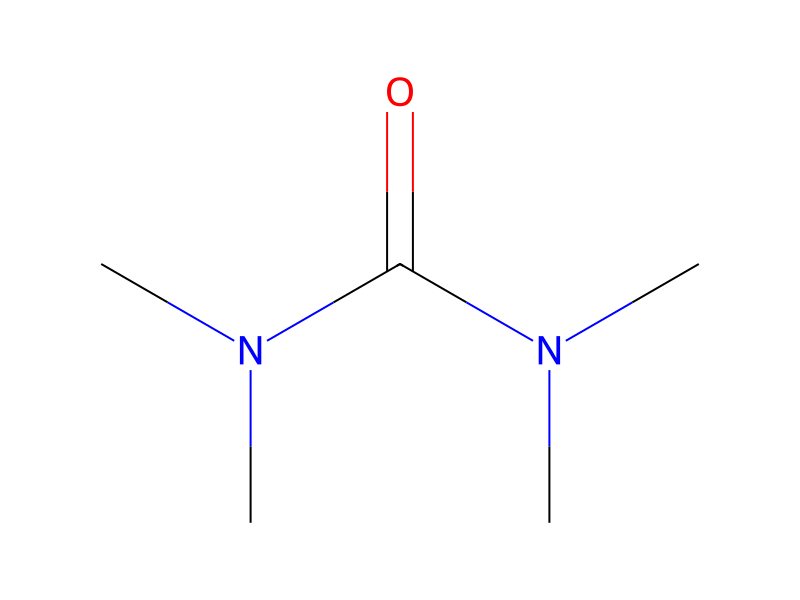
632-22-4- Standard-SMILES
CN(C)C(=O)N(C)C- InChIKey
AVQQQNCBBIEMEU-UHFFFAOYSA-N- Summenformel
- C5H12N2O
- Durchschnittliche Molmasse
- 116,16 g/mol
- Monoisotopische Masse
- 116,094963
Überblick
1,1,3,3-tetramethylurea is a member of the class of ureas that is urea substituted by methyl groups at positions 1, 1, 3 and 3 respectively. Metabolite observed in cancer metabolism. It has a role as a human metabolite.
Namen und Bezeichner
- Bevorzugter Name
- Tetramethylurea
- IUPAC
- 1,1,3,3-tetramethylurea
- Lokaler Name
- Tetramethylharnstoff
- Englischer Name
- 1,1,3,3-Tetramethylurea
- Summenformel
- C5H12N2O
- Molmasse
- 116.16
Namen und Synonyme
1,1,3,3-TetramethylureaTETRAMETHYLUREA632-22-4TemurUrea, tetramethyl-N,N,N',N'-TetramethylureaTetramethylureeUrea, 1,1,3,3-tetramethyl-NSC-914882O1EJ64031DTXSID1060893CHEBI:84278
Weitere Namen anzeigen
tetramethyl-ureOlaparib Impurity 381,1,3,3-tetramethyl-ure((CH3)2N)2CO
RefChem:188798DTXCID1043750211-173-9TMUurea, N,N,N',N'-tetramethyl-Tetramethyl UreaNSC 91488BRN 0773898
Datenbank-Bezeichner
- CAS
632-22-4- PubChem CID
- 12437
- DTXSID
DTXSID1060893- ChEMBL
CHEMBL11949- ChEBI
CHEBI:84278- UNII
- 2O1EJ64031
- EC Number
- 211-173-9
- Nikkaji
- J6.897G
Eigenschaften
Berechnete StruktureigenschaftenWird ergänzt
- XLogP
- 0,2
- Polarare Oberfläche (TPSA)
- 23,6 Ų
- H-Brücken-Donoren
- 0
- H-Brücken-Akzeptoren
- 1
- Frei drehbare Bindungen
- 0
- Schwere Atome
- 8
- Formalladung
- 0
- Komplexität
- 78,4
Experimentelle und physikochemische Eigenschaften
Chemical ClassesNitrogen Compounds -> Urea Compounds
SpringerMaterials PropertiesSchoenflies notation
LogP
log Kow = 0.19
0.19
OdorFAINT, PLEASANT
Density0.9687 @ 20 °C/4 °C
Color/FormLIQUID
Solubility
MISCIBLE WITH WATER, PETROLEUM ETHER, ALL COMMON SOLVENTS
SLIGHTLY SOL IN ALCOHOL
water solubility = 1X10+6 mg/l
Flash PointABOUT 75 °C
Boiling Point176.5 °C
Melting Point-1.2 °C
Vapor Pressure
Sicherheit und Regulatorisches
Sicherheitsangaben dienen nur zur Orientierung und ersetzen weder das Sicherheitsdatenblatt (SDB) des Lieferanten noch geltende Vorschriften oder eine fachliche Bewertung.
GHS-Klassifizierung
GHS Classification
Danger
H302 (97.4%): Harmful if swallowed [Warning Acute toxicity, oral]
P203, P264, P270, P280, P301+P317, P318, P330, P405, and P501 (click each P-code to see the statement)
Aggregated GHS information provided per 116 reports by companies from 8 notifications to the ECHA C&L Inventory. Each notification may be associated with multiple companies.
Danger
H227: Combustible liquid [Warning Flammable liquids]
Gefahrenhinweise
Regulatory Information
Chemical: Urea, tetramethyl-
Tetramethylurea: Does not have an individual approval but may be used under an appropriate group standard
Fire PotentialFIRE HAZARD: MODERATE, VIA HEAT, FLAME & OXIDIZERS.
Hazards Summary
Teratogenic effects observed in mice dosed by SC injection; IV doses of 150 mg/kg daily for five days produced weight loss in dogs, monkeys, and mice; [HSDB] A strong skin irritant, but not a sensitizer in guinea pigs; Temporary kidney injury and possible liver injury observed in two week feeding study of male rats at 450 mg/kg; [EPA] Causes general anesthesia and somnolence in IP lethal-dose study of mice; [RTECS] Teratogenic effects and fetal loss observed in studies of rodents; No human data on reproductive or lactation effects; [REPROTOX] An irritant; [Alfa Aesar MSDS]
Special ReportsREVIEW OF PREPN, MFR, PROPERTIES AND USE AS SOLVENT AND AS REAGENT: LUTTRINGHAUS, DIRKSEN, AGNEW CHEM INT ED 3, 260 (1964).[The Merck Index. 9th ed. Rahway, New Jersey: Merck & Co., Inc., 1976., p. 1190]
Hazard Classes and Categories
Chemie und Industrie
Verwendung und Herstellung
Uses
Used as solvent and reagent; [Merck Index]
SOLVENT & REAGENT
U.S. Exports
(1972) No Data
(1975) No Data
U.S. Imports
(1972) No Data
(1975) No Data
U.S. Production
(1972) PROBABLY GREATER THAN 4.54X10+5 GRAMS
(1975) PROBABLY LESS THAN 4.54X10+5 GRAMS
Methods of ManufacturingPREPN: LAWSON, CROOM, J ORG CHEM, 28, 232 (1963).
General Manufacturing InformationUrea, N,N,N',N'-tetramethyl-: ACTIVE
Anwendungen
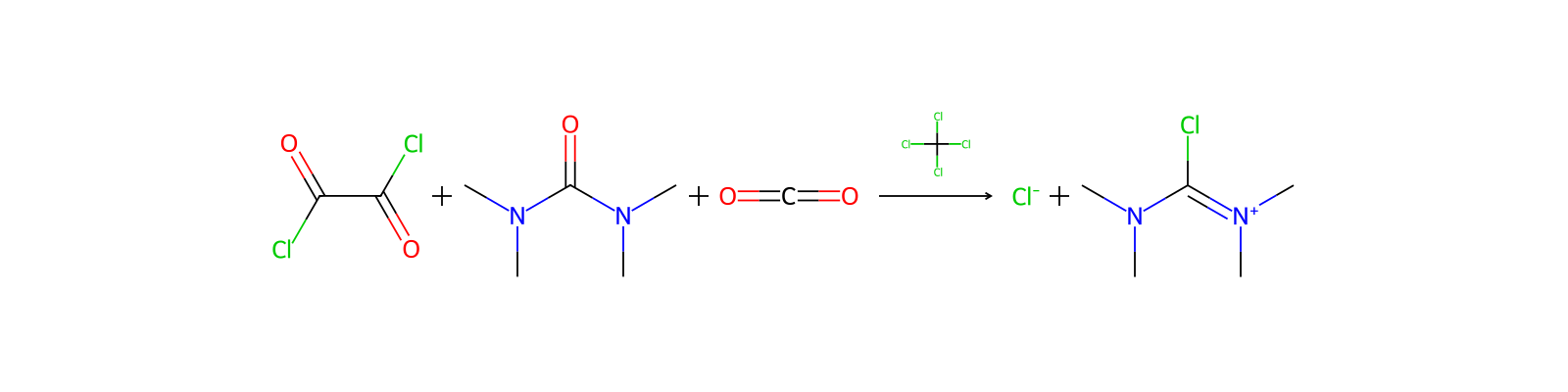
VerwendenTetramethylurea is used as a solvent in dyestuff industries, in condensation reaction and intermediates in surfactant. It is utilized for base catalyzed isomerization and alkylation hydrocyanation due to its low permittivity. It reacts with oxalyl chloride to prepare tetramethyl chloroformamidinium chloride, which is used for the conversion of carboxylic acids and dialkyl phosphates to anhydrides and pyrophosphates respectively.
Darstellung
synthetischeThe reaction of dimethylamine with phosgene in the presence of e. g. 50 % sodium hydroxide solution and subsequent extraction with 1,2-dichloroethane yields tetramethylurea in 95% yield.
Vor- und nachgelagerte Produkte
Vorgelagerte Rohstoffe
Zugehörige Reaktionen
56




Notizen zur Verbindung
Wird geladen…