
Dicyclohexylphosphin
Dicyclohexylphosphine

Grundinformationen
- CAS
829-84-5- Standard-SMILES
C1CCC(PC2CCCCC2)CC1- InChIKey
HDULBKVLSJEMGN-UHFFFAOYSA-N- Summenformel
- C12H23P
- Durchschnittliche Molmasse
- 198,28 g/mol
- Monoisotopische Masse
- 198,15373737
Namen und Bezeichner
- Bevorzugter Name
- Dicyclohexylphosphine
- IUPAC
- dicyclohexylphosphane
- Lokaler Name
- Dicyclohexylphosphin
- Englischer Name
- Dicyclohexylphosphine
- Summenformel
- C12H23P
- Molmasse
- 198.28
Namen und Synonyme
DICYCLOHEXYLPHOSPHINEPhosphine, dicyclohexyl-EINECS 212-590-9DTXSID7061190RefChem:133251DTXCID7048322212-590-9HDULBKVLSJEMGN-UHFFFAOYSA-Ndicyclohexylphosphane829-84-5MFCD00014296C12H23P
Weitere Namen anzeigen
Dicyclohexylphosphino98% Cy2PHicyclohexylphosphanedicyclohexyl-phosphinPhosphine,dicyclohexyl-Bis(cyclohexyl)phosphineDicyclohexylphosphine,98%Dicyclohexylphosphine,98% Cy2PH
Dicyclohexyl phosphineCy2PHF7LBQ7EZ7ZDicyclohexylphosphine, 97%SCHEMBL303960SCHEMBL303961AAA82984AKOS015840836
Datenbank-Bezeichner
- CAS
829-84-5- PubChem CID
- 13239
- DTXSID
DTXSID7061190- UNII
- F7LBQ7EZ7Z
- EC Number
- 212-590-9
- Nikkaji
- J79.979C
Eigenschaften
Berechnete Struktureigenschaften
- XLogP
- 3,5
- Polarare Oberfläche (TPSA)
- 0 Ų
- H-Brücken-Donoren
- 0
- H-Brücken-Akzeptoren
- 0
- Frei drehbare Bindungen
- 2
- Schwere Atome
- 13
- Formalladung
- 0
- Komplexität
- 116
Physikochemische Eigenschaften
- Schmelzpunkt
- 2 °C · 2°C
- Siedepunkt
- 129 °C · 129 °C 8 mm Hg
- Dichte
- 0 · 0,98 g/cm3
- Brechungsindex
- 20 · n 20/D 1.516
- Flammpunkt
- 2 °C · 2 °C
- storage temp.
- 20 · 20-25°C
- Aggregatzustand
- liquid
- Wichte
- 0.98 · 0.98
- Farbe
- colorless to light yellow
- InChI
- InChI=1S/C12H23P/c1-3-7-11(8-4-1)13-12-9-5-2-6-10-12/h11-13H,1-10H2
- InChIKey
- HDULBKVLSJEMGN-UHFFFAOYSA-N
- SMILES
- P(C1CCCCC1)C1CCCCC1
- CAS Datenbank
- 829 · 829-84-5
- EPA chemische Informationen
- Phosphine, dicyclohexyl- (829-84-5)
Sicherheit und Regulatorisches
Sicherheitsangaben dienen nur zur Orientierung und ersetzen weder das Sicherheitsdatenblatt (SDB) des Lieferanten noch geltende Vorschriften oder eine fachliche Bewertung.
GHS-Klassifizierung
GHS Classification
Danger
H225 (70.4%): Highly Flammable liquid and vapor [Danger Flammable liquids]
P210, P222, P231, P233, P240, P241, P242, P243, P260, P261, P262, P264, P264+P265, P270, P271, P273, P280, P301+P316, P301+P330+P331, P302+P335+P334, P302+P352, P302+P361+P354, P303+P361+P353, P304+P340, P305+P351+P338, P305+P354+P338, P316, P321, P330, P337+P317, P361+P364, P363, P370+P378, P391, P403+P233, P403+P235, P405, and P501 (click each P-code to see the statement)
Aggregated GHS information provided per 54 reports by companies from 4 notifications to the ECHA C&L Inventory. Each notification may be associated with multiple companies.
Gefahrenhinweise
Hazard Classes and CategoriesFlam. Liq. 2 (70.4%)
Sicherheitsdaten
- wgk
- WGK 3
- tsca
- TSCA listed
- ridadr
- UN 2845 4.2/PG 1
- risk_code
- 17-23/24/25
- hazard_code
- F,T
- safety_code
- 17-36/37/39-45
- Speicherklasse
- 4.2 - Pyrophoric and self-heating hazardous materials
- Hazard Classifications
- Acute Tox. 3 DermalAcute Tox. 3 InhalationAcute Tox. 3 OralEye Irrit. 2Pyr. Liq. 1
Chemie und Industrie
Verwendung und Herstellung
General Manufacturing InformationPhosphine, dicyclohexyl-: ACTIVE
Anwendungen
VerwendenWang et al. developed a novel fluorescent probe based on dicyclohexylphosphine for rapid and sensitive detection of HOCl in an aqueous solution. The probe exhibits a significant fluorescence turn-on response to HOCl through the specific oxidative reaction between dicyclohexylphosphine and HOCl[1].
Vor- und nachgelagerte Produkte
Nachgelagerte Produkte
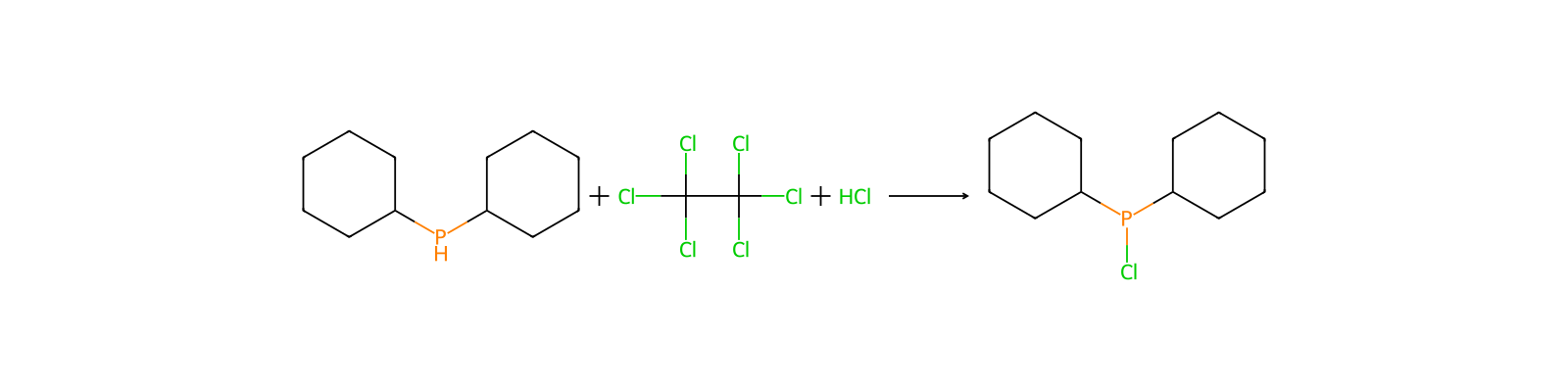
Zugehörige Reaktionen
13


Notizen zur Verbindung
Wird geladen…