
Grundinformationen
- Standard-SMILES
CCC(=O)N(c1ccccc1)C1CCN(CCc2ccccc2)CC1.O=C(O)CC(O)(CC(=O)O)C(=O)O- InChIKey
IVLVTNPOHDFFCJ-UHFFFAOYSA-N- Summenformel
- C28H36N2O8
- Durchschnittliche Molmasse
- 528,6 g/mol
- Monoisotopische Masse
- 528,24716611
Überblick
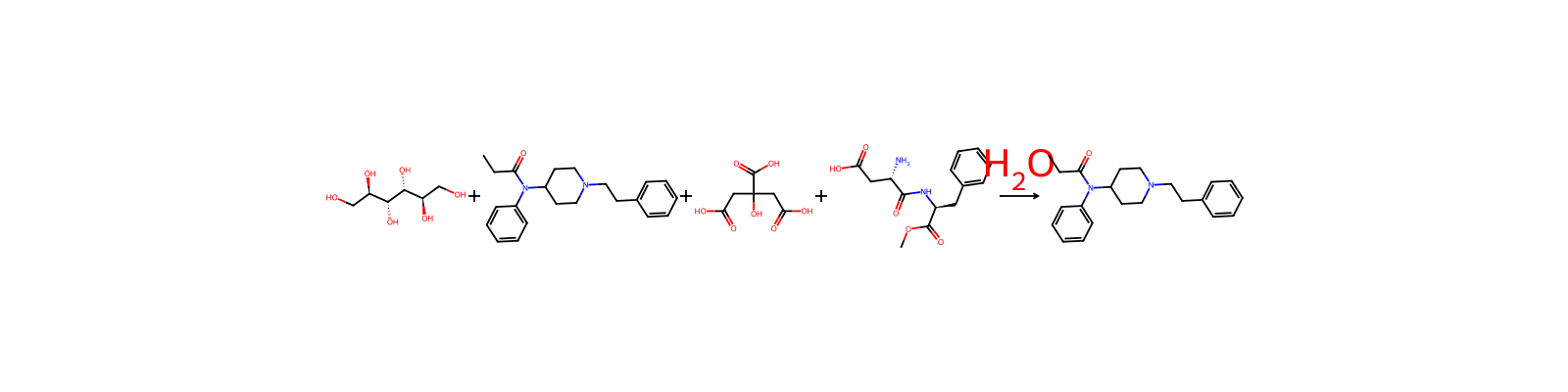
Fentanyl citrate is the citric acid salt of fentanyl, comprising equimolar amounts of citric acid and fentanyl. A -opioid receptor agonist, it is a potent opioid analgesic used in the management of labour pain, postoperative pain, and chronic intractable cancer pain. It is also widely used as the analgesic component of balanced anaesthesia. It has a role as an opioid analgesic and a mu-opioid receptor agonist. It contains a fentanyl.
Namen und Bezeichner
- Bevorzugter Name
- Fentanyl Citrate
- IUPAC
- 2-hydroxypropane-1,2,3-tricarboxylic acid;N-phenyl-N-[1-(2-phenylethyl)piperidin-4-yl]propanamide
Namen und Synonyme
FENTANYL CITRATE990-73-8LeptanalOraletPhentanyl citrateActiqAbstralLazandaOnsolisInstanylFentanyl buccalMcN-JR-4263-49
Weitere Namen anzeigen
Fentanyl citrate ciiSUBLIMAZE PRESERVATIVE FREEMUN5LYG46HN-(1-Phenethyl-4-piperidyl)propionanilide citrateFENTANYL CITRATE PRESERVATIVE FREEKw-2246N-(1-Phenethyl-4-piperidyl)propionanilide dihydrogen citrateN-(1-Phenethyl-4-piperidinyl)propionanilide dihydrogen citrate
Datenbank-Bezeichner
- CAS
990-73-8- PubChem CID
- 13810
- DTXSID
DTXSID80243933- ChEMBL
CHEMBL688- ChEBI
CHEBI:31602- UNII
- MUN5LYG46H
- EC Number
- 213-588-0
Eigenschaften
Berechnete Struktureigenschaften
- Polarare Oberfläche (TPSA)
- 156 Ų
- H-Brücken-Donoren
- 4
- H-Brücken-Akzeptoren
- 9
- Frei drehbare Bindungen
- 11
- Schwere Atome
- 38
- Formalladung
- 0
- Komplexität
- 618
Experimentelle und physikochemische Eigenschaften
Chemical ClassesOther Uses -> Pharmaceuticals
Human Drugs
FDA approved drugs -> Active ingredient
EMA approved medicines: Human medicine
FDA approved drugs -> Active ingredient
Animal DrugsActive Ingredients (Fentanyl Citrate) -> FDA Greenbook
Sicherheit und Regulatorisches
GHS-Klassifizierung
GHS Classification
Danger
H300 (100%): Fatal if swallowed [Danger Acute toxicity, oral]
P233, P260, P261, P262, P264, P270, P271, P272, P280, P284, P301+P316, P302+P352, P304+P340, P316, P320, P321, P330, P333+P317, P342+P316, P361+P364, P362+P364, P403, P403+P233, P405, and P501 (click each P-code to see the statement)
Aggregated GHS information provided per 68 reports by companies from 11 notifications to the ECHA C&L Inventory. Each notification may be associated with multiple companies.
Gefahrenhinweise
Regulatory InformationFentanyl citrate: HSNO Approval: HSR003800 Approved with controls
Other Safety InformationIMAP assessments - Propanamide, N-phenyl-N-[1-(2-phenylethyl)-4-piperidinyl]-,2-hydroxy-1,2,3-propanetricarboxylate (1:1): Environment tier I assessment
Hazards Summary
Fentanyl is a solid. It is a Schedule II controlled substance. Fentanyl citrate is a strong analgesic used preoperatively, during surgery, and in the immediate postoperative period for its analgesic action. . . . Introduced into clinical practice in the 1960s, the analgesic fentanyl is 100 times more potent than morphine. [HSDB] TLV Basis is CNS impairment and respiratory depression; [ACGIH TLVs and BEIs]
Hazard Classes and CategoriesAcute Tox. 2 (100%)
Sicherheit und Schutzausrüstung
Threshold Limit Values (TLV)
0.00001, inhalable particulate matter (Surface Level = 1 ug/100cm2)
0.00002, inhalable particulate matter
Toxikologische Informationen
Adverse EffectsACGIH Carcinogen - Not Classifiable.
Chemie und Industrie
Pharmakologische Informationen
FDA Pharmacological Classification
FENTANYL CITRATE
Opioid Agonist [EPC]; Full Opioid Agonists [MoA]
MeSH Pharmacological Classification
Compounds with activity like OPIATE ALKALOIDS, acting at OPIOID RECEPTORS. Properties include induction of ANALGESIA or NARCOSIS.
Agents that are administered in association with anesthetics to increase effectiveness, improve delivery, or decrease required dosage.
Agents that induce NARCOSIS. Narcotics include agents that cause somnolence or induced sleep (STUPOR); natural or synthetic derivatives of OPIUM or MORPHINE or any substance that has such effects. They are potent inducers of ANALGESIA and OPIOID-RELATED DISORDERS.
Ultrashort-acting anesthetics that are used for induction. Loss of consciousness is rapid and induction is pleasant, but there is no muscle relaxation and reflexes frequently are not reduced adequately. Repeated administration results in accumulation and prolongs the recovery time. Since these agents have little if any analgesic activity, they are seldom used alone except in brief minor procedures. (From AMA Drug Evaluations Annual, 1994, p174)
Verwendung und Herstellung
Use ClassificationAnimal Drugs -> FDA Approved Animal Drug Products (Green Book) -> Active Ingredients
Zugehörige Reaktionen
5




Verknüpfte Notizen
Wird geladen…