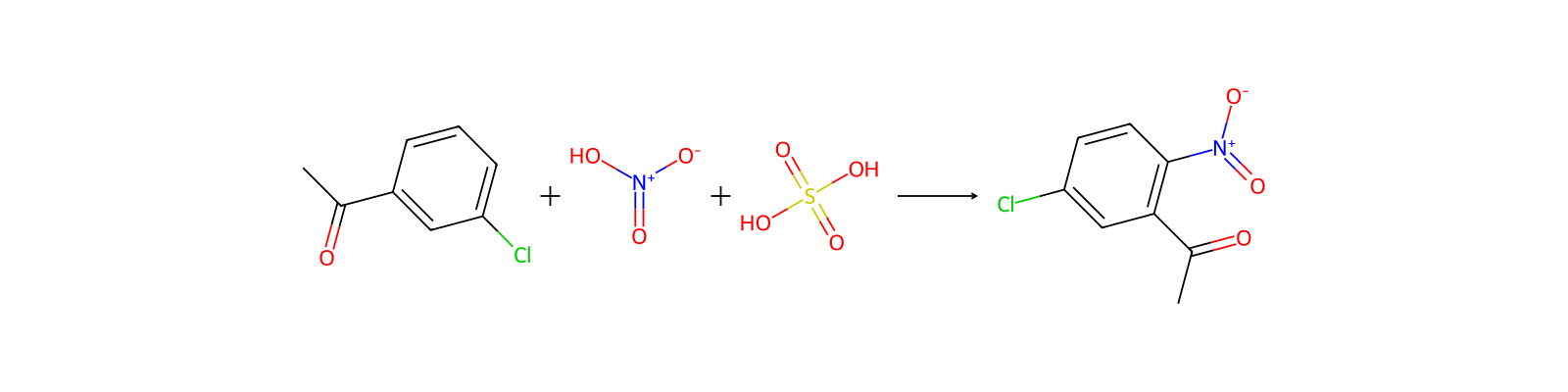

Grundinformationen
- Standard-SMILES
CC(=O)c1cccc(Cl)c1- InChIKey
UUWJBXKHMMQDED-UHFFFAOYSA-N- Summenformel
- C8H7ClO
- Durchschnittliche Molmasse
- 154,59 g/mol
- Monoisotopische Masse
- 154,01854252
Namen und Bezeichner
- Bevorzugter Name
- 1-(3-Chlorophenyl)ethanone
- IUPAC
- 1-(3-chlorophenyl)ethanone
- Englischer Name
- 3’-Chloroacetophenone
- Summenformel
- C8H7ClO
- Molmasse
- 154.595
Namen und Synonyme
3'-Chloroacetophenone99-02-51-(3-Chlorophenyl)ethanoneEthanone, 1-(3-chlorophenyl)-EZZ4YCH58KDTXSID8059182RefChem:484668DTXCID3049091202-721-8m-Chloroacetophenone1-(3-Chlorophenyl)ethan-1-one1341-24-8
Weitere Namen anzeigen
Ethanone, 1-phenyl-,Monochloro deriv. (9CI)
3-chloroacetophenoneMFCD000005931-(3-chloro-phenyl)-ethanone1-acetyl-3-chlorobenzeneAcetophenone, 3'-chloro-3 inverted exclamation marka-ChloroacetophenoneChloroacetophenonesCCRIS 638
Datenbank-Bezeichner
- CAS
1341-24-8、99-02-5- PubChem CID
- 14933
- DTXSID
DTXSID8059182- UNII
- EZZ4YCH58K
- EC Number
- 202-721-8
- Nikkaji
- J100.178G
Eigenschaften
Berechnete Struktureigenschaften
- XLogP
- 2,5
- Polarare Oberfläche (TPSA)
- 17,1 Ų
- H-Brücken-Donoren
- 0
- H-Brücken-Akzeptoren
- 1
- Frei drehbare Bindungen
- 1
- Schwere Atome
- 10
- Formalladung
- 0
- Komplexität
- 133
Experimentelle und physikochemische Eigenschaften
SpringerMaterials Properties13C nuclear magnetic resonance spectrum
LogP2.43
Sicherheit und Regulatorisches
GHS-Klassifizierung
GHS Classification
Warning
H302 (17.3%): Harmful if swallowed [Warning Acute toxicity, oral]
P261, P264, P264+P265, P270, P271, P280, P301+P317, P302+P352, P304+P340, P305+P351+P338, P319, P321, P330, P332+P317, P337+P317, P362+P364, P403+P233, P405, and P501 (click each P-code to see the statement)
Aggregated GHS information provided per 52 reports by companies from 9 notifications to the ECHA C&L Inventory. Each notification may be associated with multiple companies.
Gefahrenhinweise
Regulatory Information3'-Chloroacetophenone: Does not have an individual approval but may be used under an appropriate group standard
Hazard Classes and CategoriesAcute Tox. 4 (17.3%)
Chemie und Industrie
Pharmakologische Informationen
MeSH Pharmacological Classification
Drugs that act locally on cutaneous or mucosal surfaces to produce inflammation; those that cause redness due to hyperemia are rubefacients; those that raise blisters are vesicants and those that penetrate sebaceous glands and cause abscesses are pustulants; tear gases and mustard gases are also irritants.
Gases that irritate the eyes, throat, or skin. Severe lacrimation develops upon irritation of the eyes.
Verwendung und Herstellung
General Manufacturing InformationEthanone, 1-(3-chlorophenyl)-: ACTIVE
Anbieter50 Anbieter
梯希爱(上海)化成工业发展有限公司021-67121386 · [email protected]
湖北永阔科技有限公司027-59223108 15972152991 · [email protected]
山东海舟生物工程有限公司130-0567-0367 13006570367 · [email protected]
武汉欣扬瑞和化学科技有限公司153-07155313 15307155313 · [email protected]
温州共赢化学有限公司+86-0086-577-64498589 +86-15355981851 · [email protected]
爱斯特(成都)生物制药股份有限公司+86-28-85122536 85324413 · [email protected]
Baoji Guokang Healthchem co.,ltd+8615604608665 15604608665 · [email protected]
Dayang Chem (Hangzhou) Co.,Ltd.+86-0571-88938639 17705817739 · [email protected]
科瑞迪化学400-821-5857 021-64326257 · [email protected]
Syntechem Co.,Ltd[email protected]
上海迈瑞尔生化科技有限公司4006356688 18621169109 · [email protected]
上海辅欣医药科技有限公司+86-021-021-50872116 · [email protected]
阿法埃莎(中国)化学有限公司400-6106006 · [email protected]
安耐吉化学&3A(安徽泽升科技股份有限公司)400-0056266 · [email protected]
武汉凯威斯科技有限公司86-027-67849912 · [email protected]
上海瀚鸿科技股份有限公司021-54306202 13764082696 · [email protected]
上海景颜化工科技有限公司13817811078 · [email protected]
嘉兴市艾森化工有限公司0573-85285100 18627885956 · [email protected]
上海隆盛化工有限公司58099637 13585536065 · [email protected]
郑州研德生物科技有限公司0371-63682289 15538176268 · [email protected]
上海竺钥化工有限公司021-33559231 18964673308 · [email protected]
Beckmann-Kenko GmbH+49 4241 9308 88 · [email protected]
苏州启航生物科技有限公司18662190603;18151111370 · [email protected]
山东西亚化学有限公司13355009207 13355009207 · [email protected]
玛雅试剂+86 (573) 82222445 (0)18006601000 452520369 · [email protected]
四川库利南科技有限公司400-1166-196 18981987031 · [email protected]
上海耐士化工科技有限公司400-188-0725 +86 21 34310725 13611771617
天津希恩思生化科技有限公司400 638 7771 · [email protected]
Xiamen AmoyChem Co., Ltd+86-86-5926051114 · [email protected]
南京化学试剂股份有限公司025-58369808 17895012682 · [email protected]
河南多贝化工有限公司0370-2785118 17550508557 · [email protected]
上海思域化工科技有限公司86-21-34053660 · [email protected]
赛默飞世尔科技(中国)有限公司800-810-5118 · [email protected]
北京伊诺凯科技有限公司400-810-7969 010-59572699 · [email protected]
上海遐瑞医药科技有限公司+86 21 61551611
江苏艾康生物医药研发有限公司025-66113011 13913916777 · [email protected]
上海健超生物科技有限公司150-2103-5486 18017383231 · [email protected]
TCI AMERICA800-4238616 · [email protected]
TOKYO CHEMICAL INDUSTRY CO., LTD.03-36680489 · [email protected]
TCI Europe320-37350700 · [email protected]
上海贤鼎生物科技有限公司4009209199 · [email protected]
越林试剂021-62960152 · [email protected]
上海睿升化工科技有限公司+86-021-50935922
北京环宇世纪化学科技有限公司hysj_bj.com
HBCChem, Inc.+1-510-219-6317 · [email protected]
上海毕得医药科技股份有限公司400-164-7117 18317119277 · [email protected]
日照力德士化工有限公司010-51268198 · [email protected]
美岚实业(上海)有限公司021-58958189 · [email protected]
上海爱蝶实业有限公司021-58957966 18930537195 · [email protected]
广拓化学(上海)有限公司021-60899189-8001 18918189673 · [email protected]
Zugehörige Reaktionen
66


Verknüpfte Notizen
Wird geladen…