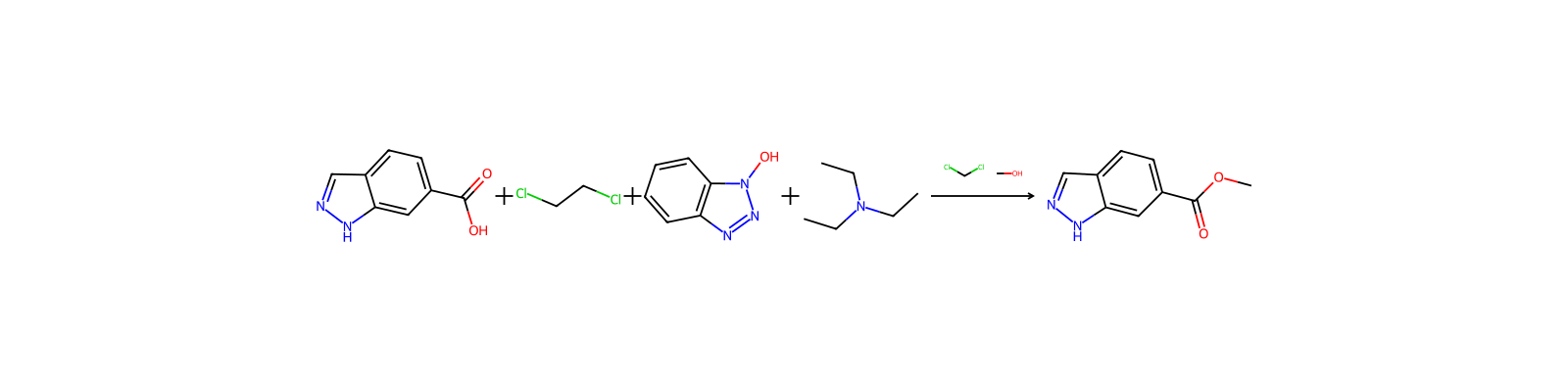
HRID 14163als Edukt

704-91-6O=C(O)c1ccc2cn[nH]c2c1DNCVTVVLMRHJCJ-UHFFFAOYSA-N704-91-6DTXSID30585471CHEMBL4867341Sicherheitsangaben dienen nur zur Orientierung und ersetzen weder das Sicherheitsdatenblatt (SDB) des Lieferanten noch geltende Vorschriften oder eine fachliche Bewertung.
Warning
H302 (16.7%): Harmful if swallowed [Warning Acute toxicity, oral]
P261, P264, P264+P265, P270, P271, P280, P301+P317, P302+P352, P304+P340, P305+P351+P338, P319, P321, P330, P332+P317, P337+P317, P362+P364, P403+P233, P405, and P501 (click each P-code to see the statement)
Aggregated GHS information provided per 6 reports by companies from 3 notifications to the ECHA C&L Inventory. Each notification may be associated with multiple companies.
Verwenden1H-Indazole-6-carboxylic Acid is used as a reagent to synthesize azabicyclic aryl amides, which act as α7 nicotinic acetylcholine receptor agonists.
synthetischeSynthesis of 1H-indazole-6-carboxylic acid, H2L3: MeL3Ac (1.0 g; 4.6 mmol) was dissolved in 40 mL THF, and this solution was added to a 40 mL aqueous solution of lithium hydroxide (5.0 g; 210 mmol). The resulting suspension was heated at reflux with vigorous stirring overnight, after which time the solution was concentrated under vacuum to remove the organic phase. The resulting solution was filtered, adjusted to pH 3 with conc. HCl, to precipitate the product as a pale brown solid, which was filtered, washed with water and dried under vacuum. Yield 315 mg, 43%. mp 292–296 °C (decomp); δH (500 MHz, d6-DMSO): 7.67 (dd, 1H, J = 8.3, 1.0 Hz, H4 ), 7.85 (dd, 1H, J = 8.3, 0.8 Hz, H3 ), 8.15 (s, 1H, H6 ), 8.18 (d, 1H, J = 0.8 Hz, H2 ), 13.24 (br s, 2H, H1 & H5 ); δC (125 MHz, CD3OD): 114.1, 122.0, 122.6, 127.1, 130.6, 135.2, 141.4, 170.4; HRMS-ESI m/z: found: 163.0503; C8H7N2O2 requires: 163.0502 [M + H+ ]; ˉνmax/cm1 (KBr): 3258 br, 2864 br, 2582 br, 1679 s, 1579 m, 1518 m, 1425 m, 1230 s, 1087 m, 954 s, 857 m, 762 m, 693 m.