
HRID 70406als Edukt
N-Isopropylacrylamide
Daten werden ergänzt – lade die Seite später neu, um den aktuellen Stand zu sehen
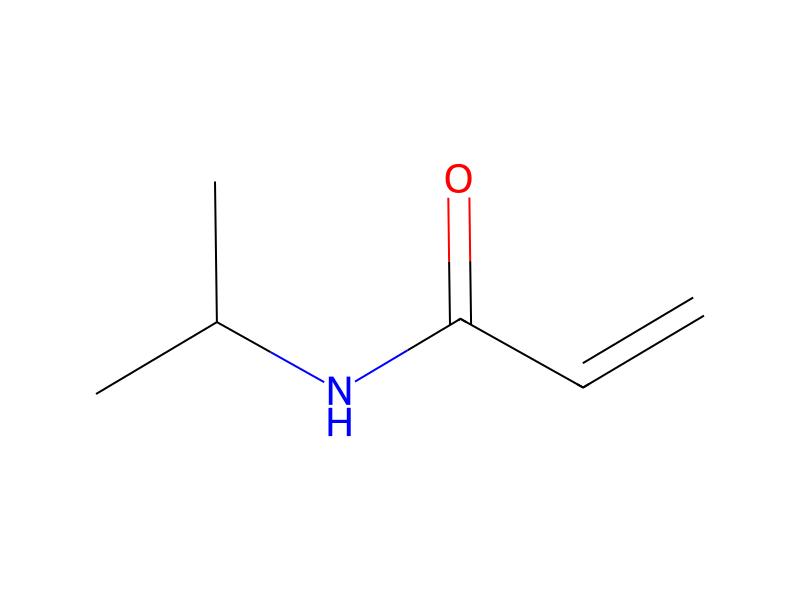
2210-25-5C=CC(=O)NC(C)CQNILTEGFHQSKFF-UHFFFAOYSA-Ncan polymerize with glycidyl acrylate to form reactive water-soluble polymer that can react with the amino groups of enzymes-proteins or other ligands
2210-25-5DTXSID0033754CHEMBL1527236Crystalline solid
Cream-colored powder
Hazardous decomposition products /formed under fire conditions/: Carbon oxides, nitrogen oxides (NOx)
When heated to decomposition it emits toxic fumes of /nitrogen oxides/ (NOx).
Sicherheitsangaben dienen nur zur Orientierung und ersetzen weder das Sicherheitsdatenblatt (SDB) des Lieferanten noch geltende Vorschriften oder eine fachliche Bewertung.
Danger
H302 (100%): Harmful if swallowed [Warning Acute toxicity, oral]
P264, P264+P265, P270, P280, P301+P317, P305+P351+P338, P305+P354+P338, P317, P330, P337+P317, and P501 (click each P-code to see the statement)
Aggregated GHS information provided per 157 reports by companies from 8 notifications to the ECHA C&L Inventory. Each notification may be associated with multiple companies.
Warning
H302: Harmful if swallowed [Warning Acute toxicity, oral]
Crude solutions may cause skin irritation; Causes hind quarter paralysis and head tremors in cats administered intraperitoneally at total cumulative dose of 840 mg/kg over 18 day period (fully recovered after five weeks); Testicular atrophy (degeneration of epithelial cells of the seminiferous tubules) observed in mice following repeated oral doses; [HSDB] A moderate eye irritant; Causes spastic paralysis and hemorrhage in dermal lethal-dose study of rabbits and oral lethal-dose study or rats; Causes changes in testicular weight in eight week intermittent oral study of mice; [RTECS] An irritant; [Aldrich MSDS]
Special hazards arising from the substance or mixture: Hazardous decomposition products formed under fire conditions. - Carbon oxides, nitrogen oxides (NOx)
When heated to decomposition it emits toxic fumes of /nitrogen oxides/ (NOx).
Acute Tox. 4 (100%)
Acute toxicity (Oral) - Category 4
The in vitro biotransformations of acrylamide and ten related compounds in the hepatic enzyme system of the mouse were studied in order to learn more about their toxic actions in vivo. ... The metabolite of N-isopropylacrylamide was identified as acrylamide by gas chromatography-mass spectrometry. ... Phenobarbital pretreatment of mice enhanced the metabolic reactions of the seven compounds, but did not elevate those of acrylamide and crotonamide. The Km value of N-isopropylacrylamide was 0.35 mM, which was the smallest of all the test analogues. All of the eleven analogues studied were found to be metabolized by hepatic glutathione S-transferases as well. This reaction was also elevated by the phenobarbital treatment of mice. ...
Used in binders for textiles, paper, adhesives, detergents, and cosmetics; [Hawley]
Pulp and Paper Processing [Category: Industry]
Binders in textiles, paper adhesives, detergents, cosmetics
One of the water-soluble monomers used in the production of polyacrylamides, poly(acrylic acid), and poly(methacrylic acid)
Chemical intermediate in the development of photosensitized drug delivery systems
Core/shell precursor in gold nanoparticle applications
2-Propenamide, N-(1-methylethyl)-: ACTIVE
Homopolymers and copolymers prepared with this material show inverse solubility in water.
Temperature and moisture responsive smart textile. US 20080057809 A1
Thermoplastic polymers or copolymers of acrylic acids, methacrylic acid, esters of these acids, or acrylonitrile. The monomers are colorless liquids that polymerize readily in the presence of light, heat, or catalysts such as benzoyl peroxide; they must be stored or shipped with inhibitors present to avoid spontaneous and explosive polymerization. /Acrylic resins/


BP: 89-92 °C at 2 mm Hg; VP: 2 mm Hg at 83 °C; Storage temp: 2-8 °C
Acrylic resins vary from hard, brittle solids to fibrous, elastomeric structures to viscous liquids, depending on the monomer used and the method of polymerization. A distinctive property of cast sheet and extruded rods of acrylic resins is ability to transmit light /Acrylic resins/
Wear self contained breathing apparatus for fire fighting if necessary.
Use water spray, alcohol-resistant foam, dry chemical or carbon dioxide.
Pick up and arrange disposal without creating dust. Sweep up and shovel. Keep in suitable, closed containers for disposal.
Use personal protective equipment. Avoid dust formation. Avoid breathing vapors, mist or gas. Ensure adequate ventilation. Avoid breathing dust.
Do not let product enter drains.
Product: Offer surplus and non-recyclable solutions to a licensed disposal company. Contact a licensed professional waste disposal service to dispose of this material. Dissolve or mix the material with a combustible solvent and burn in a chemical incinerator equipped with an afterburner and scrubber.
Contaminated packaging: Dispose of as unused product.
SRP: The most favorable course of action is to use an alternative chemical product with less inherent propensity for occupational harm/injury/toxicity or environmental contamination. Recycle any unused portion of the material for its approved use or return it to the manufacturer or supplier. Ultimate disposal of the chemical must consider: the material's impact on air quality; potential migration in soil or water; effects on animal and plant life; and conformance with environmental and public health regulations.
Avoid contact with skin and eyes. Avoid formation of dust and aerosols. Provide appropriate exhaust ventilation at places where dust is formed. Normal measures for preventive fire protection.
Gloves must be inspected prior to use. Use proper glove removal technique (without touching glove's outer surface) to avoid skin contact with this product. Dispose of contaminated gloves after use in accordance with applicable laws and good laboratory practices. Wash and dry hands.
Respiratory protection: For nuisance exposures use type P95 (US) or type P1 (EU EN 143) particle respirator.For higher level protection use type OV/AG/P99 (US) or type ABEK-P2 (EU EN 143) respirator cartridges. Use respirators and components tested and approved under appropriate government standards such as NIOSH (US) or CEN (EU).
Eye/face protection: Safety glasses with side-shields conforming to EN166 Use equipment for eye protection tested and approved under appropriate government standards such as NIOSH (US) or EN 166(EU).
Handle with gloves.
Body Protection: Complete suit protecting against chemicals, The type of protective equipment must be selected according to the concentration and amount of the dangerous substance at the specific workplace.
TERRESTRIAL FATE: Based on a classification scheme(1), an estimated Koc value of 19(SRC), determined from a structure estimation method(2), indicates that N-isopropylacrylamide is expected to have very high mobility in soil(SRC). Volatilization of N-isopropylacrylamide from moist soil surfaces is not expected to be an important fate process(SRC) given an estimated Henry's Law constant of 2.3X10⁻⁸ atm-cu m/mole(SRC), using a fragment constant estimation method(3). N-Isopropylacrylamide is not expected to volatilize from dry soil surfaces(SRC) based upon an estimated vapor pressure of 2.3X10⁻² mm Hg at 25 °C(SRC), determined from a fragment constant method(2). Biodegradation data in soil were not available(SRC, 2013).
AQUATIC FATE: Based on a classification scheme(1), an estimated Koc value of 19(SRC), determined from a structure estimation method(2), indicates that N-isopropylacrylamide is not expected to adsorb to suspended solids and sediment(SRC). Volatilization from water surfaces is not expected(3) based upon an estimated Henry's Law constant of 2.3X10⁻⁸ atm-cu m/mole(SRC), developed using a fragment constant estimation method(4). According to a classification scheme(5), an estimated BCF of 3(SRC), from an estimated log Kow of 0.57(2)and a regression-derived equation(2), suggests the potential for bioconcentration in aquatic organisms is low(SRC). Biodegradation data in water were not available(SRC, 2013).
ATMOSPHERIC FATE: According to a model of gas/particle partitioning of semivolatile organic compounds in the atmosphere(1), N-isopropylacrylamide, which has an estimated vapor pressure of 2.3X10⁻² mm Hg at 25 °C(SRC), determined from a fragment constant method(2), is expected to exist solely as a vapor in the ambient atmosphere. Vapor-phase N-isopropylacrylamide is degraded in the atmosphere by reaction with photochemically-produced hydroxyl radicals(SRC); the half-life for this reaction in air is estimated to be 0.5 days(SRC), calculated from its rate constant of 2.3X10⁻¹¹ cu cm/molecule-sec at 25 °C(SRC) that was derived using a structure estimation method(3). N-Isopropylacrylamide contains chromophores that absorb at wavelengths >290 nm(4) and, therefore, may be susceptible to direct photolysis by sunlight(SRC).
Using a structure estimation method based on molecular connectivity indices(1), the Koc of N-isopropylacrylamide can be estimated to be 19(SRC). According to a classification scheme(2), this estimated Koc value suggests that N-isopropylacrylamide is expected to have very high mobility in soil.
N-Isopropylacrylamide's production and use as a binder in textiles, paper adhesives, detergents, cosmetics(1), and chemical intermediate in processes such as drug delivery systems(2) and nanotechnology(3) may result in its release to the environment through various waste streams(SRC).
An estimated BCF of 3 was calculated in fish for N-isopropylacrylamide(SRC), using an estimated log Kow of 0.57(1) and a regression-derived equation(1). According to a classification scheme(2), this BCF suggests the potential for bioconcentration in aquatic organisms is low(SRC).
The Henry's Law constant for N-isopropylacrylamide is estimated as 2.3X10⁻⁸ atm-cu m/mole(SRC) using a fragment constant estimation method(1). This Henry's Law constant indicates that N-isopropylacrylamide is expected to be essentially nonvolatile from water and moist soil surfaces(2). N-Isopropylacrylamide is not expected to volatilize from dry soil surfaces(SRC) based upon an estimated vapor pressure of 2.3X10⁻² mm Hg(SRC), determined from a fragment constant method(3).
/LABORATORY ANIMALS: Subchronic or Prechronic Exposure/ A total cumulative dose of 840 mg/kg ip in cat over period of 18 days produced paralysis of hind quarters and head tremors. No visual hallucinations, hypermetria, or loss of righting were present. Treatment was discontinued and full recovery took place in about 5 weeks.
/LABORATORY ANIMALS: Developmental or Reproductive Toxicity/ Neurotoxicity of acrylamide and related compounds and their effects on the testis after repeated oral doses were studied in mice. ... Acrylamide, N-hydroxymethylacrylamide, N-isopropylacrylamide, N-methylacrylamide and N,N'-methylene-bis-acrylamide produced testicular atrophy. Atrophy was either prevented by phenobarbital treatment, as in the cases of acrylamide and N-isopropylacrylamide, or reduced, as in the case of N-hydroxymethylacrylamide. Histological changes in the testis produced by the active compounds were degenerations of the epithelial cells of the seminiferous tubules, with the interstitial cells being normal.
/LABORATORY ANIMALS: Neurotoxicity/ Neurotoxicity of acrylamide and related compounds and their effects on the testis after repeated oral doses were studied in mice. Of fourteen analogues tested, five produced neuropathy. In decreasing order of potency as assessed by the rotated performance test, these were as follows: acrylamide greater than N-isopropylacrylamide greater than N-methylacrylamide = methacrylamide greater than N-hydroxymethylacrylamide. The development of neurotoxicity was either greatly reduced or delayed by phenobarbital treatment. ...
The rate constant for the vapor-phase reaction of N-isopropylacrylamide with photochemically-produced hydroxyl radicals has been estimated as 2.3X10⁻¹¹ cu cm/molecule-sec at 25 °C(SRC) using a structure estimation method(1). This corresponds to an atmospheric half-life of about 0.5 days at an atmospheric concentration of 5X10+5 hydroxyl radicals per cu cm(1). The rate constant for the vapor-phase reaction of N-isopropylacrylamide with ozone has been estimated as 1.8X10⁻¹⁸ cu cm/molecule-sec at 25 °C(SRC) that was derived using a structure estimation method(1). This corresponds to an atmospheric half-life of about 6.6 days at an atmospheric concentration of 7X10+11 ozone molecules per cu cm(2). With the exception of a few halogenated acetamides, most amides hydrolyze to acids extremely slowly at 25 °C and pH7 with half-lives measured in centuries. Electronegative groups on carbon or nitrogen greatly accelerate base catalyzed hydrolysis, but alkyl groups on nitrogen retard both acid and base catalyzed processes. No neutral hydrolysis is evident(3). N-Isopropylacrylamide contains chromophores that absorb at wavelengths >290 nm(4) and, therefore, may be susceptible to direct photolysis by sunlight(SRC).
N-Isopropylacrylamide's production and use as a binder in textiles, paper adhesives, detergents, cosmetics, and chemical intermediate in processes such as drug delivery systems and nanotechnology may result in its release to the environment through various waste streams. If released to air, an estimated vapor pressure of 2.3X10⁻² mm Hg at 25 °C indicates N-isopropylacrylamide will exist solely as a vapor in the atmosphere. Vapor-phase N-isopropylacrylamide will be degraded in the atmosphere by reaction with photochemically-produced hydroxyl radicals; the half-life for this reaction in air is estimated to be 0.5 days. N-Isopropylacrylamide contains chromophores that absorb at wavelengths >290 nm and, therefore, may be susceptible to direct photolysis by sunlight. If released to soil, N-isopropylacrylamide is expected to have very high mobility based upon an estimated Koc of 19. Volatilization from moist soil surfaces is not expected to be an important fate process based upon an estimated Henry's Law constant of 2.3X10⁻⁸ atm-cu m/mole. N-Isopropylacrylamide is not expected to volatilize from dry soil surfaces based upon its vapor pressure. Biodegradation data in soil or water were not available. If released into water, N-isopropylacrylamide is not expected to adsorb to suspended solids and sediment based upon the estimated Koc. Volatilization from water surfaces is not expected to be an important fate process based upon this compound's estimated Henry's Law constant. An estimated BCF of 3 suggests the potential for bioconcentration in aquatic organisms is low. Chemical hydrolysis is not expected to be an important environmental fate process since amides do not hydrolyze under environmental conditions (pH 5-9). Occupational exposure to N-isopropylacrylamide may occur through inhalation and dermal contact with this compound at workplaces where N-isopropylacrylamide is produced or used. (SRC)
/SRP:/ Basic treatment: Establish a patent airway (oropharyngeal or nasopharyngeal airway, if needed). Suction if necessary. Watch for signs of respiratory insufficiency and assist respirations if necessary. Administer oxygen by nonrebreather mask at 10 to 15 L/min. Monitor for pulmonary edema and treat if necessary ... . Monitor for shock and treat if necessary ... . For eye contamination, flush eyes immediately with water. Irrigate each eye continuously with 0.9% saline (NS) during transport ... . Do not use emetics. For ingestion, rinse mouth and administer 5 mL/kg up to 200 mL of water for dilution if the patient can swallow, has a strong gag reflex, and does not drool. Activated charcoal is not effective ... . Do not attempt to neutralize because of exothermic reaction. Cover skin burns with dry, sterile dressings after decontamination ... . /Organic acids and related compounds/
/SRP:/ Immediate first aid: Ensure that adequate decontamination has been carried out. If patient is not breathing, start artificial respiration, preferably with a demand-valve resuscitator, bag-valve-mask device, or pocket mask, as trained. Perform CPR as necessary. Immediately flush contaminated eyes with gently flowing water. Do not induce vomiting. If vomiting occurs, lean patient forward or place on left side (head-down position, if possible) to maintain an open airway and prevent aspiration. Keep patient quiet and maintain normal body temperature. Obtain medical attention. /Organic acids and related compounds/
/SRP:/ Advanced treatment: Consider orotracheal or nasotracheal intubation for airway control in the patient who is unconscious, has severe pulmonary edema, or is in severe respiratory distress. Early intubation, at the first sign of upper airway obstruction, may be necessary. Positive-pressure ventilation techniques with a bag valve mask device may be beneficial. Consider drug therapy for pulmonary edema ... . Consider administering a beta agonist such as albuterol for severe bronchospasm ... . Monitor cardiac rhythm and treat arrhythmias as necessary ... . Start IV administration of D5W /SRP: "To keep open", minimal flow rate/. Use 0.9% saline (NS) or lactated Ringer's (LR) if signs of hypovolemia are present. For hypotension with signs of hypovolemia, administer fluid cautiously. Consider vasopressors if patient is hypotensive with a normal fluid volume. Watch for signs of fluid overload ... . Use proparacaine hydrochloride to assist eye irrigation ... . /Organic acids and related compounds/
BeschreibungN-Isopropylacrylamide (NIPAM) is a biocompatible monomeric unit that can be used in the formation of stimuli responsive polymers due to its temperature sensitive properties, which include temperature-based volumetric and phase changes. These properties change when the temperature of the solution reaches a lower critical solution temperature (LCST).
VerwendenBinders in textiles, paper, adhesives, detergents, cosmetics.N-Isopropylacrylamide is used to produce poly(N-isopropylacrylamide) (pNIPA, pNIPAAm, pNIPAA or pNIPAm) thermo sensitive polymer- or copolymer-based hydrogels. Polymers that contain NIPAM shrink dramatically above 33°C. Monomer used in the preparation of thermally sensitive, water-swellable hydrogels.