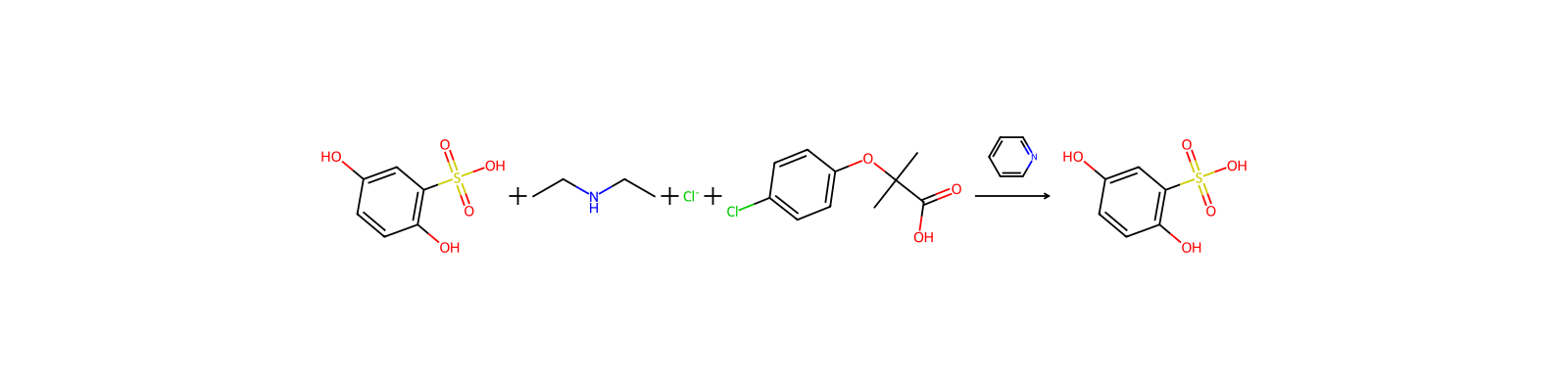
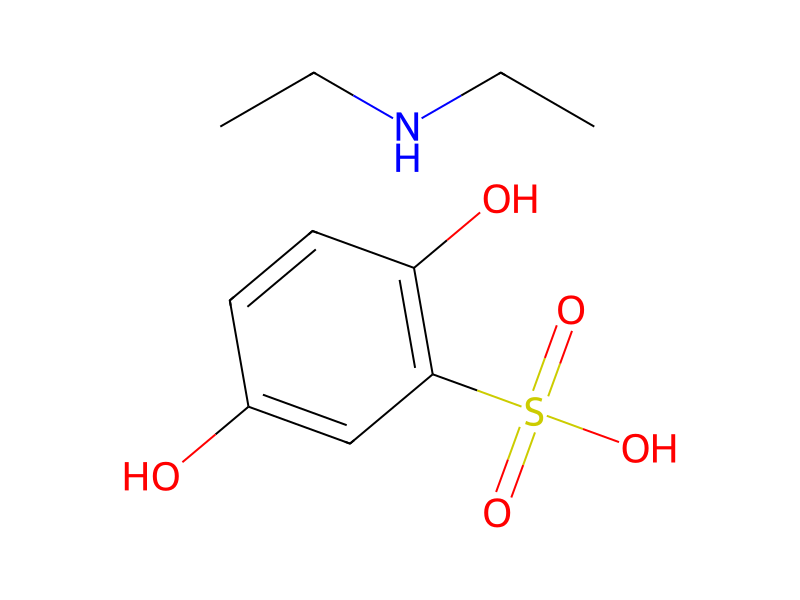
Grundinformationen
- Standard-SMILES
CCNCC.O=S(=O)(O)c1cc(O)ccc1O- InChIKey
HBGOLJKPSFNJSD-UHFFFAOYSA-N- Summenformel
- C10H17NO5S
- Durchschnittliche Molmasse
- 263,31 g/mol
- Monoisotopische Masse
- 263,08274382
Namen und Bezeichner
- Bevorzugter Name
- Etamsylate
- IUPAC
- 2,5-dihydroxybenzenesulfonic acid;N-ethylethanamine
- Lokaler Name
- Etamsylat
- Englischer Name
- Etamsylate
- Summenformel
- C10H17NO5S
- Molmasse
- 263.31
Namen und Synonyme
EtamsylateETHAMSYLATE2624-44-4CyclonamineDicyneneEtamsilatoEtamsylatumEtamsilateMD 141E 141Diethylamine dobesilateDTXSID4045559
Weitere Namen anzeigen
Phenolsulfonatee141md141eselinHeMsylK-StatSylatealtodoraglumin
24YL531VOHMD-141DTXCID2025559E-141Dicynene 1000RefChem:55154B02BX012,5-dihydroxybenzene-1-sulfonic acid; diethylamine
Datenbank-Bezeichner
- CAS
2624-44-4- PubChem CID
- 17506
- DTXSID
DTXSID4045559- ChEMBL
CHEMBL1514715- ChEBI
CHEBI:31563- UNII
- 24YL531VOH
- EC Number
- 220-090-7
Eigenschaften
Berechnete Struktureigenschaften
- Polarare Oberfläche (TPSA)
- 115 Ų
- H-Brücken-Donoren
- 4
- H-Brücken-Akzeptoren
- 6
- Frei drehbare Bindungen
- 3
- Schwere Atome
- 17
- Formalladung
- 0
- Komplexität
- 252
Physikochemische Eigenschaften
- Schmelzpunkt
- 125 ° · 125°
- Dichte
- 1.3441 · 1.3441 (rough estimate)
- Brechungsindex
- 1.506 · 1.5060 (estimate)
- storage temp.
- Keep in dark place,Inert atmosphere,Room temperature
- Löslichkeit
- Very soluble in water, freely soluble in methanol, soluble in anhydrous ethanol, practically insoluble in methylene chloride.
- Aggregatzustand
- Solid
- Farbe
- White to Pale Red
- Merck
- 14 · 14,3722
- Stabilität
- Hygroscopic
- InChI
- InChI=1S/C6H6O5S.C4H11N/c7-4-1-2-5(8)6(3-4)12(9,10)11;1-3-5-4-2/h1-3,7-8H,(H,9,10,11);5H,3-4H2,1-2H3
- InChIKey
- HBGOLJKPSFNJSD-UHFFFAOYSA-N
- SMILES
- C1(S(=O)(=O)O)=CC(=CC=C1O)O.N(CC)CC
- CAS Datenbank
- 2624 · 2624-44-4(CAS DataBase Reference)
- EPA chemische Informationen
- Ethamsylate (2624-44-4)
Sicherheit und Regulatorisches
GHS-Klassifizierung
GHS Classification
This chemical does not meet GHS hazard criteria for 12.2% (5 of 41) of reports.
Warning
H319 (85.4%): Causes serious eye irritation [Warning Serious eye damage/eye irritation]
P264+P265, P280, P305+P351+P338, and P337+P317 (click each P-code to see the statement)
Aggregated GHS information provided per 41 reports by companies from 3 notifications to the ECHA C&L Inventory.;Reported as not meeting GHS hazard criteria per 5 of 41 reports by companies.;There are 2 notifications provided by 36 of 41 reports by companies with hazard statement code(s).;Information may vary between notifications depending on impurities, additives, and other factors. The percentage value in parenthesis indicates the notified classification ratio from companies that provide hazard codes. Only hazard codes with percentage values above 10% are shown. For more detailed information, please visit ECHA C&L website.
Gefahrenhinweise
Regulatory InformationChemical: Benzenesulfonic acid, 2,5-dihydroxy-, compound with N-ethylethanamine (1:1)
Other Safety InformationEvaluation - Chemicals not considered for in depth evaluation - Not commercially active in Australia
Hazard Classes and CategoriesEye Irrit. 2 (85.4%)
Regulatorische Informationen
Regulatory InformationChemical: Benzenesulfonic acid, 2,5-dihydroxy-, compound with N-ethylethanamine (1:1)
Sicherheitsdaten
- wgk
- WGK 3
- tsca
- TSCA listed
- hs_code
- 2921.19.6190
- RTECS-Nr.
- DB6145000
- Toxizität
- LD50 i.v. in mice, rats: 800, 1350 mg/kg (Esteve)
- hazard_class
- IRRITANT
- Speicherklasse
- 11 - Combustible Solids
Chemie und Industrie
Pharmakologische Informationen
ATC Code
B02BX01
B - Blood and blood forming organs;B02 - Antihemorrhagics;B02B - Vitamin k and other hemostatics;B02BX - Other systemic hemostatics;B02BX01 - Etamsylate
QB - Blood and blood forming organs;QB02 - Antihemorrhagics;QB02B - Vitamin k and other hemostatics;QB02BX - Other systemic hemostatics;QB02BX01 - Etamsylate
MeSH Pharmacological Classification
Agents acting to arrest the flow of blood. Absorbable hemostatics arrest bleeding either by the formation of an artificial clot or by providing a mechanical matrix that facilitates clotting when applied directly to the bleeding surface. These agents function more at the capillary level and are not effective at stemming arterial or venous bleeding under any significant intravascular pressure.
Verwendung und Herstellung
General Manufacturing InformationBenzenesulfonic acid, 2,5-dihydroxy-, compd. with N-ethylethanamine (1:1): INACTIVE
Anwendungen
VerwendenHemostatic;prostaglandin synthesis inhibitor
Vor- und nachgelagerte Produkte
Vorgelagerte Rohstoffe
Anbieter50 Anbieter
上海阿拉丁生化科技股份有限公司400-6206333 13167063860 · [email protected]
Shanghai Biolang Biotechnology Co., Ltd.+86-15970428662 +86-13397199602 · [email protected]
Baoji Guokang Healthchem co.,ltd+8615604608665 15604608665 · [email protected]
Dayang Chem (Hangzhou) Co.,Ltd.+86-0571-88938639 17705817739 · [email protected]
Jai Radhe Sales+(91)-(79)-26431096/65255722 · [email protected]
湖北恒硕化工有限公司027-82830253 13995541600 · [email protected]
Syntechem Co.,Ltd[email protected]
武汉易泰科技有限公司上海分公司18930552037 · [email protected]
大连美仑生物技术有限公司0411-62910999 13889544652 · [email protected]
太原市瑞和丰科贸有限公司+86 351 7031519 · [email protected]
安耐吉化学&3A(安徽泽升科技股份有限公司)400-0056266 · [email protected]
上海瀚鸿科技股份有限公司021-54306202 13764082696 · [email protected]
上海钰康生物科技有限公司+86-18930848214 +86-021-56762820 · [email protected]
上海景颜化工科技有限公司13817811078 · [email protected]
Pure Chemistry Scientific Inc.001-857-928-2050 or 1-888-588-9418 · [email protected]
上海泰坦科技股份有限公司400-6009262 15618770481 · [email protected]
MedChemexpress LLC021-58955995 · [email protected]
上海瀚香生物科技有限公司177-54423994 17754423994 · [email protected]
合肥天健化工有限公司551-65418679 15856988503;15837135945 · [email protected]
孝感深远化工有限公司15527621225; 15527621225 · [email protected]
天津希恩思生化科技有限公司400 638 7771 · [email protected]
湖南汇百侍生物科技有限公司0731-85526065 13308475853 · [email protected]
上海源叶生物科技有限公司13636370518 · [email protected]
Wuhan NCE Biomedical Co.,Ltd.4000-027-021 |24 +86-13986109188 | +86-15623472865 | +81-08033611988
TCI AMERICA800-4238616 · [email protected]
TOKYO CHEMICAL INDUSTRY CO., LTD.03-36680489 · [email protected]
TCI Europe320-37350700 · [email protected]
深圳振强药物研发有限公司0755-66853366 13670046396 · [email protected]
广州爱纯医药科技有限公司020-39119399 18927568969 · [email protected]
南京生利德生物科技有限公司025-57798810 18652991625 · [email protected]
湖北威德利化学试剂有限公司186-02735115 18602735115 · [email protected]
湖北鑫源顺医药化工有限公司13971561712, 13995564702, 027-50664929 · [email protected]
平和安康医药科技有限公司18086832706 · [email protected]
上海鑫圭生物科技有限公司15121041756 · [email protected]
上海乾劲化工科技有限公司021-20900665 17321230821 · [email protected]
上海寰川实业有限公司021-61478794 · [email protected]
江苏艾康生物医药研发有限公司025-66028182 17714375163 · [email protected]
凯试(上海)科技有限公司021-50135380 · [email protected]
湖北巨胜科技有限公司027-59599241 18871490274 · [email protected]
池州凯隆进出口贸易有限公司[email protected]
济南睿兴医药科技有限公司531-88883606 15688880361 · [email protected]
桦特昇生物科技(武汉)有限公司027-59207879 1972026995 18140587686 · [email protected]
南京伶亚生物医药科技有限公司18068075658 · [email protected]
TargetMol中国(陶术生物)021-021-33632979 15002134094 · [email protected]
上海陶术生物科技股份有限公司+1-781-999-5354; +1-00000000000 · [email protected]
上海波以尔化工有限公司021-50182298 021-50180596 · [email protected]
BOC Sciences16314854226; +8616314854226 · [email protected]
江苏辉润药业有限公司15715295967; 15715295967 · [email protected]
Qiuxian Baitai New Material Co., LTD+86-19932103556 · [email protected]
广州市齐云生物技术有限公司020-61288194 61288195 · [email protected]
Zugehörige Reaktionen
3


Verknüpfte Notizen
Wird geladen…