
Ceric ammonium nitrate
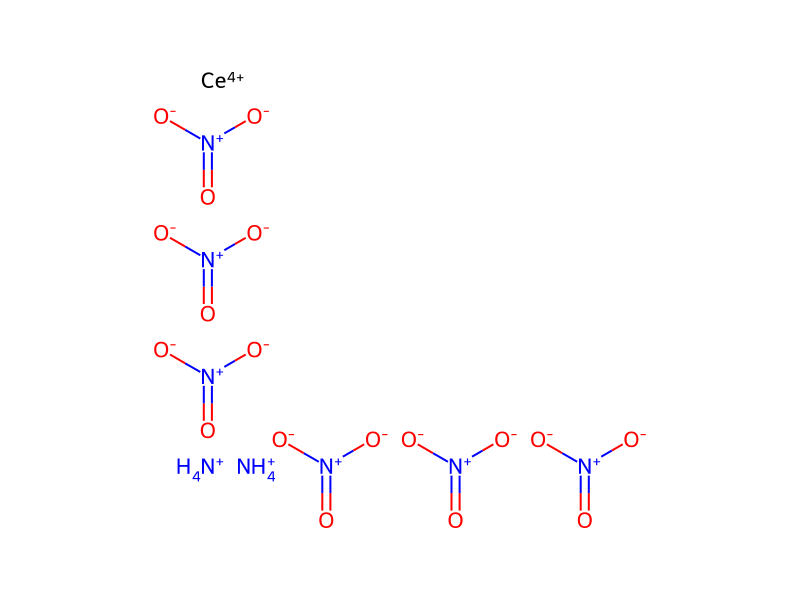
Grundinformationen
- CAS
10139-51-2- Standard-SMILES
O=[N+]([O-])[O-].O=[N+]([O-])[O-].O=[N+]([O-])[O-].O=[N+]([O-])[O-].O=[N+]([O-])[O-].O=[N+]([O-])[O-].[Ce+4].[NH4+].[NH4+]- InChIKey
XMPZTFVPEKAKFH-UHFFFAOYSA-P- Summenformel
- CeH8N8O18
- Durchschnittliche Molmasse
- 548,22 g/mol
- Monoisotopische Masse
- 547,9011
Überblick
Ceric ammonium nitrate is a inorganic compound of nitrate and ammonium. It is used as an oxidising agent in organic synthesis. Nitrite is a toxic compound known to cause methemoglobinemia. (L1137, L1622)
Namen und Bezeichner
- Bevorzugter Name
- Ceric ammonium nitrate
- IUPAC
- diazanium;cerium(4+);hexanitrate
- Englischer Name
- Cerium(IV) ammonium nitrate
- Summenformel
- CeH4N2O3
- Molmasse
- 220.16
Namen und Synonyme
Cerium ammonium nitrateDiammonium hexanitratocerate10139-51-2U99S55ED6BNSC-215187RefChem:124502lambda4-cerium(4+) ion bis(nitric acid) diamine tetranitrate240-827-6Ammonium cerium nitrateAmmonium hexanitratocerateAmmonium hexanitratocerate(IV)Cerate(2-), hexakis(nitrato-kappaO)-, ammonium (1:2), (OC-6-11)-
Weitere Namen anzeigen
Ceric ammonium nitrateCeric(IV) ammonium nitrateAmmonium cerium IV Nitratediazanium;cerium(4+);hexanitrateSCHEMBL313904cerium (IV) diammonium nitratediammonium cerium (IV) nitratedi-ammonium cerium (IV) nitrate
Datenbank-Bezeichner
- CAS
10139-51-2、16774-21-3- PubChem CID
- 180504
- UNII
- U99S55ED6B
- EC Number
- 240-827-6
Eigenschaften
Berechnete Struktureigenschaften
- Polarare Oberfläche (TPSA)
- 379 Ų
- H-Brücken-Donoren
- 2
- H-Brücken-Akzeptoren
- 18
- Frei drehbare Bindungen
- 0
- Schwere Atome
- 27
- Formalladung
- 0
- Komplexität
- 18,8
Experimentelle und physikochemische Eigenschaften
Chemical ClassesMetals -> Rare Earth Metals
Physical DescriptionOrange solid, soluble in water; [Merck Index]
Sicherheit und Regulatorisches
Sicherheitsangaben dienen nur zur Orientierung und ersetzen weder das Sicherheitsdatenblatt (SDB) des Lieferanten noch geltende Vorschriften oder eine fachliche Bewertung.
GHS-Klassifizierung
GHS Classification
Danger
H272 (99.4%): May intensify fire; oxidizer [Danger Oxidizing liquids; Oxidizing solids]
P210, P220, P260, P261, P264, P264+P265, P270, P271, P272, P273, P280, P301+P317, P301+P330+P331, P302+P352, P302+P361+P354, P304+P340, P305+P351+P338, P305+P354+P338, P316, P317, P319, P321, P330, P332+P317, P333+P317, P337+P317, P362+P364, P363, P370+P378, P391, P403+P233, P405, and P501 (click each P-code to see the statement)
Aggregated GHS information provided per 175 reports by companies from 19 notifications to the ECHA C&L Inventory. Each notification may be associated with multiple companies.
Gefahrenhinweise
Regulatory InformationREACH registered substance: Diammonium hexanitratocerate (EC: 240-827-6)
Hazards SummarySee Cerium. See RARE EARTH METALS and linked occupational diseases.
Hazard Classes and CategoriesOx. Sol. 2 (99.4%)
Sicherheit und Schutzausrüstung
Protective Action Criteria (PAC)
0.054 [mg/m3]
0.58 [mg/m3]
3.5 [mg/m3]
Toxikologische Informationen
Treatment
Methemoglobinemia can be treated with supplemental oxygen and methylene blue 1% solution administered intravenously slowly over five minutes followed by IV flush with normal saline. Methylene blue restores the iron in hemoglobin to its normal (reduced) oxygen-carrying state. (L1613)
Chemie und Industrie
Pharmakologische Informationen
Metabolism/Metabolites
Intake of some amount of nitrates and nitrites is a normal part of the nitrogen cycle in humans. In vivo conversion of nitrates to nitrites can occur in the gastrointestional tract under the right conditions, significantly enhancing nitrates' toxic potency. The major metabolic pathway for nitrate is conversion to nitrite, and then to ammonia. Nitrites, nitrates, and their metabolites are excreted in the urine. (L1137)
Verwendung und Herstellung
UsesUsed as a standard in oxidimetry and an oxidant in redox reactions; Used in a solution of perchloric acid to etch printed circuits; [Merck Index]
General Manufacturing InformationCerate(2-), hexakis(nitrato-.kappa.O)-, ammonium (1:2), (OC-6-11)-: ACTIVE
Zugehörige Reaktionen
301



Notizen zur Verbindung
Wird geladen…