
Dibromoisocyanuric acid

Grundinformationen
- CAS
15114-43-9- Standard-SMILES
O=c1[nH]c(=O)n(Br)c(=O)n1Br- InChIKey
HHBCEKAWSILOOP-UHFFFAOYSA-N- Summenformel
- C3HBr2N3O3
- Durchschnittliche Molmasse
- 286,87 g/mol
- Monoisotopische Masse
- 284,83846509
Namen und Bezeichner
- Bevorzugter Name
- Dibromoisocyanuric acid
- IUPAC
- 1,3-dibromo-1,3,5-triazinane-2,4,6-trione
- Englischer Name
- DIBROMOISOCYANURIC ACID
- Summenformel
- C3HBr2N3O3
- Molmasse
- 286.87
Namen und Synonyme
Dibromoisocyanuric acid15114-43-91,3-Dibromo-1,3,5-triazine-2,4,6(1H,3H,5H)-trioneDTXSID00164717RefChem:132907DTXCID80872081,3-dibromo-1,3,5-triazinane-2,4,6-trione1,3,5-Triazine-2,4,6(1H,3H,5H)-trione, 1,3-dibromo-MFCD004639411,3-Dibromo-1,3,5-triazine-2,4,6-trioneC3HBr2N3O31,3-Dibromo-1,3,5-triazine-2,4,6(1H,3H,5H)-trione; Dibromocyanuric Acid;
Weitere Namen anzeigen
Dibromocyanuric acidCAS:15114-43-9Dibromocyanuric acicIsocyanuric dibromideDibromoisocyanuricAcid>1,3-DibroMoisocyanuricacid
1,3-dibromoisocyanuric acidn,n'-dibromoisocyanuric acidDibromoisocyanuric acid, 96%SCHEMBL147816SCHEMBL13467938HHBCEKAWSILOOP-UHFFFAOYSA-NGEO-04303AKOS015916374
Datenbank-Bezeichner
- CAS
15114-43-9- PubChem CID
- 192912
- DTXSID
DTXSID00164717- EC Number
Eigenschaften
Berechnete Struktureigenschaften
- XLogP
- 0,8
- Polarare Oberfläche (TPSA)
- 69,7 Ų
- H-Brücken-Donoren
- 1
- H-Brücken-Akzeptoren
- 3
- Frei drehbare Bindungen
- 0
- Schwere Atome
- 11
- Formalladung
- 0
- Komplexität
- 220
Physikochemische Eigenschaften
- Schmelzpunkt
- 309 °C · 309 °C
- Dichte
- 2.789 · 2.789±0.06 g/cm3(Predicted)
- storage temp.
- 2 · 2-8°C
- Löslichkeit
- DMSO, Methanol
- pka
- 3.23 · 3.23±0.20(Predicted)
- Aggregatzustand
- Solid
- Farbe
- Off-White to Pale Yellow
- InChI
- InChI=1S/C3HBr2N3O3/c4-7-1(9)6-2(10)8(5)3(7)11/h(H,6,9,10)
- InChIKey
- HHBCEKAWSILOOP-UHFFFAOYSA-N
- SMILES
- N1(Br)C(=O)NC(=O)N(Br)C1=O
- CAS Datenbank
- 15114 · 15114-43-9
Sicherheit und Regulatorisches
Sicherheitsangaben dienen nur zur Orientierung und ersetzen weder das Sicherheitsdatenblatt (SDB) des Lieferanten noch geltende Vorschriften oder eine fachliche Bewertung.
GHS-Klassifizierung
GHS Classification
Danger
H272 (100%): May intensify fire; oxidizer [Danger Oxidizing liquids; Oxidizing solids]
P210, P220, P260, P264, P270, P280, P301+P317, P301+P330+P331, P302+P361+P354, P304+P340, P305+P354+P338, P316, P321, P330, P363, P370+P378, P405, and P501 (click each P-code to see the statement)
Aggregated GHS information provided per 41 reports by companies from 3 notifications to the ECHA C&L Inventory. Each notification may be associated with multiple companies.
Gefahrenhinweise
Hazard Classes and CategoriesOx. Sol. 3 (100%)
Sicherheitsdaten
- wgk
- 3
- ridadr
- UN 3085 8(5.1) / PGII
- hs_code
- 29336990
- risk_code
- 8-22-31-34-50/53
- hazard_code
- O,C,N
- safety_code
- 8-26-36/37/39-41-45-60-61
- hazard_class
- 5.1/8
- packing_group
- II
- Speicherklasse
- 5.1B - Oxidizing hazardous materials
- Hazard Classifications
- Acute Tox. 4 OralOx. Sol. 2Skin Corr. 1B
Chemie und Industrie
Anwendungen
VerwendenDibromoisocyanuric acid is a bromine compound with a superior bactericidal activity.
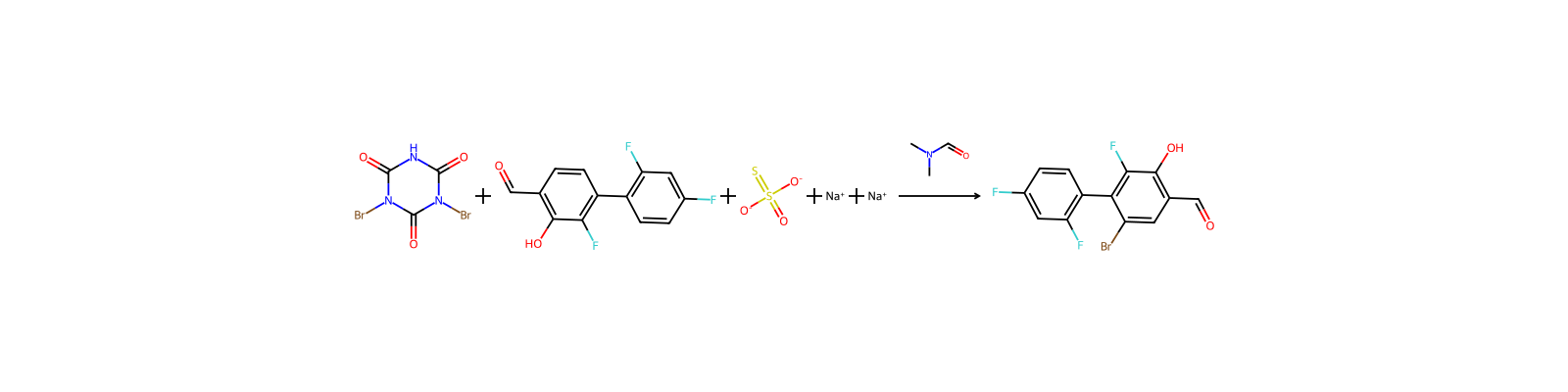
Verwenden1,3-Dibromoisocyanuric Acid (DBI) is used for electrophilic bromination of aromatic compounds, oximes.
Darstellung
synthetischeDibromoisocyanuric acid has been prepared by treatment of isocyanuric acid (0.1 mol) and LiOH (0.2 mol) with Br2 (0.4 mol) in water (1 L) at 20 °C.[1] After vigorous stirring to effect dissolution of Br2, the mixture is cooled slowly in a refrigerator for 24 h. The product is collected by filtration, washed with ice-cold bromine water, and then dried in vacuo, first over KOH, then over P2O5 (88% yield).
Vor- und nachgelagerte Produkte
Nachgelagerte Produkte
Anbieter100 Anbieter
梯希爱(上海)化成工业发展有限公司021-67121386 · [email protected]
上海阿拉丁生化科技股份有限公司400-6206333 13167063860 · [email protected]
上海策嵘生物科技有限公司[email protected]
毕佳索(上海毕得医药科技股份有限公司)400-6005915 · [email protected]
上海麦克林生化科技股份有限公司021-50706066 15221275939 · [email protected]
Dayang Chem (Hangzhou) Co.,Ltd.
Zugehörige Reaktionen
22



Notizen zur Verbindung
Wird geladen…