Grundinformationen
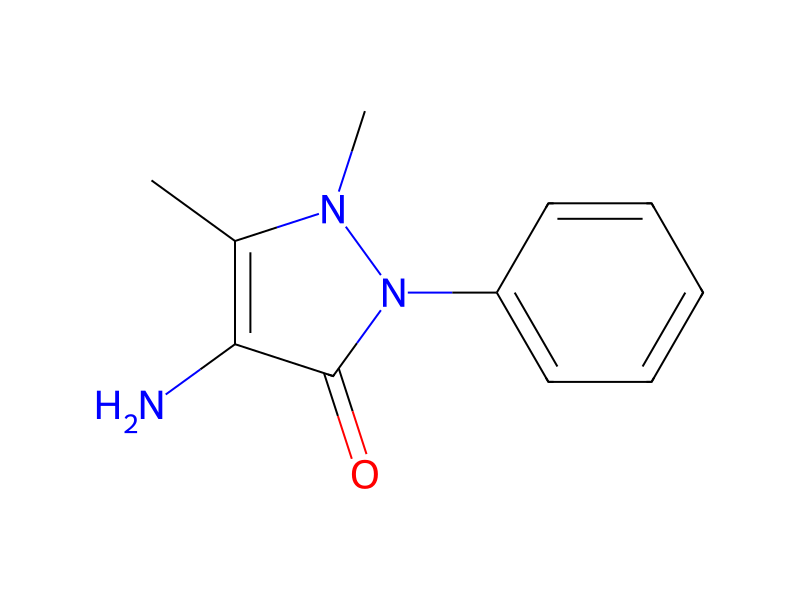
- Standard-SMILES
Cc1c(N)c(=O)n(-c2ccccc2)n1C- InChIKey
RLFWWDJHLFCNIJ-UHFFFAOYSA-N- Summenformel
- C11H13N3O
- Durchschnittliche Molmasse
- 203,24 g/mol
- Monoisotopische Masse
- 203,10586204
Überblick
4-aminoantipyrine is a pyrazolone, a member of the class of pyrazoles that is antipyrine substituted at C-4 by an amino group. It is a metabolite of aminopyrine and of metamizole. It has a role as a non-steroidal anti-inflammatory drug, a non-narcotic analgesic, an antipyretic, an EC 1.14.99.1 (prostaglandin-endoperoxide synthase) inhibitor, an antirheumatic drug, a drug metabolite, a peripheral nervous system drug and a marine xenobiotic metabolite. It is a primary amino compound and a pyrazolone. It is functionally related to an antipyrine.
Namen und Bezeichner
- Bevorzugter Name
- 4-Aminoantipyrine
- IUPAC
- 4-amino-1,5-dimethyl-2-phenylpyrazol-3-one
- Lokaler Name
- 4-Amino-2,3-dimethyl-1-phenyl-3-pyrazolin-5-on
- Englischer Name
- 4-Aminoantipyrine
- Summenformel
- C11H13N3O
- Molmasse
- 203.24
Namen und Synonyme
4-AminoantipyrineAMPYRONE83-07-84-AminophenazoneAminoantipyrineMetapirazoneAminoantipyrin4-AminoantipyreneSolvapyrin-AAminoazopheneAminoazophenazoneSolnapyrin-A
Weitere Namen anzeigen
4-AMINOANTIPYRIN4-AMINO-1,5-DIMETHYL-2-PHENYL-1,2-DIHYDRO-PYRAZOL-3-ONENSC 60242
4-AAP4-Amino-2,3-dimethyl-1-phenyl-3-pyrazolin-5-one3H-Pyrazol-3-one, 4-amino-1,2-dihydro-1,5-dimethyl-2-phenyl-4-Amino-1,5-dimethyl-2-phenyl-1,2-dihydro-3H-pyrazol-3-oneDTXSID8048860CHEBI:590260M0B7474RANSC-60242
Datenbank-Bezeichner
- CAS
83-07-8- PubChem CID
- 2151
- DTXSID
DTXSID8048860- ChEMBL
CHEMBL1165011- ChEBI
CHEBI:59026- UNII
- 0M0B7474RA
- EC Number
- 201-452-3
- Nikkaji
- J796J
Eigenschaften
Berechnete Struktureigenschaften
- XLogP
- 0,1
- Polarare Oberfläche (TPSA)
- 49,6 Ų
- H-Brücken-Donoren
- 1
- H-Brücken-Akzeptoren
- 3
- Frei drehbare Bindungen
- 1
- Schwere Atome
- 15
- Formalladung
- 0
- Komplexität
- 305
Experimentelle und physikochemische Eigenschaften
DrugsPharmaceuticals -> Metabolite of Metamizole
Animal DrugsPharmaceuticals -> Animal Drugs -> Approved in Taiwan
Endocrine DisruptorsPotential endocrine disrupting compound
Collision Cross Section
151.49 Ų [M+K]+ [CCS Type: TW; Method: calibrated with polyalanine and drug standards]
142.6 Ų [M+H]+ [CCS Type: TW; Method: calibrated with polyalanine and drug standards]
142.48 Ų [M+H]+
Physikochemische Eigenschaften
- Schmelzpunkt
- 105 · 105-110 °C(lit.)
- Siedepunkt
- 340 C · 340 C
- Dichte
- 0.8 · 0.8
- Brechungsindex
- 1.493 · 1.4930 (estimate)
- storage temp.
- Keep in dark place,Inert atmosphere,Room temperature
- Löslichkeit
- 2 O: · H2O: 0.1 g/mL, clear
- pka
- 1 · pK1: 4.94(+1) (25°C)
- Aggregatzustand
- Powder or Crystals
- Farbe
- Yellow to yellow-brown
- PH
- 7.1 · 7.1 (100g/l, H2O, 20℃)(slurry)
- Geruch (Odor)
- Odorless
- Wasserlöslichkeit
- 500 g/L · ca. 500 g/L (20 ºC)
- Merck
- 14 · 14,591
- BRN
- 181635 · 181635
- Stabilität
- Stable. May be light sensitive.
- InChI
- 1S/C11H13N3O/c1-8-10(12)11(15)14(13(8)2)9-6-4-3-5-7-9/h3-7H,12H2,1-2H3
- InChIKey
- RLFWWDJHLFCNIJ-UHFFFAOYSA-N
- SMILES
- CN1N(c2ccccc2)C(=O)C(N)=C1C
- LogP
- -0.257 · -0.257 (est)
- CAS Datenbank
- 83 · 83-07-8(CAS DataBase Reference)
- NIST chemische Informationen
- Aminoantipyrene(83-07-8)
- EPA chemische Informationen
- 4 · 4-Aminoantipyrene (83-07-8)
Sicherheit und Regulatorisches
GHS-Klassifizierung
GHS Classification
This chemical does not meet GHS hazard criteria for 1% (1 of 105) of reports.
Warning
H302 (99%): Harmful if swallowed [Warning Acute toxicity, oral]
P261, P264, P264+P265, P270, P271, P280, P301+P317, P302+P352, P304+P340, P305+P351+P338, P319, P321, P330, P332+P317, P337+P317, P362+P364, P403+P233, P405, and P501 (click each P-code to see the statement)
Aggregated GHS information provided per 105 reports by companies from 13 notifications to the ECHA C&L Inventory. Each notification may be associated with multiple companies.
Gefahrenhinweise
Regulatory Information4-Amino-2,3-dimethyl-1-phenyl-3-pyrazolin-5-one: Does not have an individual approval but may be used under an appropriate group standard
Other Safety InformationIMAP assessments - 3H-Pyrazol-3-one, 4-amino-1,2-dihydro-1,5-dimethyl-2-phenyl-: Environment tier I assessment
Hazard Classes and CategoriesAcute Tox. 4 (99%)
Sicherheitsdaten
- F
- 8-9-23
- wgk
- 3
- tsca
- TSCA listed
- hs_code
- 29331190
- RTECS-Nr.
- CD2480000
- risk_code
- 22-36/37/38-20/21/22
- Toxizität
- LD50 orally in Rabbit: 1700 mg/kg
- hazard_code
- Xn
- hazard_note
- Harmful
- safety_code
- 26-36-36/37/39
- Speicherklasse
- 11 - Combustible Solids
- Hazard Classifications
- Acute Tox. 4 Oral
Chemie und Industrie
Pharmakologische Informationen
ATC CodeN02BB03
MeSH Pharmacological Classification
Anti-inflammatory agents that are non-steroidal in nature. In addition to anti-inflammatory actions, they have analgesic, antipyretic, and platelet-inhibitory actions. They act by blocking the synthesis of prostaglandins by inhibiting cyclooxygenase, which converts arachidonic acid to cyclic endoperoxides, precursors of prostaglandins. Inhibition of prostaglandin synthesis accounts for their analgesic, antipyretic, and platelet-inhibitory actions; other mechanisms may contribute to their anti-inflammatory effects.
Substances used for the detection, identification, analysis, etc. of chemical, biological, or pathologic processes or conditions. Indicators are substances that change in physical appearance, e.g., color, at or approaching the endpoint of a chemical titration, e.g., on the passage between acidity and alkalinity. Reagents are substances used for the detection or determination of another substance by chemical or microscopical means, especially analysis. Types of reagents are precipitants, solvents, oxidizers, reducers, fluxes, and colorimetric reagents. (From Grant & Hackh's Chemical Dictionary, 5th ed, p301, p499)
Verwendung und Herstellung
Use Classification
Pharmaceuticals -> Nervous System -> Analgesics -> Pyrazolones -> Transformation products
Pharmaceuticals -> Animal Drugs -> Approved in Taiwan
General Manufacturing Information3H-Pyrazol-3-one, 4-amino-1,2-dihydro-1,5-dimethyl-2-phenyl-: ACTIVE
Anwendungen
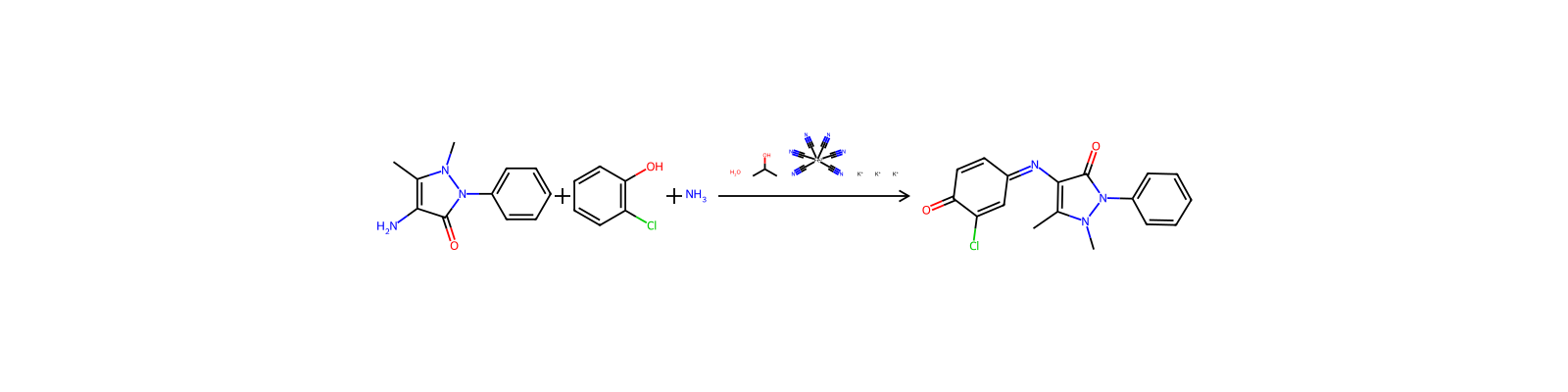
Verwenden4-Aminoantipyrine is a metabolite of aminopyrine, having both analgesic and anti-inflammatory properties. It readily forms metal complexes due to its amino nitrogen, a strong coordination site.4-aminoantipyrine forms Schiff bases when treated with aldehydes/ketones, which are used in chemosensing applications.Coupling Reagent for Trinder's reagent in colorimetric hydrogen peroxide detectionassays.Forms highly stable dyes by coupling with Trinder's reagent in presence of Peroxidase and H2O2. Therefore suitable for use in test strip and solution diagnostics.
Darstellung
synthetischesynthesis of 4-aminoantipyrine: Antipyrine is nitrosated by sodium nitrite, reduced by ammonium bisulfite and ammonium sulfite, hydrolyzed by sulfuric acid, and finally neutralized with liquid ammonia to obtain 4-aminoantipyrine.
Vor- und nachgelagerte Produkte
Vorgelagerte Rohstoffe
Nachgelagerte Produkte
Anbieter50 Anbieter
国药集团化学试剂有限公司86-21-63210123 · [email protected]
北京华美互利生物化工010-56205725 · [email protected]
梯希爱(上海)化成工业发展有限公司021-67121386 · [email protected]
上海阿拉丁生化科技股份有限公司400-6206333 13167063860 · [email protected]
杭州品高化工有限公司0571-87658025 · [email protected]
INTATRADE GmbH+49 3493/605464 · [email protected]
爱斯特(成都)生物制药股份有限公司+86-28-85122536 85324413 · [email protected]
上海如吉生物科技发展有限公司+86-21-65211385-8001 36031160 · [email protected]
Syntechem Co.,Ltd[email protected]
上海迈瑞尔生化科技有限公司4006356688 18621169109 · [email protected]
大连美仑生物技术有限公司0411-62910999 13889544652 · [email protected]
阿法埃莎(中国)化学有限公司400-6106006 · [email protected]
安耐吉化学&3A(安徽泽升科技股份有限公司)400-0056266 · [email protected]
北京绿百草科技发展有限公司010-61136123 · [email protected]
上海瀚鸿科技股份有限公司021-54306202 13764082696 · [email protected]
上海景颜化工科技有限公司13817811078 · [email protected]
武汉丰泰威远科技有限公司027-87465837 19945049750 · [email protected]
云南西力生物技术股份有限公司0871-65217109 · [email protected]
山东西亚化学有限公司13355009207 13355009207 · [email protected]
玛雅试剂+86 (573) 82222445 (0)18006601000 452520369 · [email protected]
四川库利南科技有限公司400-1166-196 18981987031 · [email protected]
上海耐士化工科技有限公司400-188-0725 +86 21 34310725 13611771617
天津希恩思生化科技有限公司400 638 7771 · [email protected]
湖南汇百侍生物科技有限公司0731-85526065 13308475853 · [email protected]
斯百全化学(上海)有限公司021-021-021-67601398-809-809-809 15221380277 · [email protected]
上海源叶生物科技有限公司13636370518 · [email protected]
艾科试剂4008-755-333 18080918076 · [email protected]
上海思域化工科技有限公司86-21-34053660 · [email protected]
赛默飞世尔科技(中国)有限公司800-810-5118 · [email protected]
北京伊诺凯科技有限公司400-810-7969 010-59572699 · [email protected]
TCI AMERICA800-4238616 · [email protected]
TOKYO CHEMICAL INDUSTRY CO., LTD.03-36680489 · [email protected]
TCI Europe320-37350700 · [email protected]
上海贤鼎生物科技有限公司4009209199 · [email protected]
深圳振强药物研发有限公司0755-66853366 13670046396 · [email protected]
越林试剂021-62960152 · [email protected]
Clearsynth Labs Limited+91-22-26355700 · [email protected]
广州爱纯医药科技有限公司020-39119399 18927568969 · [email protected]
上海灏云化工科技有限公司021-68367562 · [email protected]
北京环宇世纪化学科技有限公司hysj_bj.com
安徽科迪达化工有限公司0554-2106669 · [email protected]
HBCChem, Inc.+1-510-219-6317 · [email protected]
成都零六生物科技有限公司400-1166-196 13458535857 · [email protected]
上海麦克林生化科技股份有限公司15221275939 15221275939 · [email protected]
杭州杰恒化工有限公司0571-87396432 · [email protected]
成都润泽本土化工有限公司13096311329 028-88469284 616445927 · [email protected]
凯试(上海)科技有限公司021-50135380 · [email protected]
湖北巨胜科技有限公司027-59599241 18871490274 · [email protected]
Sigma-Aldrich西格玛奥德里奇(上海)贸易有限公司021-61415566 800-8193336 · [email protected]
天津阿尔塔科技有限公司022-6537-8550 15522853686 · [email protected]
Ergänzende Hinweise
DefinitionChEBI: 4-aminoantipyrine is a pyrazolone, a member of the class of pyrazoles that is antipyrine substituted at C-4 by an amino group. It is a metabolite of aminopyrine and of metamizole. It has a role as a non-steroidal anti-inflammatory drug, a non-narcotic analgesic, an antirheumatic drug, a peripheral nervous system drug, an EC 1.14.99.1 (prostaglandin-endoperoxide synthase) inhibitor, an antipyretic, a drug metabolite and a marine xenobiotic metabolite. It is a primary amino compound and a pyrazolone. It derives from an antipyrine.
Zugehörige Reaktionen
19






Verknüpfte Notizen
Wird geladen…